Primrose première
Perennial early-bloomers kick off season
Advertisement
Read this article for free:
or
Already have an account? Log in here »
To continue reading, please subscribe:
Monthly Digital Subscription
$0 for the first 4 weeks*
- Enjoy unlimited reading on winnipegfreepress.com
- Read the E-Edition, our digital replica newspaper
- Access News Break, our award-winning app
- Play interactive puzzles
*No charge for 4 weeks then price increases to the regular rate of $19.95 plus GST every four weeks. Offer available to new and qualified returning subscribers only. Cancel any time.
Monthly Digital Subscription
$4.99/week*
- Enjoy unlimited reading on winnipegfreepress.com
- Read the E-Edition, our digital replica newspaper
- Access News Break, our award-winning app
- Play interactive puzzles
*Billed as $19.95 plus GST every four weeks. Cancel any time.
To continue reading, please subscribe:
Add Free Press access to your Brandon Sun subscription for only an additional
$1 for the first 4 weeks*
*Your next subscription payment will increase by $1.00 and you will be charged $16.99 plus GST for four weeks. After four weeks, your payment will increase to $23.99 plus GST every four weeks.
Read unlimited articles for free today:
or
Already have an account? Log in here »
Hey there, time traveller!
This article was published 07/05/2011 (5355 days ago), so information in it may no longer be current.
Primroses or primulas get their name from the Latin word for ‘first’ — and rightly so, for they’re among the earliest perennials to bloom.
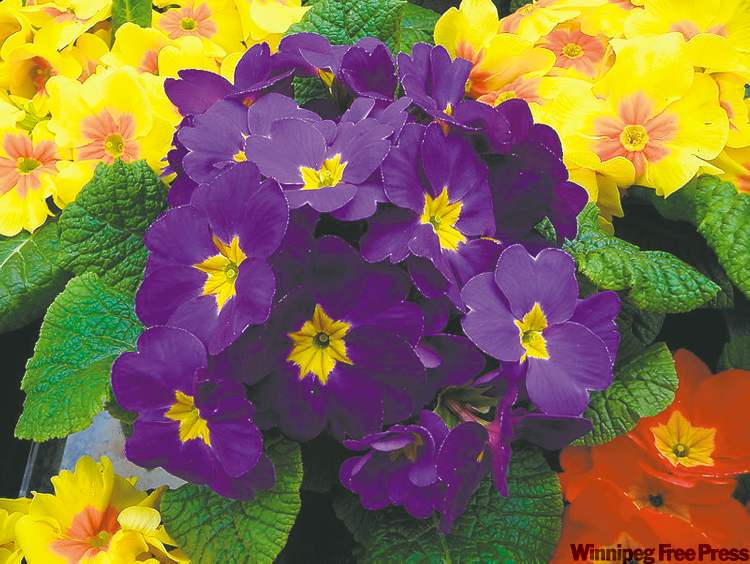
Every year about this time, supermarkets tempt winter-weary eyes with the big, bright flowers and crinkly leaves of Danova and other hybrid varieties of Primula acaulis, the English primrose. Often called Polyanthus hybrids, their blooms range from yellow to rose to violet-blue, each with a starry yellow centre.
If you live in Vancouver or Victoria, you can take them home, pop them right in the garden and, if happy in their location, they’ll bloom again next year. But, in Winnipeg, they don’t last long inside our warm houses unless you keep them very cool (10 C to 15 C) and give them lots of light. Planted outside in the spring, they’re also unlikely to make it through one of our winters. It’s worth a try, in a protected location, but it’s a long shot.
Fortunately, there are much hardier candidates among the 400-plus species and countless hybrids of the genus Primula. Many of them are native to other cold places like the Himalayas. These tough beauties really should be more widely available in our region because, given correct siting and care, they will return each year to brighten our May gardens along with the more familiar tulips.
All primulas require rich soil and constant moisture. They also prefer to be out of the hot sun, which means they expand our repertoire of shade-tolerant flowers. They do need a protected site such as next to a fence or a foundation, at least until established. There they will need regular watering, especially if they’re under the eaves. The same holds true if they’re near the roots of mature trees, which will compete with them for moisture.
Probably the hardiest primula for our region is the Auricula or dusty miller primrose. Its rosettes of light green, fleshy leaves are covered with a white powder called farina. The 15- to 20-centimetre-tall flowers, with their bright yellow eyes and colours that include pink, purple and near-black, easily rival the supermarket primroses. They require steady moisture but good drainage, so they’d suit a shady or partly shady rock garden.
Another equally hardy species is a native of Siberia, the Cortusa primrose (Primula cortusoides). In early May, it sends up lovely pink flowers on 30-cm stalks and is quite happy in deep shade. Plant it by a north-facing back door and keep it well-watered, and it will cheer you as you come and go.
Also worth trying are the ‘Wanda’ hybrids, Primula x pruhoniciana, a group developed from a species found in the Caucasus Mountains. Available in a range of colours, they are low-growing (7.5-15 cm) and spread by stolons to create a patch of bloom. ‘Wanda’ primroses were offered last year at the Mother’s Day plant sale of the Friends of the Conservatory. Gardeners anticipate their reappearance this spring with optimism, for they are rated as hardy here — in a protected spot.
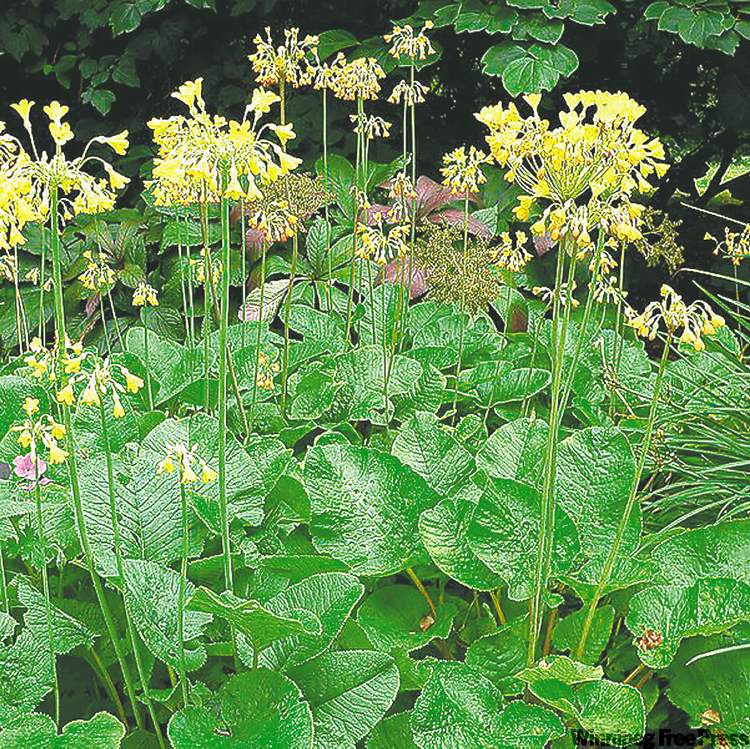
Readers of British background will fondly remember two other sturdy primroses: the cowslip (Primula veris) and the oxslip (Primula eliator). These old-fashioned flowers grow in moist open meadows in England, but here, with our hot, sunny summers, they need a shady site. Cowslips have bright yellow, fragrant clusters of nodding flowers. Oxslip flowers are larger and exactly that soft shade of yellow called primrose, blooming over a long period.
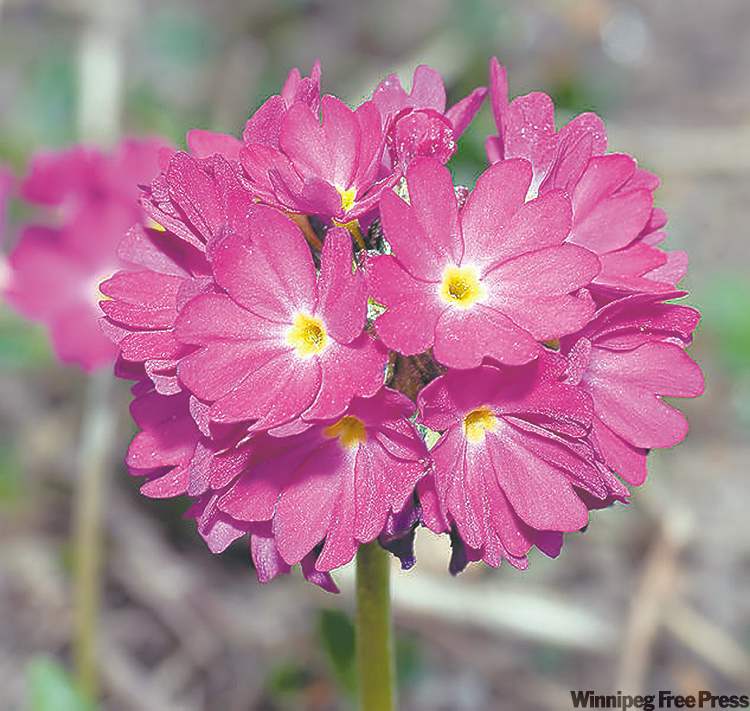
Primula denticulata or the drumstick primrose is another species that has proven hardy in our region. Its purple, pink or white flowers appear in a round cluster atop 30-cm stalks. The Ronsdorf variety is often available at local garden centres.
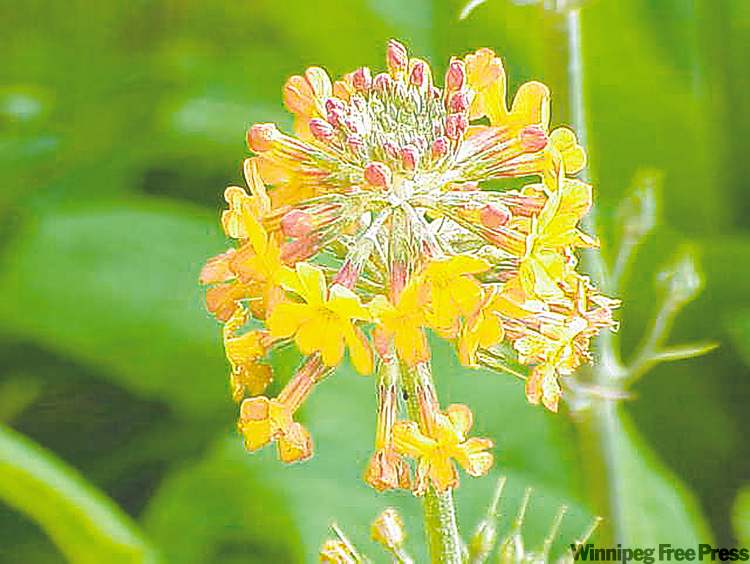
Gardeners looking for something different may like candelabra primroses, whose flowers hang in tiers from tall (up to 90-cm) stems. Blooming later than other primulas, they require a wet location — pondside or a bog. One candelabra primrose, Primula bullesiana, was available last year at Paterson Bedding Plants; spring will tell if it’s hardy. Another one, Tibetan primrose or Primula florindae, boasts extremely fragrant yellow flowers and has proved hardy for several years in a Winnipeg garden.
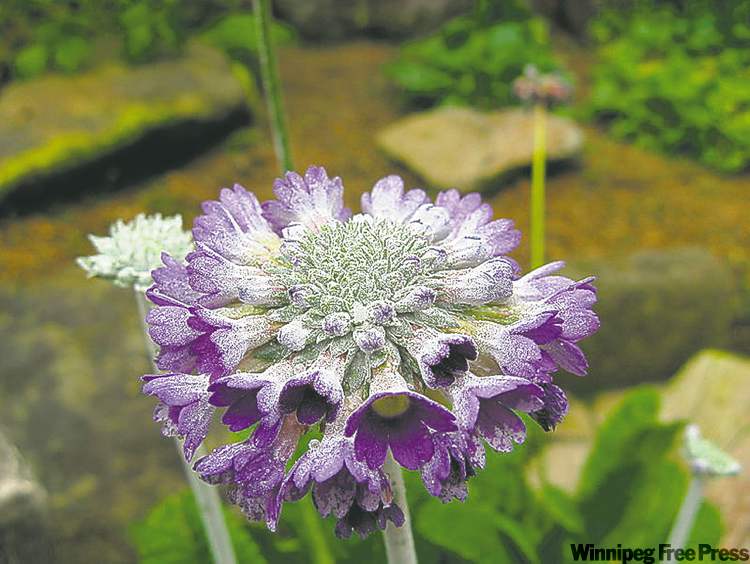
Cook’s Choice Gardens (3099 Main St.) plans to offer several primrose species, including a new introduction, Primula capitata, Noverna Deep Blue, which has unusual globe-shaped blooms. Small plugs will be available from mid-May for 99 cents each.
For more information about the genus Primula, visit the outstanding website of Pam Eveleigh, a Calgary collector: www.primulaworld.com
Linda Dietrick is a professor of modern languages and literatures at the University of Winnipeg and a passionate gardener whose beds include primroses.
Calendar
For a great selection of new, rare, and favourite plants, drop by the 22nd Annual Mother’s Day Plant Sale hosted by the Friends of Gardens Manitoba (formerly Friends of the Assiniboine Park Conservatory) tomorrow from 9 a.m. to 4 p.m. Look for the big white tent at the Canadian Mennonite University, 500 Shaftesbury Blvd., North Campus.