

Some hard facts on ICF house construction
Advertisement
Read this article for free:
or
Already have an account? Log in here »
To continue reading, please subscribe:

Digital Subscription
One year of digital access for only $205*
- Enjoy unlimited reading on winnipegfreepress.com
- Read the E-Edition, our digital replica newspaper
- Access News Break, our award-winning app
- Play interactive puzzles
*First annual payment billed as $205.00 + GST for one year. This annual subscription will automatically renew at $233.00 + GST every 52 weeks (10% off the regular annual price of $259.35). Offer available to new and qualified returning subscribers only. Cancel any time.
To continue reading, please subscribe:
Add Free Press access to your Brandon Sun subscription for only an additional
$1 for the first 4 weeks*
- Enjoy unlimited reading on winnipegfreepress.com
- Read the E-Edition, our digital replica newspaper
- Access News Break, our award-winning app
- Play interactive puzzles
*Your next Brandon Sun subscription payment will increase by $1.00 and you will be charged $17.95 plus GST for four weeks. After four weeks, your payment will increase to $24.95 plus GST every four weeks.
Read unlimited articles for free today:
or
Already have an account? Log in here »
Hey there, time traveller!
This article was published 09/06/2012 (5242 days ago), so information in it may no longer be current.
Question: My wife and I have purchased property in southern Manitoba and are starting to get information on building a home. One of the things we have looked at is ICF construction. I am familiar with the use of this method to do basements, but have also recently read articles about people who build their whole house using this method. Any insight on this type of construction would be greatly appreciated.
Thank you. — Robert Bancken
Answer: I have not seen any homes built completely with ICF construction, and only a few with complete foundations, but I’ve seen several additions and other buildings. It does make good sense, in some cases, to construct an entire home from ICF-encased concrete, but it requires careful planning.
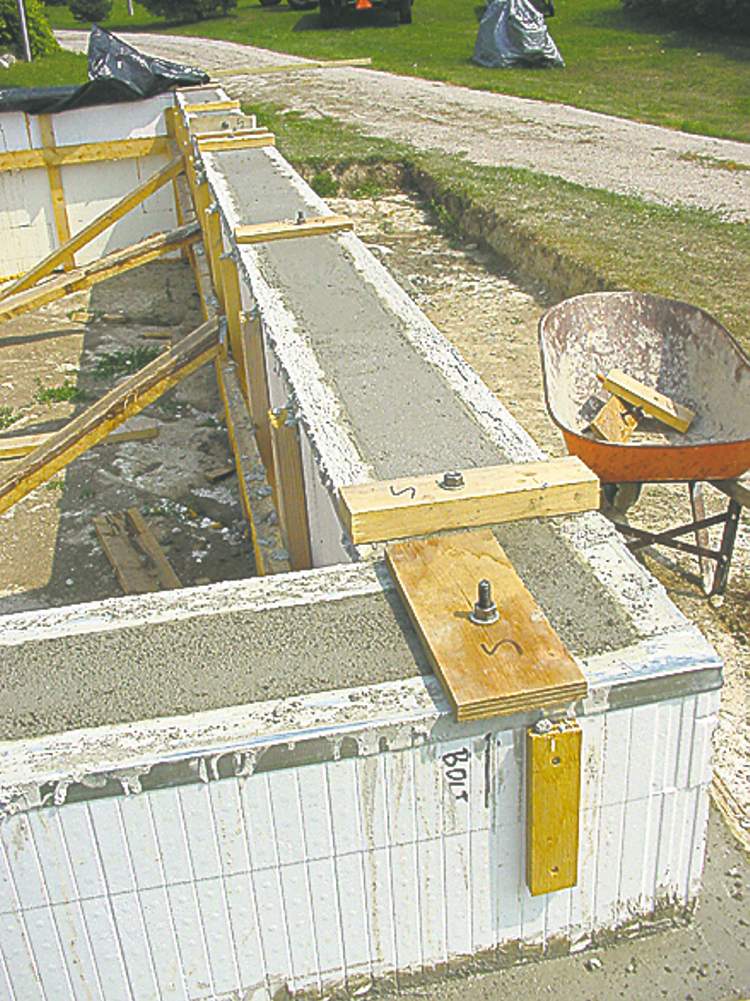
Insulated concrete forms (ICFs) are a moderately new product that combines a non-removable form for pouring concrete walls with integral foam insulation. The rigid foam inside and outside the forms provides the interior and exterior support required to pour liquid concrete so it can cure. The ICFs come in small, individual sections that are stacked, sort of like Lego, before the concrete is poured. Rebar can also be installed prior to the pour by inserting it inside the stacked ICF forms.
There are several benefits of using this type of system, especially for foundations in our cold climate. The first plus is no forms have to be removed after the concrete is poured and set. Cutting of snap ties and removal of large plywood forms once the wet concrete has set is labour-intensive, and storing large forms for reuse requires a fair amount of space. With ICF construction, once the form is installed in place, it is permanent. The modular style of placing the forms in small individual sections can also make it easier than erecting tall wooden forms. Although simple installation is a bonus, the biggest benefit comes after the concrete is poured and set in place.
Because the newly poured concrete walls are completely encased in rigid foam insulation, there is no need for costly installation of additional interior insulation for basement walls. Having insulation on the exterior of the foundation also prevents the concrete from losing a large amount of heat to the soil and air outside the home, typical of a standard foundation wall. This same property virtually eliminates the possibility of condensation on the foundation’s interior, preventing mould.
The interior of the ICFs normally have a mechanism for attaching wood strapping, so interior-wall finishes can be added. This will also allow for installation of complete interior wood walls if desired, or if a larger cavity is needed to install electrical and plumbing components. The outside of the ICF can also be sheathed later on, if desired, for installation of membranes or siding. That is critical if you are planning to build an entire home, and not just the foundation, in this manner. For a foundation, installation of a waterproof membrane or damp-proofing is also necessary on the exterior to prevent seepage into the concrete and damage to the exterior foam insulation.
Because of the design of this system, constructing entire buildings with ICFs can take significant additional planning compared to conventional construction. As already stated, accommodations for electrical and plumbing components often installed in exterior walls have to be modified or installed before concrete is poured. Also, walls constructed with ICFs may not meet current local building requirements for insulation levels. It may take some convincing of local building officials that these pre-insulated concrete walls are to be treated differently than typical two-by-six ones. ICF walls may be considerably thicker than in normal construction, requiring doors and window frames to be extended substantially.
The bottom line in any atypical construction method may be the cost factor. The cost of building an entire home with ICF construction may be prohibitive relative to typical wood-frame construction due to the additional cost of the raw materials as well as design and labour costs of adapting standard systems. That is not to say that constructing an entire home from ICFs is impossible, just that it may be impractical unless you do an extraordinary amount of planning ahead of time.
Ari Marantz is the owner of Trained Eye Home Inspection Ltd. and president of the Canadian Association of Home and Property Inspectors — Manitoba (www.cahpi.mb.ca). Questions can be emailed to the address below. Ari can be reached at (204) 291-5358 or check out his website at www.trainedeye.ca
trainedeye@iname.com