

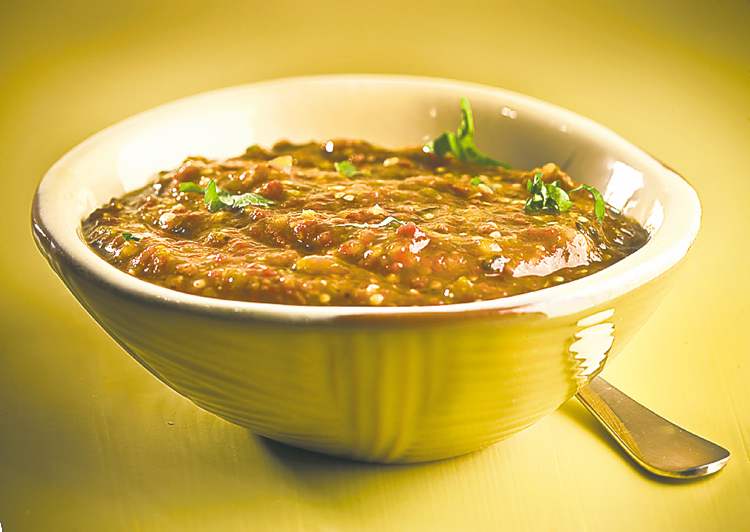
SOLUTIONS: A thickening solution for your salsa dip
Advertisement
Read this article for free:
or
Already have an account? Log in here »
To continue reading, please subscribe:
Monthly Digital Subscription
$1 per week for 24 weeks*
- Enjoy unlimited reading on winnipegfreepress.com
- Read the E-Edition, our digital replica newspaper
- Access News Break, our award-winning app
- Play interactive puzzles
*Billed as $4.00 plus GST every four weeks. After 24 weeks, price increases to the regular rate of $19.95 plus GST every four weeks. Offer available to new and qualified returning subscribers only. Cancel any time.
Monthly Digital Subscription
$4.99/week*
- Enjoy unlimited reading on winnipegfreepress.com
- Read the E-Edition, our digital replica newspaper
- Access News Break, our award-winning app
- Play interactive puzzles
*Billed as $19.95 plus GST every four weeks. Cancel any time.
To continue reading, please subscribe:
Add Free Press access to your Brandon Sun subscription for only an additional
$1 for the first 4 weeks*
*Your next subscription payment will increase by $1.00 and you will be charged $16.99 plus GST for four weeks. After four weeks, your payment will increase to $23.99 plus GST every four weeks.
Read unlimited articles for free today:
or
Already have an account? Log in here »
Hey there, time traveller!
This article was published 23/06/2012 (5040 days ago), so information in it may no longer be current.
QUESTION: I made a delicious pot of salsa, but after scooping it up with taco chips, I found it was too runny. What can I do to thicken the recipe for next time? Joshua (Stonewall, MB)
ANSWER: Begin by dunking the tomatoes in hot water and then in cold water. Peel each tomato (optional). Include the seeds with your salsa. Along with the tomatoes, add peppers, onions, etc. As you cook the salsa, add in cans of tomato paste and stir until you have reached the desired consistency. For example, when making a 22-quart batch, add about six small cans of tomato paste (more or less depending on the size of your recipe). Tomato paste consists of tomatoes that have been cooked for several hours and reduced to a thick, red concentrate before being strained, so by adding tomato paste you are adding extra healthy goodness.
QUESTION: I have two white cotton and one cotton/polyester knit short-sleeved shirts that were white and are now drab, possibly from our hard water. Do you know of a solution I can soak them in to see if they will become whiter? Bleach doesn’t help at all, and though they aren’t expensive I could still use them. Thanks for any suggestions. Barb, Winnipeg
ANSWER: You can wash whites with hot or cold temperature. I prefer to wash whites on hot and colours on cold. It is wise to add a brightener such as washing soda or borax to all white loads. Hanging clothes outside keeps them crisp and white. The longer I live, the less I use my dryer and the longer clothes last. If you are desperate, soak the white clothes in water and Iron Out or Rit Dye Remover, in a ventilated area.
QUESTION: I would like to first of all say how much I enjoy your column and solutions. Vinegar is my best friend these days.
I am having a problem cleaning the grout in the tiles on the walls around my bathtub. We have hard water and the grout is very grungy in the area where we shower. It looks like mildew spots in places and has a dirty gray hue. I have tried Tilex (which I understand will eat the grout), bleach, vinegar, a wire brush, all to no avail. Do you have any other suggestions? Any help would be much appreciated. Carole, Winnipeg
ANSWER: Here is a wonderful recipe that is great for cleaning tile and grout. Mix into a spray bottle and use it frequently for removing soap scum, cleaning kitchens and tile counters. Combine one-quarter cup baking soda (or washing soda), one-half cup vinegar and 2 quarts of water. Some people like to add 2 tbsp. ammonia to the recipe (this is optional). No rinsing required. You can also clean grout with a dry white eraser or dampened pumice stone.
Feedback from Manitoban Who Cares:
Dear Reena,
I always enjoy reading your articles in the Free Press. I meant to respond earlier to your reply to the woman from Minnesota who had the unfortunate experience with a black liquid that oozed from a fluorescent ballast that was being replaced by an electrician.
The liquid is a solid tarry substance used in ballasts to insulate the electrical components, both electrically and for deadening the humming sound and also to prevent arcing and sparking inside the ballast container should there be a short circuit.
For the last 30 or more years, there have been safety heat shutoffs built into ballasts in case of overheating. Prior to that, many ballasts used PCBs in the tarry mixture, which would only burn at very high temperatures (rarely reached by the ballast), but could turn to liquid and leak into the fixture and then onto objects below.
The PCBs were classed as hazardous cancer-causing materials and should be handled with gloves to keep it off your skin and disposed of as hazardous waste.
Now, to attempt to remedy the staining problem: Wear gloves, use lots of clean rags and use WD-40 on the spot. WD-40 will completely remove this type of goo from non-porous surfaces (metal, Arborite, Formica etc.) Repeated applications of WD-40 and blotting up the stain should result in the eventual removal of the offending tarry material from some porous objects.
When it is clean, it should be left to dry and any suitable cleaner may be used to remove the residual aroma of the tar, such as talcum powder, soda or the like. The WD-40 has an odour, but it evaporates fairly quickly and should dissipate. In any case, knowing what the black goo is should give a cleaning professional a good idea of what needs to be used to get rid of it.
Hint: Never let an electrician replace a fluorescent ballast without covering everything beneath the fixture with a drop cloth or lots of paper and be ready with rags to wrap the old ballast before putting it into a carton and disposing of it at a hazardous materials depot. The same WD-40 should be used to clean the fluorescent fixture, which would likely have some tar or oil on the inside. Sincerely, Soody
Fantastic Tip of the Week:
Keep mice and other rodents away by putting out laxative bars covered with peanut butter. The little animals love the taste but soon realize that the food at your place makes their tummy hurt. They will leave in search of better food. Keep out of reach of pets and children. Submitted by: Jesse (cottage owner for more than 20 years)
Reena Nerbas is the author of the national bestselling Household Solutions series. Her website is www.householdsolutions.org . You can contact her at Box 429, Blumenort, Man., ROA 0C0.