

MIKE HOLMES: Stick with stucco in dry Manitoba climate
Advertisement
Read this article for free:
or
Already have an account? Log in here »
To continue reading, please subscribe:

Digital Subscription
One year of digital access for only $205*
- Enjoy unlimited reading on winnipegfreepress.com
- Read the E-Edition, our digital replica newspaper
- Access News Break, our award-winning app
- Play interactive puzzles
*First annual payment billed as $205.00 + GST for one year. This annual subscription will automatically renew at $233.00 + GST every 52 weeks (10% off the regular annual price of $259.35). Offer available to new and qualified returning subscribers only. Cancel any time.
To continue reading, please subscribe:
Add Free Press access to your Brandon Sun subscription for only an additional
$1 for the first 4 weeks*
- Enjoy unlimited reading on winnipegfreepress.com
- Read the E-Edition, our digital replica newspaper
- Access News Break, our award-winning app
- Play interactive puzzles
*Your next Brandon Sun subscription payment will increase by $1.00 and you will be charged $17.95 plus GST for four weeks. After four weeks, your payment will increase to $24.95 plus GST every four weeks.
Read unlimited articles for free today:
or
Already have an account? Log in here »
Hey there, time traveller!
This article was published 01/12/2012 (5029 days ago), so information in it may no longer be current.
Traditionally, stucco has been a popular exterior wall system. It adds character and can give a house a sophisticated finish, especially when combined with other masonry wall systems such as brick. If it’s done right, stucco can also be a great barrier against rain and snow and provide extra insulation.
The big problem is that it doesn’t work great in all environments. It works best in dry climates, because if it’s exposed to moisture it can start to crumble. Have you ever seen an old building with crumbling stucco walls? Not pretty. It’s also a pain to fix because you’re not dealing with just one layer.
Fixing it usually requires tackling all those other layers. It takes time, and it’s expensive. A stucco exterior on a home can cost $30,000 to $40,000, sometimes more. That’s why you mainly see stucco on homes in hot, dry climates such as the southern United States, where it generally lasts longer. But there are a couple of strategies that help preserve stucco in climates like ours.
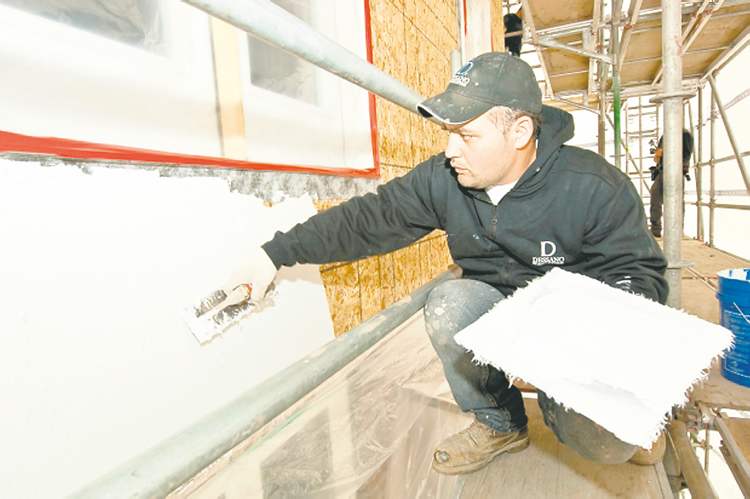
First, you don’t want a stucco wall to have snow resting against it. If you’ve seen a house or building that has a stucco exterior from top to bottom, you might see it crumbling or flaking wherever it’s been most exposed to moisture. In most cases, that’s along the bottom of a house where moisture from the ground, precipitation and snow will sit.
That’s why if we’re doing stucco I like to have a masonry bottom and a stucco finish at the top of the house — usually on the second floor. Keeping stucco away from the ground helps prolong its life.
The second strategy is controlling the air and moisture behind the stucco finish.
As I’ve said before, stucco has many layers. The first layer is the substrate — the material the stucco is applied to. This material must be tough and durable. A product such as oriented strand board (OSB) works best, but plywood sheathing is also effective.
On top of the substrate is the air and moisture barrier, probably the most important layer. Some people call it water/moisture/weather material.
The purpose of this layer is to prevent moisture from penetrating through to the substrate material that’s vulnerable to moisture, like wood sheathing or gypsum. If moisture gets trapped there it can start to rot the material and damage the stucco finish on the surface.
Depending on local code or manufacturer’s instructions or both, there might be specific moisture barrier and assembly requirements. Always check what they are and verify it with your contractor. In my line of work, asking questions rarely leads to problems. It’s when homeowners don’t ask enough questions that things get messy.
Some contractors will use waterproof building paper as the air and moisture barrier. If that’s the case, vertical seams should be overlapped by 15 centimetres or more; horizontal seams by 10.2 centimetres or more. But my guys apply an air and moisture barrier that looks a lot like icing on a cake. There are no seams so it provides one solid layer of protection.
The traditional way of doing stucco requires a steel mesh that’s properly installed on top of the moisture barrier. Then the stucco is applied — two layers if you’re working over masonry or concrete (one base coat, one finish coat). Three layers if it’s going over wood framing (scratch coat, base coat and finish coat). But there are a couple of new systems out there that have changed the process.
We now have exterior insulation finish systems (EIFS) that are basically rigid foam panels that go over the moisture barrier. I like them for two reasons: It gives us extra insulation and increases the R-value (resistance to heat loss) of your exterior walls. Two, these systems can help drain any moisture caught behind the stucco layers.
On a recent job we used a type of EIFS called PUCCS (pressure-utilized compartmented cavity system). PUCCS insulation is flat on one side with puck-looking shapes on the other — go figure. The side with the puck shapes goes against the air and moisture barrier. So in case moisture gets in, it flows through the cavities in between all the pucks and finds its way to the bottom of the wall where there is the drainage track.
There’s so much to consider when it comes to stucco. Every tradesperson will have a different way of doing it.
But the most important thing to keep in mind is to follow the manufacturer’s instructions on all the materials. If they aren’t followed, the manufacturer’s warranty can be compromised, so if there was a problem you’d be out of luck and stuck with the repair bill.
Be smart. Be involved. And ask questions to make sure your home’s stucco stands the test of time.
Catch Mike Holmes in his new series, Holmes Makes It Right, Tuesdays at 9 p.m. on HGTV. For more information, visit hgtv.ca. For more information on home renovations, visit makeitright.ca.