

MIKE HOLMES: Net-zero house a big plus in the long term
Advertisement
Read this article for free:
or
Already have an account? Log in here »
To continue reading, please subscribe:

Digital Subscription
One year of digital access for only $205*
- Enjoy unlimited reading on winnipegfreepress.com
- Read the E-Edition, our digital replica newspaper
- Access News Break, our award-winning app
- Play interactive puzzles
*First annual payment billed as $205.00 + GST for one year. This annual subscription will automatically renew at $233.00 + GST every 52 weeks (10% off the regular annual price of $259.35). Offer available to new and qualified returning subscribers only. Cancel any time.
To continue reading, please subscribe:
Add Free Press access to your Brandon Sun subscription for only an additional
$1 for the first 4 weeks*
- Enjoy unlimited reading on winnipegfreepress.com
- Read the E-Edition, our digital replica newspaper
- Access News Break, our award-winning app
- Play interactive puzzles
*Your next Brandon Sun subscription payment will increase by $1.00 and you will be charged $17.95 plus GST for four weeks. After four weeks, your payment will increase to $24.95 plus GST every four weeks.
Read unlimited articles for free today:
or
Already have an account? Log in here »
Hey there, time traveller!
This article was published 22/06/2013 (4792 days ago), so information in it may no longer be current.
Homeowners, builders and architects are working together and pushing standards to build net-zero homes.
These homes produce as much energy as they consume on an annual basis, taking the EnerGuide rating up to 100. EnerGuide rates the energy efficiency of a house; a higher rating means a more energy-efficient home.
One of my partner builders recently built a net-zero home in Edmonton. It features some of the latest green technology, such as prefab wall systems and triple-pane glass, to achieve an EnerGuide rating of 100. And it looks good.
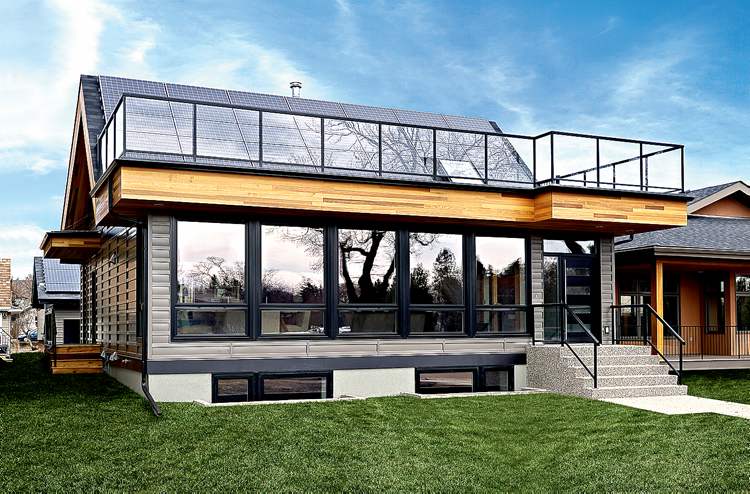
When you incorporate the right technologies with the right systems — always using the right pros — you can build a home that produces as much energy as it uses, sometimes more. Whatever you don’t use you can sell back to the grid. Who wouldn’t like that?
There are two things you need to keep in mind when it comes to a net-zero home. To support its own energy needs, it usually means incorporating a solar-electric system and sometimes wind power too.
Next, the building envelope must be highly efficient — it has to have a high R-value (a material’s ability to resist heat flow) and needs to be tightly sealed. This ensures the home uses every unit of energy to its maximum potential.
When building a net-zero home, there are some key considerations, starting with the walls.
Prefab wall systems are insulated and structurally sound. The ones we use are made with Pinkwood, which is mould-, moisture- and fire-resistant, and have polystyrene infill panels. This yields a highly energy-efficient building envelope with an insulation value of R-42. If you go with a 16-inch (41-centimetre), double-stud, wood frame with blown-in cellulose, you can bump that insulation value up to R-56. This is great for your walls and attic, another heat-loss hot spot.
The foundation is another potential area for major energy loss, so it must be well insulated. On the house in Edmonton, the builders insulated the foundation below and outside the slab with expanded polystyrene (EPS). They also built the foundation using insulated concrete forms. The concrete is also insulated with EPS, which is non-toxic, mould-free and CFC-free and doesn’t lose insulating value over time. Also, by adding an additional interior wall to the foundation — like they did in Edmonton — you get a foundation with an insulation value of R-40.
What about the windows? Double pane used to be the best when it came to energy efficiency. But now there’s triple pane, which has two coats of low-e film, plus argon-gas-filled glazing with insulating spacers between panes.
Then there’s passive solar, which includes adding south-facing windows to allow light and heat in all day long. If your home has concrete floors, these windows will absorb the heat and radiate it back into the living space.
For heating and cooling a net-zero home, I like a geothermal system: The temperature in the ground is used to regulate the temperature in the house. Another option is installing an electric baseboard heating system. This isn’t as expensive as geothermal, so it’s a better option if you’re on a budget, but it’s not as energy-efficient either.
And we can’t forget about ventilation. When a home is airtight, you need to bring in fresh air and get rid of stale indoor air, or condensation problems can arise. Heat-recovery ventilators (HRVs) are great for exchanging indoor air for outdoor air. The air that comes in is preheated by the exhausting air — a process that can recover up to 88 per cent of the heat. And the HRV’s electronically commutated motor reduces the amount of electricity needed to run it.
Building a net-zero home isn’t cheap, it’s an investment that will pay you back every month for as long as you live in it. It’s not a trend — it’s the future of housing.
— Postmedia News
Catch Mike Holmes in his new series, Holmes Makes It Right, Tuesdays at 9 p.m. on HGTV. For more information, visit hgtv.ca. For more information on home renovations, visit makeitright.ca.