Best way to beat oak tree borers
Advertisement
Read this article for free:
or
Already have an account? Log in here »
To continue reading, please subscribe:

Digital Subscription
One year of digital access for only $205*
- Enjoy unlimited reading on winnipegfreepress.com
- Read the E-Edition, our digital replica newspaper
- Access News Break, our award-winning app
- Play interactive puzzles
*First annual payment billed as $205.00 + GST for one year. This annual subscription will automatically renew at $233.00 + GST every 52 weeks (10% off the regular annual price of $259.35). Offer available to new and qualified returning subscribers only. Cancel any time.
To continue reading, please subscribe:
Add Free Press access to your Brandon Sun subscription for only an additional
$1 for the first 4 weeks*
- Enjoy unlimited reading on winnipegfreepress.com
- Read the E-Edition, our digital replica newspaper
- Access News Break, our award-winning app
- Play interactive puzzles
*Your next Brandon Sun subscription payment will increase by $1.00 and you will be charged $17.95 plus GST for four weeks. After four weeks, your payment will increase to $24.95 plus GST every four weeks.
Read unlimited articles for free today:
or
Already have an account? Log in here »
Hey there, time traveller!
This article was published 30/08/2014 (4384 days ago), so information in it may no longer be current.
In September of last year I wrote an article on the ongoing problems bur oak trees are experiencing. I am definitely seeing a worsening of the oak situation in southern Manitoba on the basis of the volume of calls and visits I have made to see stressed oak trees this year. The activity of the two-lined chestnut borer is spreading everywhere including into the woodland adjacent to where I live. Ironically I first discovered the feeding activity of this insect in oak trees in River Heights in 1990 when I was the city forester. Nearly 25 years later the evidence of this insect’s feeding destruction has become very wide spread. Many previously healthy oaks over a hundred years old are dying.
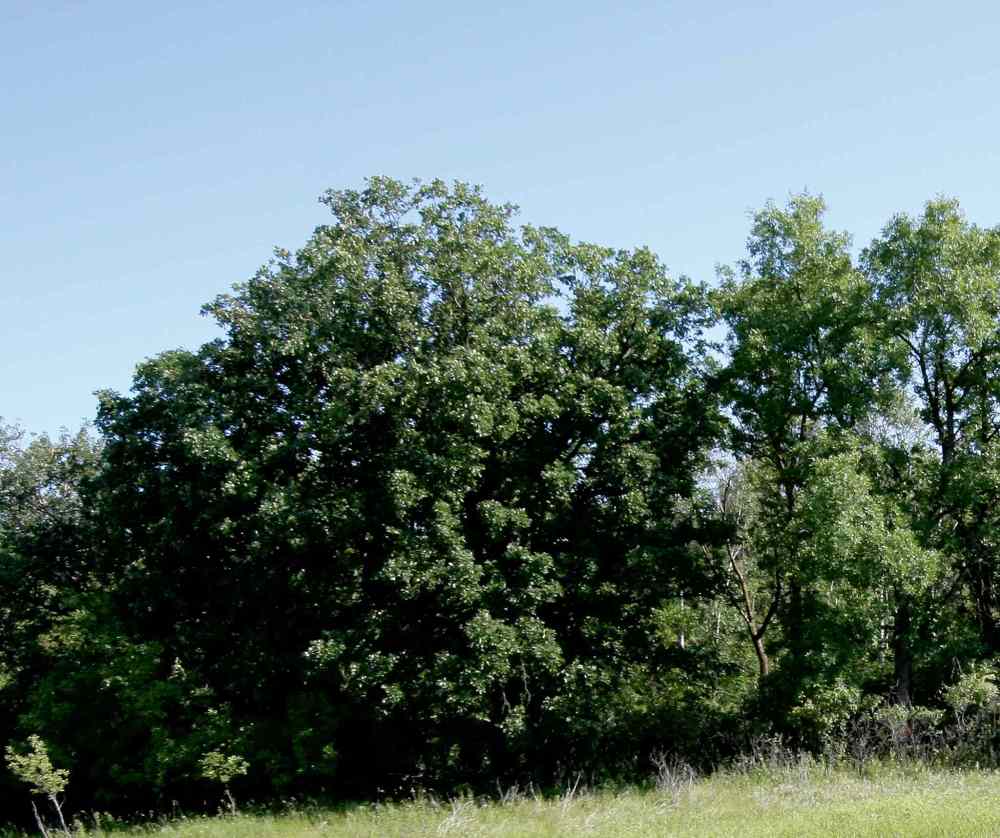
I am showing two images: the first shows a healthy looking woodland oak on public property near my home in 2009; the second shows a more advanced infestation of my favourite oak on public lands I see outside my living room window.
There are no chemical insecticides registered in Manitoba to stop or treat this borer’s infestation. If an owner of an oak tree wants to stop the spread of the infestation, the following steps need to be taken.
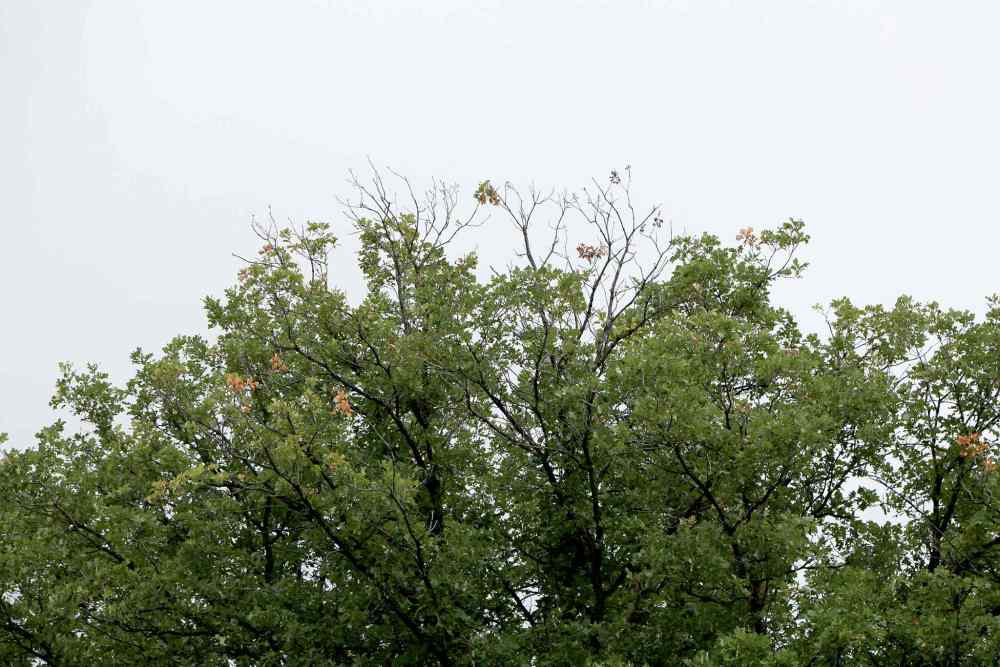
First of all you need to know how this insect operates. The feeding normally starts at the very top of the tree as I show in the illustration. In each following year, the feeding activity progresses through the upper branches down the tree as I show in another illustration. Usually there will be a distinct pattern of dead branches across the top of the tree, but this pattern can vary. Adult female beetles lay their eggs in late spring through early summer on the bark. The eggs hatch into thin white segmented larvae (they have a grub-like appearance) which bore their way into the bark to start their feeding activity in the living cambial cells. At the first recognizable signs of this feeding cycle the owner of the tree will want to hire a licensed Manitoba arborist and experienced tree climber, who is knowledgeable about the control of this insect. The arborist must prune out the dead branches as well as infested branches below the dead branches. Those infested branches will likely be growing green leaves at first, but there will be evidence of the borer’s feeding activity to a knowledgeable arborist. After one year in the tree the adult borer chews a ‘D’ shaped hole to exit the tree. Skilled arborists need to find these holes to determine where the last feeding activity occurred. They can also scrape the bark off nearby small branches to see if there are any larval galleries (feeding areas) in the wood.
Oak fire wood piles or abandoned pieces of oak lumber are ideal attractants for the borer. Oak wood should be covered or removed if they are stacked near oak trees. In a future article I will discuss how you can keep oak trees healthy.
Michael Allen M.Sc.F., RPF (ret.) is a consulting urban forester, tree diagnostician and certified arborist. He owns Viburnum Tree Experts, a Manitoba company that provides objective assessments of the condition and the care required for trees and shrubs on home and business landscapes. He is available to visit homes and gardens. He can be reached at 204-831-6503 or 204-223-7709 viburnumtrees@shaw.ca His web site is www.treeexperts.mb.ca