

The IRIS of your eye
Knockout blooms a kaleidoscope of colour

Advertisement
Read this article for free:
or
Already have an account? Log in here »
To continue reading, please subscribe:

Digital Subscription
One year of digital access for only $205*
- Enjoy unlimited reading on winnipegfreepress.com
- Read the E-Edition, our digital replica newspaper
- Access News Break, our award-winning app
- Play interactive puzzles
*First annual payment billed as $205.00 + GST for one year. This annual subscription will automatically renew at $233.00 + GST every 52 weeks (10% off the regular annual price of $259.35). Offer available to new and qualified returning subscribers only. Cancel any time.
To continue reading, please subscribe:
Add Free Press access to your Brandon Sun subscription for only an additional
$1 for the first 4 weeks*
- Enjoy unlimited reading on winnipegfreepress.com
- Read the E-Edition, our digital replica newspaper
- Access News Break, our award-winning app
- Play interactive puzzles
*Your next Brandon Sun subscription payment will increase by $1.00 and you will be charged $17.95 plus GST for four weeks. After four weeks, your payment will increase to $24.95 plus GST every four weeks.
Read unlimited articles for free today:
or
Already have an account? Log in here »
Hey there, time traveller!
This article was published 15/04/2017 (3440 days ago), so information in it may no longer be current.
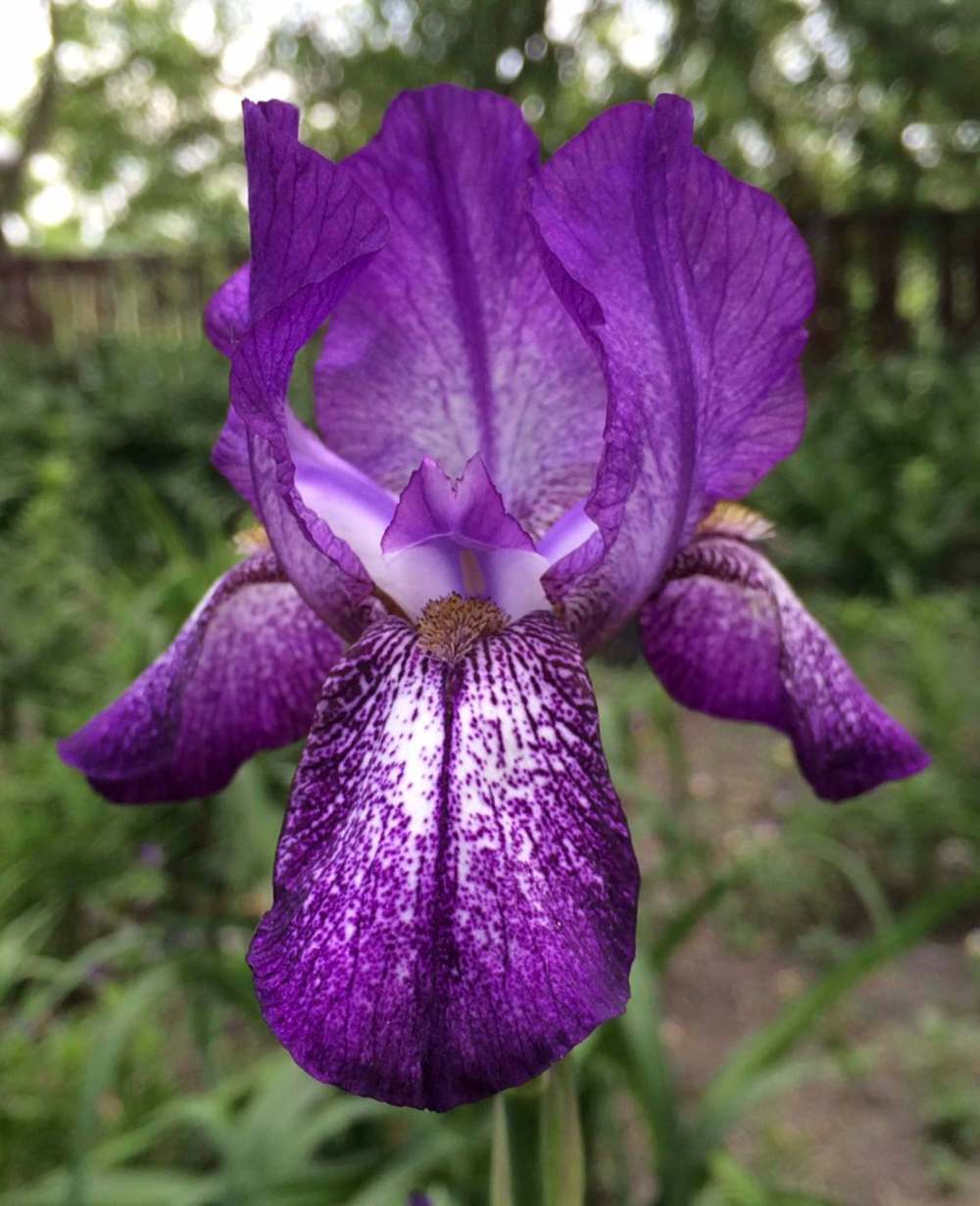
Up close and from a distance, the bearded iris distinguishes itself in the perennial bed with its erect fans of sword-shaped leaves that remain attractive throughout the growing season. When the bearded iris is flowering, the knockout blooms are a kaleidoscope of colour and intricacy.
Call it an old-fashioned perennial, if you will, but if the performance standards you demand in a perennial include reliable bloom, hardiness, and ease in both cultivation and propagation, then consider the iris a cutting-edge plant for today’s urban landscape.
Brandonite Barbara-Jean Jackson has been adding to her iris collection for the past 20 years. A member of the Can-West Iris Society (cwis.webplus.net), Jackson likes two attributes of bearded iris in particular.
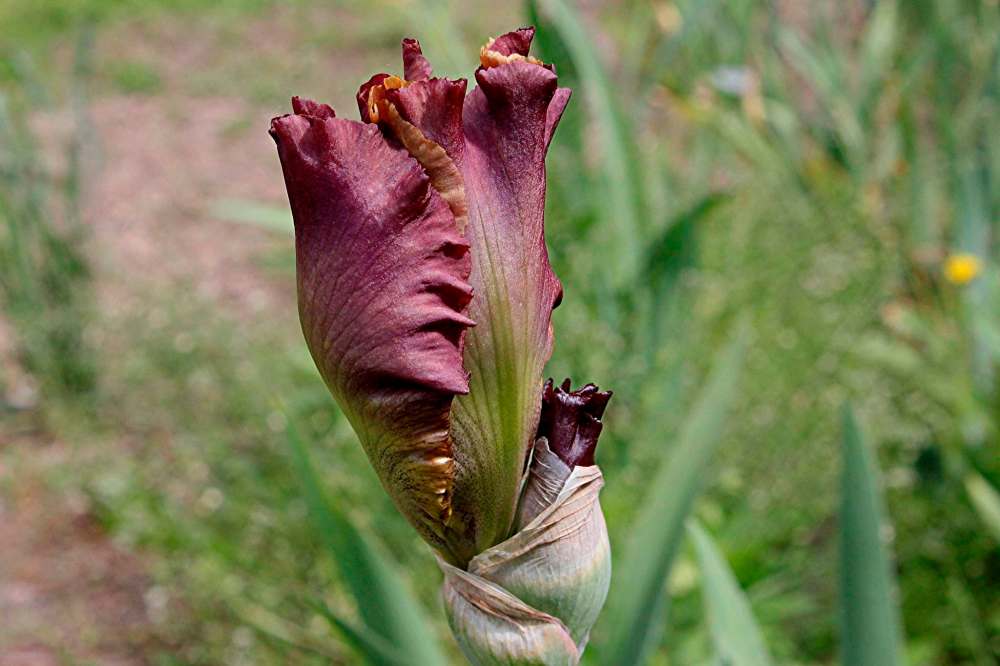
Firstly, she says, by growing different varieties, iris blooms can be enjoyed over many weeks, starting in May with the miniature dwarf bearded iris, followed by the standard dwarf beardeds, intermediate beardeds, border beardeds, miniature tall beardeds and the tall beardeds, which bloom in late June and early July.
There are also reblooming tall bearded iris varieties that bloom again in August or September, although in our temperamental climate, this unique attribute is not always guaranteed. Tall bearded iris germanica Immortality, a fragrant reblooming bearded iris with ruffled snow white blooms on 70-centimetre stems, put on a surprising show last fall in the garden of Jackson’s sister Deborah Petrie, who is also a member of the Can-West Iris Society.
Secondly, Jackson says that the affordability of iris, in relation to how fast some classes multiply, makes this perennial especially appealing. New introductions with good parentage, as well as sought-after heirloom varieties, inspire this avid collector.
Nevertheless, Jackson’s primary mandate is to choose hardy varieties that grow successfully in our cold climate.
Bearded iris grow from a rhizome and benefit from division every three to five years. Well-drained soil and plenty of sunlight are essential to healthy, vibrant growth. Jackson does not fertilize her iris in spring, however she adds compost to her soil whenever she plants something new.
She says that iris plants love alfalfa, which can be worked into the soil in spring or applied as a tea once every couple of weeks.
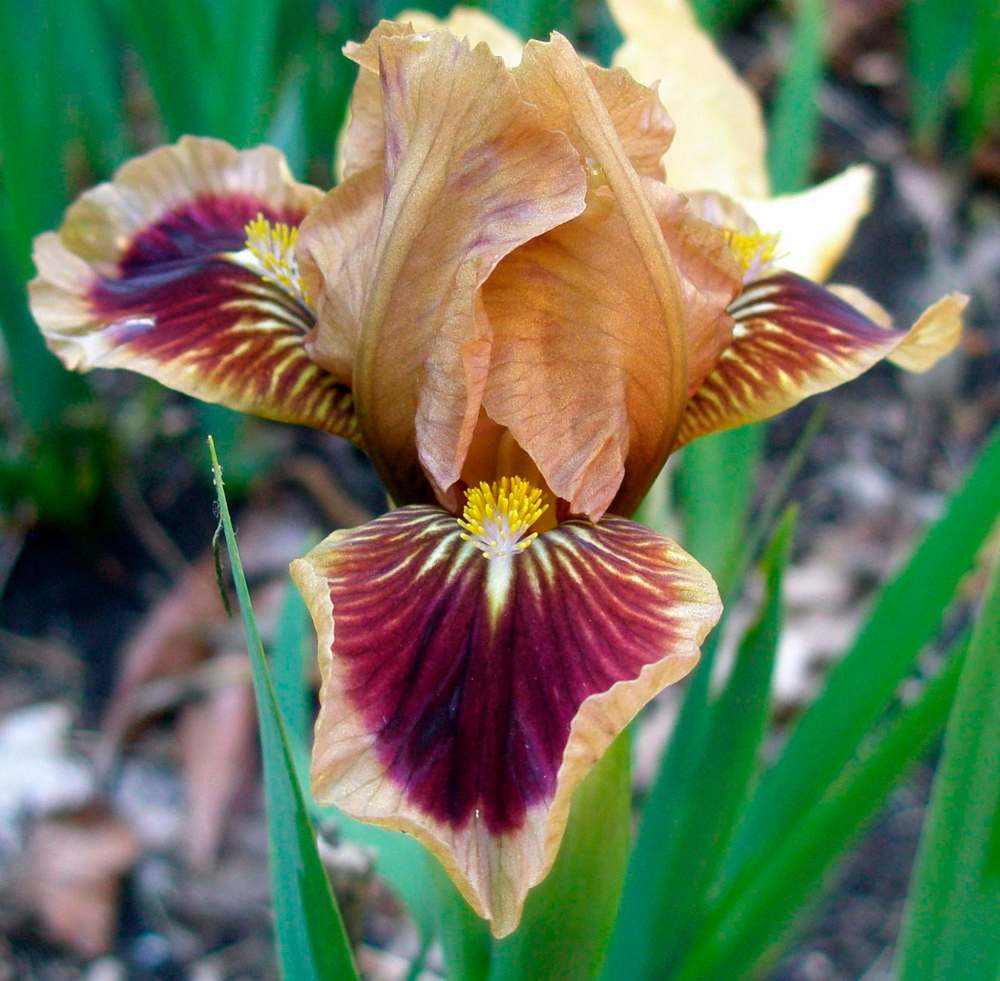
Miniature dwarf bearded varieties are the first of the bearded iris to bloom. They grow to about 20 centimetres tall and are well-suited to rock gardens. One classic example, Jackson says, is Spot of Tea with tan coloured standards (inner petals) and falls (outer flower petals). Each fall sports a well defined red-brown spot and white shoulder markings at the end of its yellow-tipped bushy beard.
A miniature tall bearded called Ace is one of Jackson’s top recommendations for an early summer blooming iris. An award-winning iris hybridized by American breeder Lynda Miller, Ace (45 to 60 cm) features dark violet standards and dark violet falls with white stippling. Jackson says that Ace is easy to grow like a chameleon flower, taking on a unique look depending on the lighting, time of day or amount of moisture. Visitors to the garden always remark on its character and beauty, she adds.
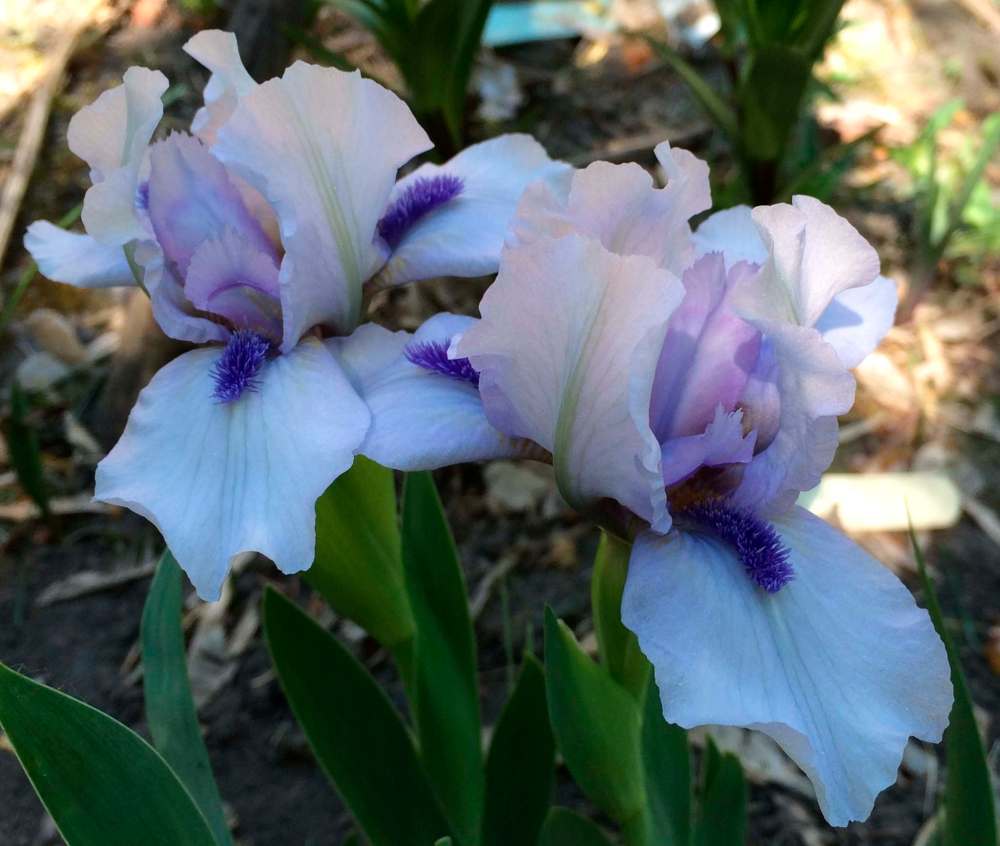
A standard dwarf bearded iris that Jackson touts as a sure-thing for novice to experienced gardeners is Forever Blue, hybridized by Canadian iris breeder Chuck Chapman (Chapman Iris). An early reblooming light blue iris with a riveting dark violet blue beard, Forever Blue astounded a few fortunate local iris gardeners in 2016, Jackson says, by reblooming as many as three times.
Two other standard dwarf bearded varieties — Blueberry Tart and Autumn Jester — have also been known to rebloom on the Prairies, albeit not reliably, Jackson adds. These were also created by Chapman.
A word of caution (but no offence), Jackson says, garden centres are not always the best place to acquire iris. Why? The discerning iris collector, Jackson says, insists on knowing where an iris originates so as to be sure that it will adapt to prairie growing conditions and that information is usually available only from specialty growers. Occasionally tags, too, can be mixed up in the frenzy of spring buying (not the fault of the proprietor). One suggestion is to know what you are looking for beforehand and to buy when an iris variety is in bloom. When ordering online, specialty iris growers such as Chapman Iris and Trails End Iris Gardens, (both in Ontario) are excellent sources.
Bob and Ann Granatier own Trails End Iris Gardens near Brantford, Ont. In a recent phone conversation, they shared some of their best tips for spring maintenance. The first task is to remove mulch on new plantings just as soon as growth starts. They use straw to cover only new plantings for the winter and recommend resetting any new plantings planted last fall that may have pushed out of the ground a bit.
Remove any leftover, mushy leaves from your iris. These can trap moisture and overwintering insects. The Granatiers also tidy their iris beds, removing debris, so that the new green growth has plenty of air circulation. If fertilizer is applied, it’s essential, they say, that it be low in nitrogen in order to ensure blooms. Timing is important — apply around the time that tulips start to bloom. Fresh manure is to be avoided at all costs as it encourages rhizome rot.
The Granatiers also tout the benefits of alfalfa meal, a natural soil conditioner that provides very low nitrogen. They use it when planting or re-planting or for top-dressing in the spring. Bone meal is mixed into the soil at the root base when they are planting irises.

Bob Granatier shares an interesting tip. Some of the newer iris varieties introduced over the last several years bloom on what are called double- and triple-socketed buds. “Instead of one bud opening up and flowering,” he says, “there will be two or three, each behind the other. Once the first bud has opened up and blossomed and then begins to fade, it can block to some degree the next bud that is trying to open.”
By deadheading the spent blossoms, the second and third ones open freely. In this way, says Granatier, your iris garden always looks its best. An iris flower stalk might have up to nine to 12 buds over a bloom period of 10 days to two weeks. Removing the bloom stalk entirely after it has finished blooming promotes good air circulation.
Ann Granatier says that the stalks snap off easily when they are nice and crisp like celery. Simply push the stalk forward over the front of the rhizome. If the stalk is too soft, she cuts it off with a pair of clean scissors. Do not remove the leaves, however, as they produce the food that will be stored in the rhizomes.
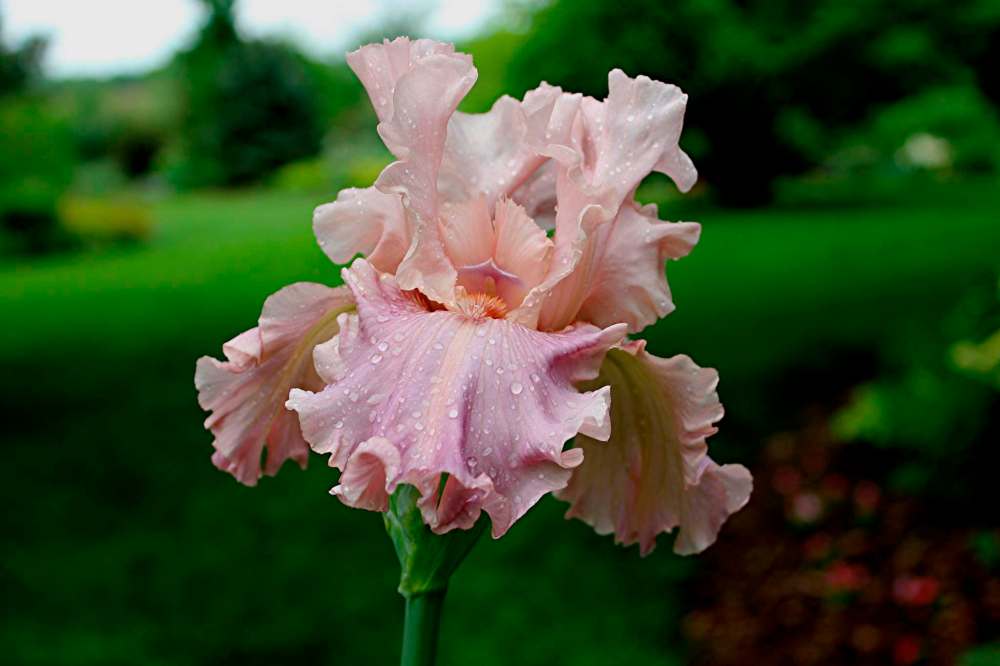
This spring, Bob Granatier, introduces his long-awaited newest creation, Lovers Holiday. This luscious tall bearded iris has large smoky, mauve-pink ruffled blooms with lacy edges. With the first iris blooms only a month away, it’s exciting to anticipate the unique characteristics offered by each of the six classes of bearded iris.
colleenizacharias@gmail.com
Colleen Zacharias
Gardening columnist
Colleen Zacharias writes about many aspects of gardening including trends, plant recommendations, and how-to information that is uniquely relevant to Prairie gardeners. She has written a column for the Free Press since 2010 and pens the monthly newsletter Winnipeg Gardener. Read more about Colleen.
Every piece of reporting Colleen produces is reviewed by an editing team before it is posted online or published in print — part of the Free Press‘s tradition, since 1872, of producing reliable independent journalism. Read more about Free Press’s history and mandate, and learn how our newsroom operates.
Our newsroom depends on a growing audience of readers to power our journalism. If you are not a paid reader, please consider becoming a subscriber.
Our newsroom depends on its audience of readers to power our journalism. Thank you for your support.
Colleen Zacharias
Gardening columnist
Colleen Zacharias writes about many aspects of gardening including trends, plant recommendations, and how-to information that is uniquely relevant to Prairie gardeners. She has written a column for the Free Press since 2010 and pens the monthly newsletter Winnipeg Gardener. Read more about Colleen.
Every piece of reporting Colleen produces is reviewed by an editing team before it is posted online or published in print — part of the Free Press‘s tradition, since 1872, of producing reliable independent journalism. Read more about Free Press’s history and mandate, and learn how our newsroom operates.
Our newsroom depends on a growing audience of readers to power our journalism. If you are not a paid reader, please consider becoming a subscriber.
Our newsroom depends on its audience of readers to power our journalism. Thank you for your support.
Advertisement Advertise With Us
Advertisement Advertise With Us