

Trap maggot flies for a crisp apple harvest
A sticky red ball is all it takes to throw off -- and permanently trap -- these pests
Advertisement
Read this article for free:
or
Already have an account? Log in here »
To continue reading, please subscribe:

Digital Subscription
One year of digital access for only $205*
- Enjoy unlimited reading on winnipegfreepress.com
- Read the E-Edition, our digital replica newspaper
- Access News Break, our award-winning app
- Play interactive puzzles
*First annual payment billed as $205.00 + GST for one year. This annual subscription will automatically renew at $233.00 + GST every 52 weeks (10% off the regular annual price of $259.35). Offer available to new and qualified returning subscribers only. Cancel any time.
To continue reading, please subscribe:
Add Free Press access to your Brandon Sun subscription for only an additional
$1 for the first 4 weeks*
- Enjoy unlimited reading on winnipegfreepress.com
- Read the E-Edition, our digital replica newspaper
- Access News Break, our award-winning app
- Play interactive puzzles
*Your next Brandon Sun subscription payment will increase by $1.00 and you will be charged $17.95 plus GST for four weeks. After four weeks, your payment will increase to $24.95 plus GST every four weeks.
Read unlimited articles for free today:
or
Already have an account? Log in here »
Hey there, time traveller!
This article was published 14/10/2017 (3266 days ago), so information in it may no longer be current.
We all eagerly await early fall, when apples are finally ready to harvest.
It’s the time of year most apples fruit have matured and are ready for picking. If the female maggot flies lay eggs on the skin of apples, the emerging young maggots from those eggs bore their way into the apple flesh, leaving the tell-tale trails of brown, often mushy tunnels. If you see faint brown trails or tunnels winding through the fruit, you definitely have apple maggots.
Feeding by the maggots causes the fruits to be totally inedible, as anyone who has had their first and quickly their last bite into an infested apple already knows.
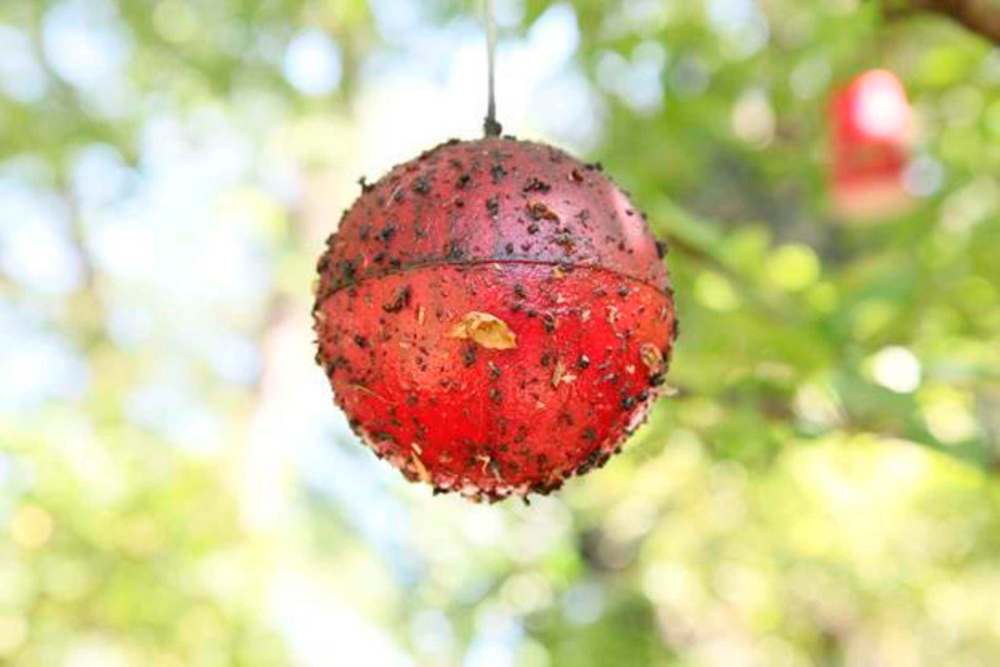
You may want to clip this article out and save it for spring, because the best way to control these maggots is to be prepared for them in early summer. You need to trick them into going after seemingly large, red fruits. You do this by using the apple maggot fly trap control method. This method involves encouraging the female apple maggot flies to land on a sticky trap where they are permanently stuck.
In early June, just as the new green apples are starting to form, hang red-coloured Christmas-tree ball ornaments from the tree twigs and branches using a good length, 15 to 25 centimetres or so of stiff (but partly flexible) wire or strong twine for each ornament. Use only red balls since the flies are totally attracted to that colour. Then, apply sticky Tanglefoot to as many red Christmas ball ornaments (nylon or plastic ones work well) as you can. Larger trees will likely need more ornaments.
Sprinkle the Tanglefoot with a moderate amount of apple cider powder or sugar crystals to entice the flies to land on the balls. The sticky red balls fool the flies into thinking they are real apples. Match the size of the ornament to the size of the fruit if you can.
Word to the wise: keep Tanglefoot away from your clothes and off your fingers. The sticky substance will destroy clothes.
Carefully hang the balls from open branches such that if they were to move in the wind they would not make contact with each other, or with other branches or leaves. Concentrate more of the ornaments on the south and west sides of the tree, which are usually favoured by the flies.
Check them frequently and clean the balls regularly when there are too many insects and parts of leaves stuck to them. Re-apply the Tanglefoot. You will probably have to do this every two to three weeks during the height of the summer depending on how many flies are attracted to the balls.
Usually, it will not be practical to save the sticky balls for next year, but many people do; keep a supply of the red ornaments for future use just in case.
You should also know that any fallen fruit that has been infested even by a small amount of maggots left on the ground from these trees has a strong likelihood of being the breeding source for next year’s maggots.
As a footnote, in recent years, the equally annoying plum curculio insect also lands on apples and many other types of tree fruits to chew their way into the flesh. Tanglefoot will trap these pests as well.
Why is it important to remove all fallen fruit from the ground on a regular basis during the fall? When the fruit falls to the ground, the maggots — which are actually larvae of the apple maggot fly — leave the fruit in the fall and burrow about five cm into the ground. In the soil, the maggots molt and become pupae — the next transition change in the form of their bodies toward becoming a fly. They hibernate underground over winter.
The following spring, the pupae change into adult flies. The flies emerge from the ground in mid-June to early July. The growth cycle of the apple maggot is then repeated. That is why one should never let infested apples rot on the ground, as the maggots do crawl out of the fruit as soon as they sense they are on the ground. As well, those fallen apples attract wasps. If only to reduce the number of wasps, let alone apple maggots, always collect fallen apples early in the fall and dispose of them in the trash or thoroughly chop them up and mix them in the compost.
You can give your fruit trees a fighting chance by keeping them in optimum health. Fertilize fruiting trees with an all-purpose commercial fertilizer such as 20-20-20, 15-30-15 or an organic compost fertilizer each spring to improve the health of the tree. You can do this every three years.
Place two tablespoons of dry fertilizer into four-cm-diameter holes drilled 15 to 25 cm into the ground. Use a long wood auger bit, say 80 cm in length for example, to drill the holes. You might need an auger extender as this will save your back from bending down each time the holes are drilled. Space the holes within concentric circles or arcs about 45 cm apart. Each circle should also be spaced similarly from each other. The visual effect should look like a bullseye with the trunk at the very centre.
The holes should extend out from the trunk in all directions (in clay loam soils typical to many area of southern Manitoba) to a distance of half the height of the tree to the drip line for apple trees. For moderate or large trees, do not drill holes any closer than one metre from the trunk. In order to facilitate adding fertilizer to the holes while standing up, get a suitable length of a 1.5-inch diameter tube that will fit over the fertilizer holes. Place a wide-neck funnel at the top of the tube so that the dry fertilizer can be added directly to the tube and settle into the base of the drilled holes in the soil. Kick the soil piles adjacent to the holes back into the holes. Thoroughly water the fertilizer afterward.
I hope you got a bumper crop of delicious apples this harvest. Now you know the tricks of the trade as to how to get an even better harvest next year.
Michael Allen M.Sc.F., RPF (ret’d) is a consulting urban forester, tree diagnostician and certified arborist. He owns Viburnum Tree Experts. He can be reached at 204-831-6503 or 204-223-7709. His website is treeexperts.mb.ca.
viburnumtrees@shaw.ca