

Cacti and succulents thrive in Winnipeg
City gardener surprises friends with unusual plants

Advertisement
Read this article for free:
or
Already have an account? Log in here »
To continue reading, please subscribe:

Digital Subscription
One year of digital access for only $205*
- Enjoy unlimited reading on winnipegfreepress.com
- Read the E-Edition, our digital replica newspaper
- Access News Break, our award-winning app
- Play interactive puzzles
*First annual payment billed as $205.00 + GST for one year. This annual subscription will automatically renew at $233.00 + GST every 52 weeks (10% off the regular annual price of $259.35). Offer available to new and qualified returning subscribers only. Cancel any time.
To continue reading, please subscribe:
Add Free Press access to your Brandon Sun subscription for only an additional
$1 for the first 4 weeks*
- Enjoy unlimited reading on winnipegfreepress.com
- Read the E-Edition, our digital replica newspaper
- Access News Break, our award-winning app
- Play interactive puzzles
*Your next Brandon Sun subscription payment will increase by $1.00 and you will be charged $17.95 plus GST for four weeks. After four weeks, your payment will increase to $24.95 plus GST every four weeks.
Read unlimited articles for free today:
or
Already have an account? Log in here »
Hey there, time traveller!
This article was published 02/06/2018 (3020 days ago), so information in it may no longer be current.
Ernie Brown recalls that 25 years ago, when he first told friends and family he planned to grow cacti year-round in his Winnipeg backyard, they looked at him in disbelief.
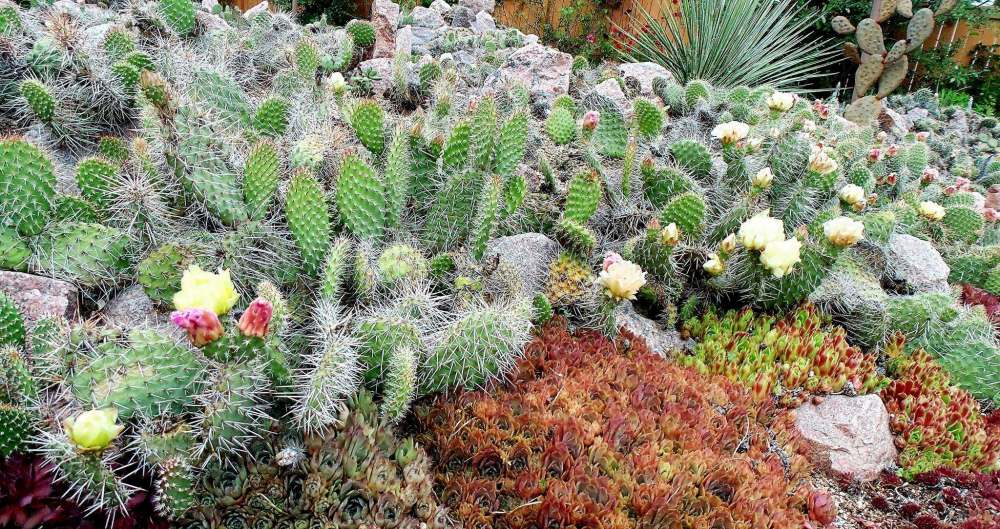
That same look of disbelief can be seen today on the faces of the many visitors to his garden. Picture this: two large, mounded rock gardens, the larger of which is nearly two metres tall, eight metres in length and six metres wide, contain a diverse collection of cacti, yucca and Sempervivum succulents, all in an array of colours and sizes.
Inspired by visits to one of his favourite places, the Badlands National Park in South Dakota, Brown has spent the past couple of decades continually expanding his vast indoor and outdoor collection, including developing many of his own unique cacti and succulent varieties.

He’s onto something big. In its 2017 state of the industry report, Garden Center magazine found that interest in succulents and cacti surpassed all other trends, including strong contenders such as edibles and container gardening. Its survey of independent retailers found that cactus and succulent sales had risen 64 per cent since 2012.
While succulents command more display space than ever before in local greenhouses, Brown expresses surprise that the availability of cacti varieties is limited at best. With a warming climate, Brown expects cacti will soon have their day in the sun in Manitoba.
“Most people don’t realize that there is an almost infinite number of cacti varieties that are hardy to our climate,” Brown says.
In Manitoba, there are two native cacti species — ball-shaped Escobaria vivipara (pincushion cactus) and Opuntia fragilis (brittle prickly-pear cactus) — both of which survive in our winter climate with no protection other than snow cover.
Pincushion cactus, Brown says, can be found in the southwestern part of our province where sandy soils dominate in comparison to the clay soils found in the Red River Valley. Localized populations in the areas of Spirit Sands, Lauder Sandhills and Oak Lake can be relatively common, Brown says, although easily overlooked because short native grasses growing on the prairie leave the cacti well-camouflaged. Brittle prickly-pear grows wild in southwestern Manitoba, but with a lower population density than pincushion cactus.
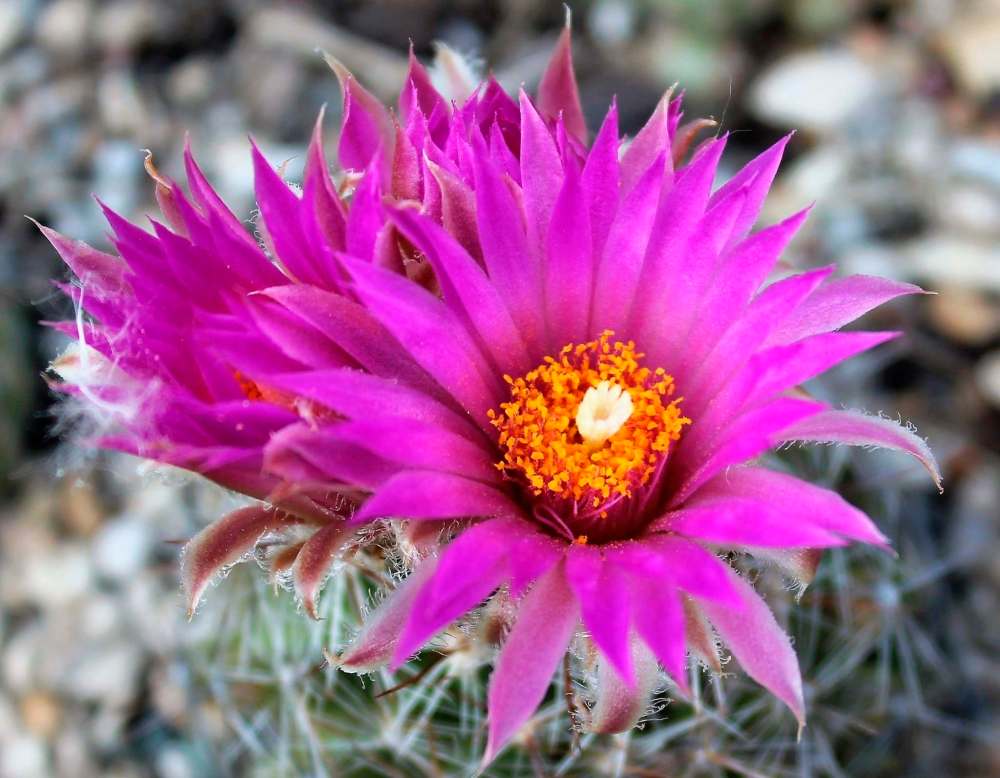
Brown grows three different species of pincushion cacti and numerous varieties, all of which produce beautiful, ethereal blooms. Escobaria vivipara produces pink to pinkish-purple or magenta flowers. Depending on the variety, Escobaria missouriensis (Missouri pincushion) has creamy or yellow-orange or tan flowers. Brown also grows Escobaria vivipara var. kaibabensis, a rare cold-hardy pincushion cactus with white spines and brilliant pink flowers.
Prickly-pear cactus, as the name suggests, is covered in prickly, razor-sharp spines. Opuntia fragilis Brittle prickly-pear is native to Manitoba and can be found growing in Spruce Woods Provincial Park as well as Whiteshell Provincial Park. Brown grows approximately nine different species of hardy prickly-pear cacti and numerous cultivars.
For the novice cacti enthusiast, Brown recommends starting with some of the different varieties of Opuntia fragilis and Opuntia polyacantha.
“Both are extremely cold hardy,” Brown says, “and tend to be more forgiving with regards to their cultivation.” These types are also easier to acquire, he adds.
Brown grows about 12 different varieties of Opuntia fragilis brittle prickly-pear. Flower colour ranges from yellow to salmon, pink and red. He grows 20 to 25 different forms of Opuntia polyacantha, also known as plains prickly-pear or starvation cactus. The variation in colours, he says, is seemingly endless, ranging from white or cream to chartreuse, yellow, salmon, peach, orange, pink, lavender, and red — everything but blue, that most elusive of colours in the garden.
Prickly-pear has a history of culinary uses. The edible stems can be roasted and the fruits can be made into jelly, after removing the spines. Brown says the fruit has a pleasant flavour and compares it to that of green beans with hints of cucumber.
Propagating prickly-pear cactus is easy, Brown says. Simply remove one of the mature, fleshy pads from the mother plant. Allow the wound to dry until it forms a callus, he says, then lay it on the ground to reroot. To activate the process, add some supplemental moisture (about every two weeks).
Brown’s collection has grown through natural hybridization as well as his own efforts at developing new varieties. One of his prize possessions is a prickly-pear cactus he developed which has highly unusual red-and-white, bi-coloured blooms. Cactus enthusiasts south of the border have offered varieties in trade. However, Brown may seek a plant patent.
How do cacti adapt to summer’s hot, dry conditions and winter’s freezing temperatures? Brown says that cacti store water in their vegetative stem tissues. If you cut open the pad of a prickly-pear cactus, he says, you will see that they are juicy inside. Although drought-tolerant, cacti and succulents should be watered when weather conditions are extremely dry. Cease any watering after the first of September, says Brown, when cacti begin preparing for winter hibernation.
Our native cacti also have freeze-tolerance. Brown says our native cacti also have a mechanism for freeze-tolerance that allows them to make something almost resembling antifreeze that helps to keep the water stored in their stems from freezing in cold temperatures.

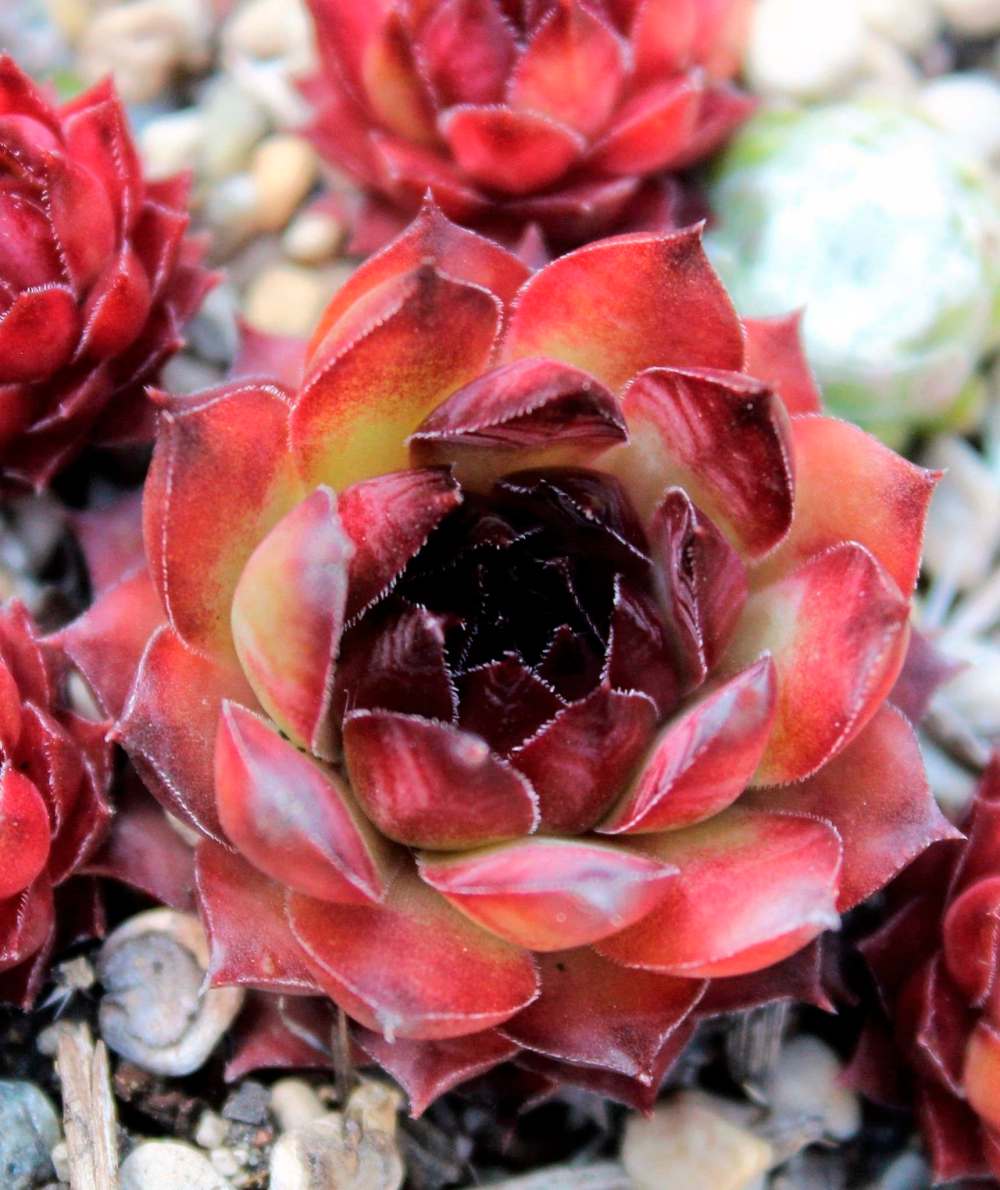
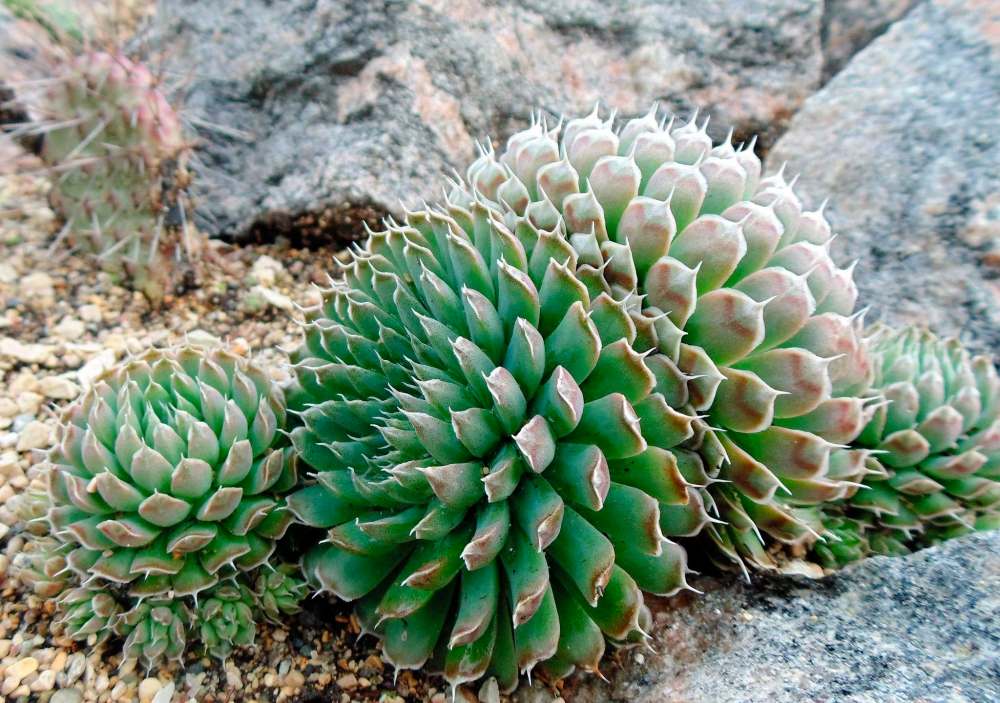
Brown started his collection of Sempervivum (hens and chicks) about 15 years ago when he ordered 10 different varieties, which included Orostachys spinosa. Fully hardy to zone 3, Brown highly recommends Orostachys spinosa, which has a unique, spiny appearance. Hens and chicks display a greater range of colour when they aren’t grown in clay-dominated soil. Brown has developed hybrids with colours such as deep red, dark purple, and greyish-mauve.
When preparing the growing mix for his plants, Brown mixes together equal parts soil, coarse sand, and fine grit or gravel. It goes without saying that a location with full, unrelenting sun is a must, hence, the importance of maintaining a weed-free garden. Allowing weeds to continue growing unabated can quickly dwarf ground-hugging cacti and succulents and also shade them from the sun.
Brown does a thorough weeding in spring, mid-summer, and again in fall. It’s a thorny matter for the most part. Some cacti have very few spines, while others have spines that are dangerously long (eight centimetres). For safety’s sake, Brown wears elbow-length leather gloves to avoid being pricked. It’s no different, he says, then tending to roses.
Interested in learning more? Brown will be speaking at the St. Vital Library at 6:30 p.m. on June 19th.
colleenizacharias@gmail.com
Colleen Zacharias
Gardening columnist
Colleen Zacharias writes about many aspects of gardening including trends, plant recommendations, and how-to information that is uniquely relevant to Prairie gardeners. She has written a column for the Free Press since 2010 and pens the monthly newsletter Winnipeg Gardener. Read more about Colleen.
Every piece of reporting Colleen produces is reviewed by an editing team before it is posted online or published in print — part of the Free Press‘s tradition, since 1872, of producing reliable independent journalism. Read more about Free Press’s history and mandate, and learn how our newsroom operates.
Our newsroom depends on a growing audience of readers to power our journalism. If you are not a paid reader, please consider becoming a subscriber.
Our newsroom depends on its audience of readers to power our journalism. Thank you for your support.
Colleen Zacharias
Gardening columnist
Colleen Zacharias writes about many aspects of gardening including trends, plant recommendations, and how-to information that is uniquely relevant to Prairie gardeners. She has written a column for the Free Press since 2010 and pens the monthly newsletter Winnipeg Gardener. Read more about Colleen.
Every piece of reporting Colleen produces is reviewed by an editing team before it is posted online or published in print — part of the Free Press‘s tradition, since 1872, of producing reliable independent journalism. Read more about Free Press’s history and mandate, and learn how our newsroom operates.
Our newsroom depends on a growing audience of readers to power our journalism. If you are not a paid reader, please consider becoming a subscriber.
Our newsroom depends on its audience of readers to power our journalism. Thank you for your support.
Advertisement Advertise With Us
Advertisement Advertise With Us