

How to spruce up steep slopes
Important to do it in an environmentally friendly way, former biology professor says

Advertisement
Read this article for free:
or
Already have an account? Log in here »
To continue reading, please subscribe:

Digital Subscription
One year of digital access for only $205*
- Enjoy unlimited reading on winnipegfreepress.com
- Read the E-Edition, our digital replica newspaper
- Access News Break, our award-winning app
- Play interactive puzzles
*First annual payment billed as $205.00 + GST for one year. This annual subscription will automatically renew at $233.00 + GST every 52 weeks (10% off the regular annual price of $259.35). Offer available to new and qualified returning subscribers only. Cancel any time.
To continue reading, please subscribe:
Add Free Press access to your Brandon Sun subscription for only an additional
$1 for the first 4 weeks*
- Enjoy unlimited reading on winnipegfreepress.com
- Read the E-Edition, our digital replica newspaper
- Access News Break, our award-winning app
- Play interactive puzzles
*Your next Brandon Sun subscription payment will increase by $1.00 and you will be charged $17.95 plus GST for four weeks. After four weeks, your payment will increase to $24.95 plus GST every four weeks.
Read unlimited articles for free today:
or
Already have an account? Log in here »
Hey there, time traveller!
This article was published 23/06/2018 (2998 days ago), so information in it may no longer be current.
Steep slopes pose unique challenges, but also opportunities. For homeowners and cottage owners who have waterfront properties, techniques for sustainable stormwater management (rainwater runoff) and soil erosion control are essential to ensure water quality.
Urban homeowners who have walkout basements often have moderate or steep slopes on their properties. In my neighbourhood, for example, there are a number of houses which have steeply sloped backyards because they were built on top of enormous amounts of clay fill that was removed decades ago from the centre of the community in order to create retention ponds.
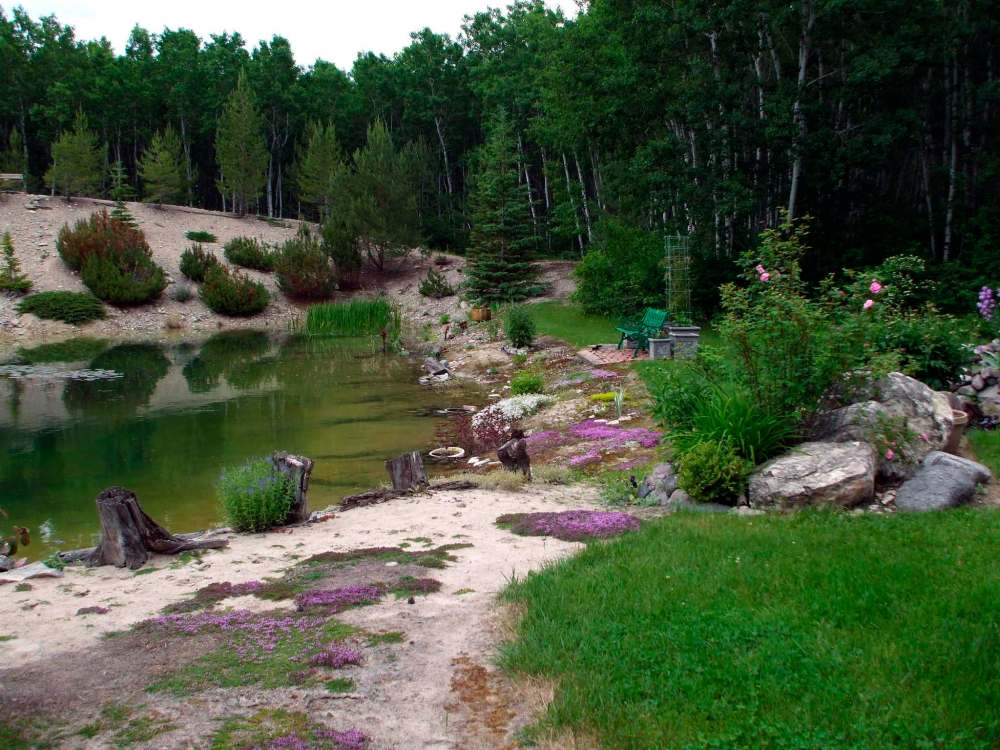
For those who want to garden on slopes, it is important to do it in a very environmentally or water-friendly way, Eva Pip says. A retired University of Winnipeg aquatic toxicologist and professor of biology, Pip is a renowned water-quality expert and dedicated advocate for the health of Lake Winnipeg. Pip gardens on steep slopes that surround an enormous pond on her 40-acre property near Beausejour and practices what she preaches.
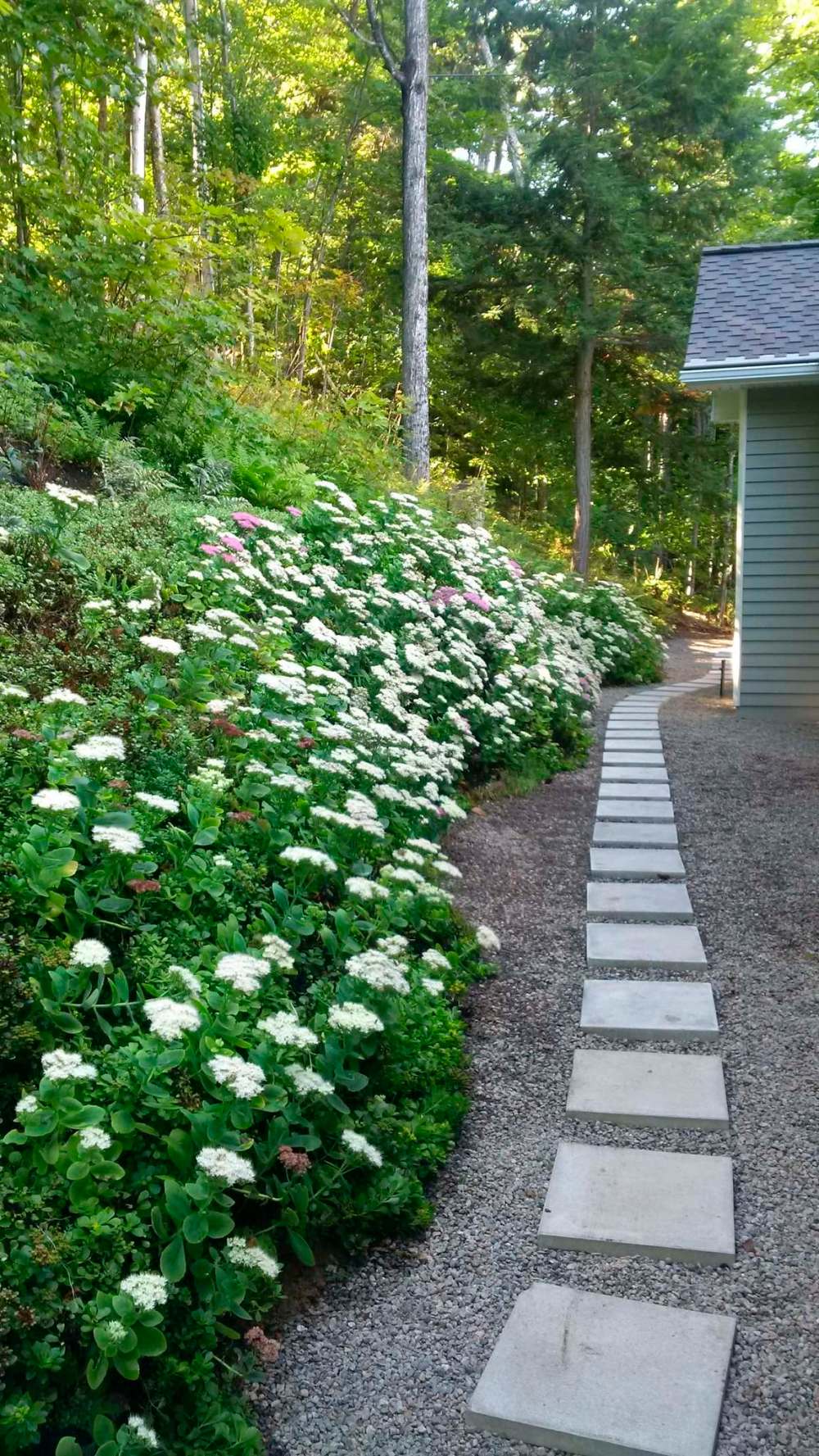
The word riparian is derived from ripa, a Latin word meaning bank or shore. Riparian plants help to reduce riverbank erosion and protect aquatic environments. Native plants are always your best choice for restoring riparian areas, Pip says. Their deep root systems help to anchor the soil in place, slow the movement of water and act as filters for pollutant materials that could contaminate rivers, lakes or ponds.
Pip says it is important to not introduce new soil, such as the type commonly added to an urban garden, because of the risk it presents to water quality. Avoid the use of chemical fertilizers or manure as well, as the nutrient content eventually ends up in the water and promotes excessive algae growth. It is better to use compost, Pip says, as compost is not as readily soluble as chemical fertilizer.
Pip digs rocks into the slope to create retention around each plant she installs on her riverbanks. This helps to protect the soil around the plant and keeps it from washing out when it rains.
When slopes are adjacent to a body of water, Pip says, there is a moisture gradient that needs to be considered before choosing your plants. For example, plant moisture-loving plants at the bottom of the slope where it is wettest and drought-tolerant woody plants near the top of the slope where conditions are drier.
Pip says that evergreen trees and shrubs are the best environmentally friendly types of woody plant material for slopes on riverbank varieties.
“Evergreens don’t shed leaves every year like the fallen leaves of deciduous trees, which drop into the water and promote problematic nutrient enrichment,” she says. As fallen leaves decay, they use up oxygen in the water.
Pip recommends the use of ground covers such as spreading junipers for sunny slopes. In addition to being low-maintenance, there are numerous widespreading varieties such as Prince of Wales or Gold Pfitzer that are capable of covering a significant amount of ground (more than two metres). Their roots help to keep the soil stabilized, thereby minimizing erosion.
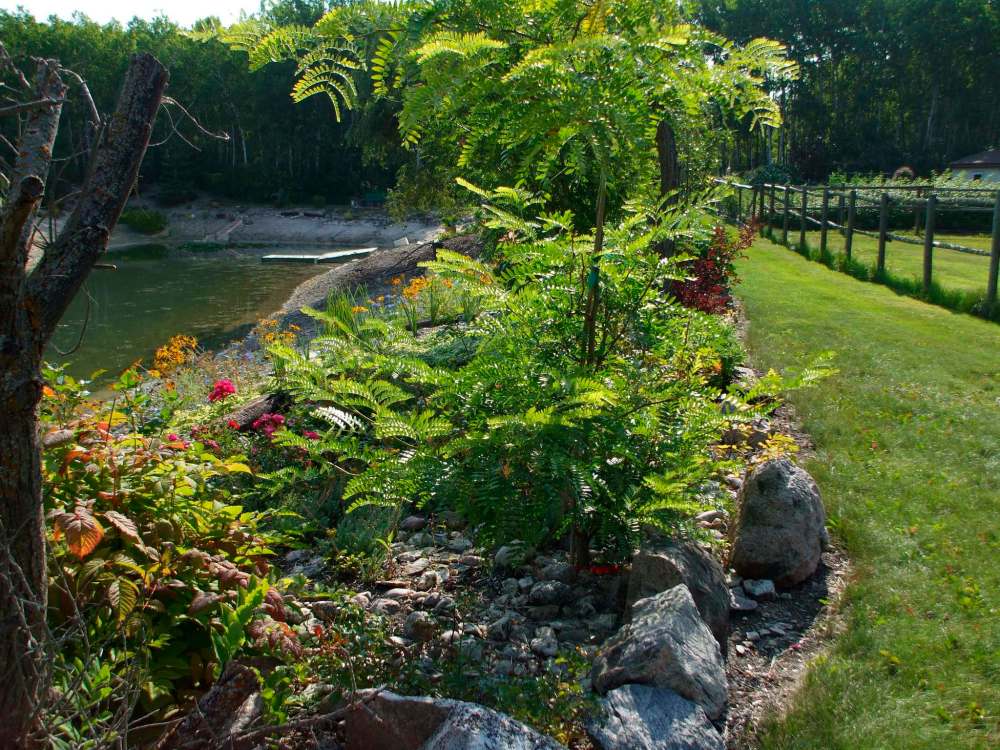
Ground covers on Pip’s stellar property include drifts of colourful mauve-flowering thyme and mint varieties as well as dense stands of fragrant monarda (Monarda didyma) and hardy shrub roses. Shady areas are planted with ferns, hostas and Bleeding Heart Dicentra. Imposing plants such as giant fleece flower (Persicaria polymorpha) and the plume poppy (Macleaya), a silver-coloured plant with large, lobed leaves grow very well on slopes. Pip says that Eupatorium Joe Pye weed, with its large pinkish-purple flowers, is spectacular in late summer.
There are all kinds of ornamental clump-forming grasses suitable for growing on slopes such as Calamagrostis Karl Foerster feather reed grass. Pip cautions against the use of Miscanthus sinensis grass on slopes as they spread by underground rhizomes and some varieties can become invasive.
Mulching with wood chips or rocks on riverbanks is preferable to the use of landscape fabric, which eventually degrades and escapes into the water.
In areas where there are fluctuating water levels, Siberian and Japanese irises are recommended, Pip says, because they grow well in up to 30 centimetres of water and continue to thrive once the water recedes. Beware of yellow flag iris, which is an invasive species.
Willows are ideal for moist riverbanks. Fred Driedger, owner of Evergreen Valley Nursery in Brandon, carries numerous native willow varieties suitable for shoreline stabilization. Driedger has a particular interest in the environmental issues affecting lakes and waterways in Manitoba and specializes in phytoremediation — the use of plants for removal of contaminants from soils, surface water and groundwater. The willow, Driedger says, is one of the best plants for phytoremediation.
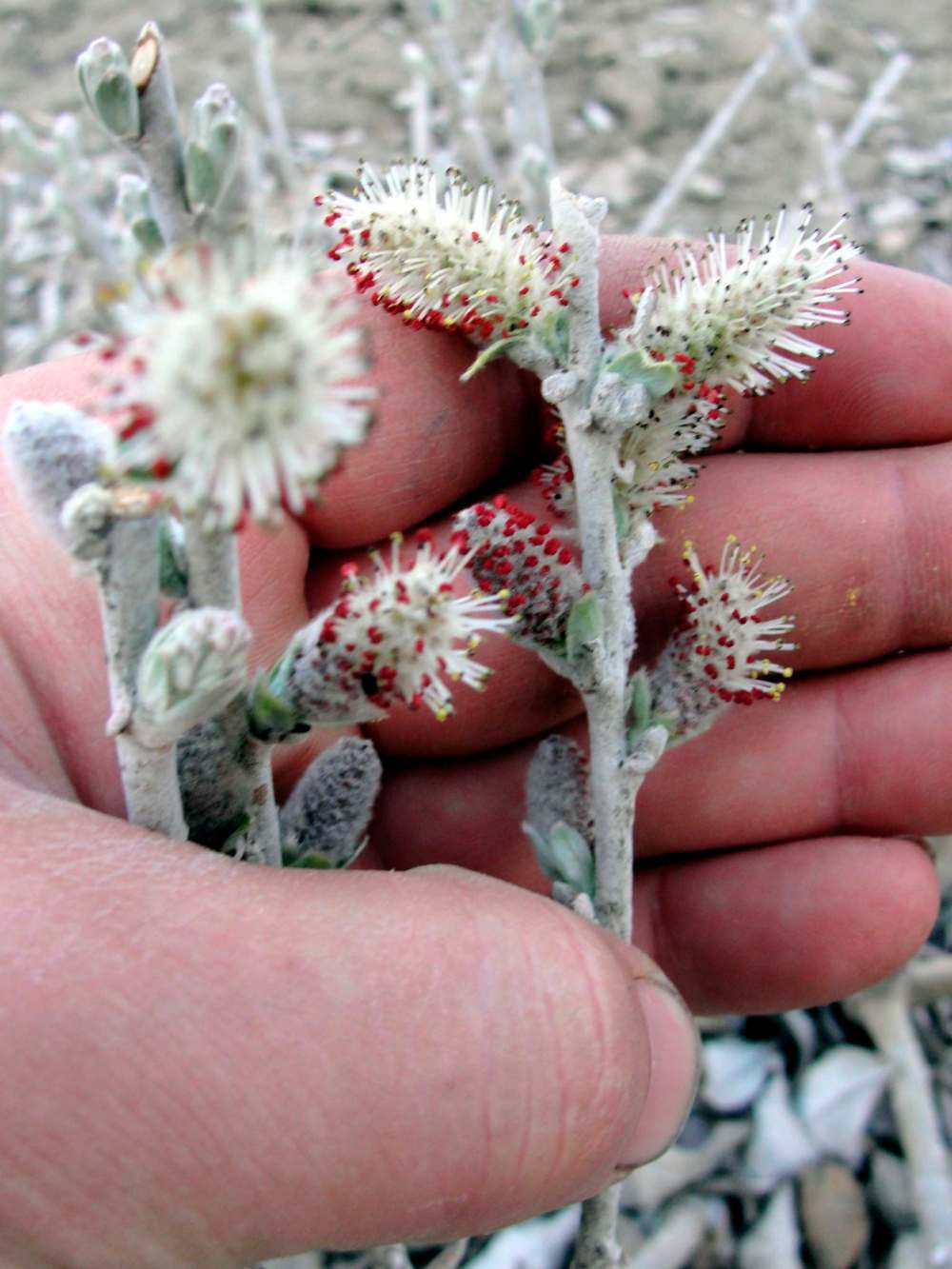
The sage-leaved willow (Salix candida) is popular with cottage owners on Lake Winnipeg, Driedger says. A native plant, sage-leaved willow grows to only 11/2 metres and although not a traditional pussy willow, it produces attractive furry catkins. The silvery-coloured leaf with very white undersides is an attractive feature in the landscape. Only native willow varieties are appropriate for planting on our riverbanks, Driedger says.
In spring 2019, an interesting new silver-leaved dwarf willow called Iceberg Alley will be introduced, which will be suitable for use on slopes in the residential landscape. Native to Newfoundland, Iceberg Alley was developed at the Memorial University of Newfoundland Botanical Garden in St. John’s.
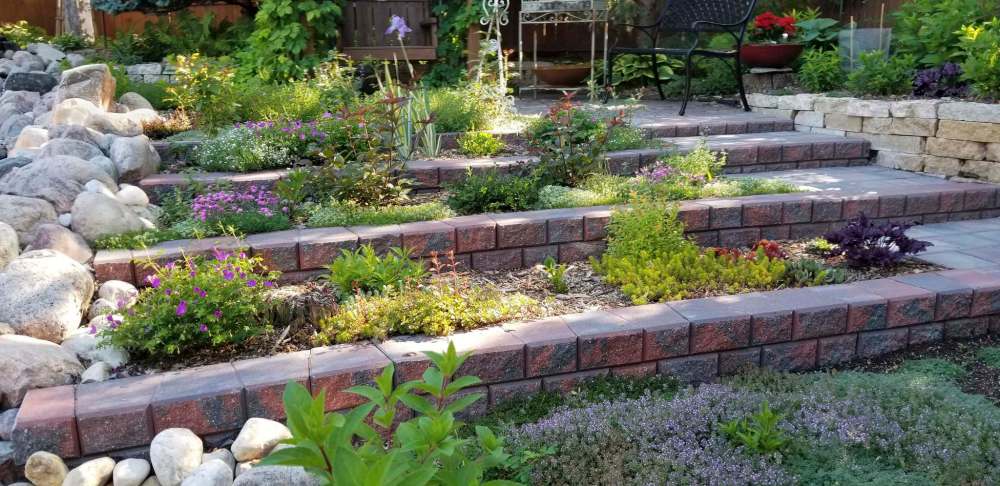
Another option for steep or moderate slopes is to create a series of terraces, each consisting of narrow levels with stone retaining walls. Incorporating steps alongside the terraced garden makes it easy to access the terraces for planting. Never use railroad ties, Pip cautions, as they contain creosote, which is toxic to plants, water and aquatic organisms.

Envirolok is a slope stabilization and shoreline restoration company that specializes in particularly unique vegetated environmental solutions. An American company, Envirolok has distributorships in Ontario and British Columbia, where it has been involved both in large-scale municipal shoreline projects as well as residential projects.
The vegetated systems are called mechanically stabilized earth structures or retained soil systems, says Jay Morgan, general manager at Envirolok Canada. They are used in erosion control and steep slope stability. Morgan says that the vegetated structures provide the same benefits as hardscape solutions, but unlike hardscapes, the structural integrity of Envirolok becomes stronger over time as the native vegetation incorporated into the system matures.
How does the system work? Recycled and recyclable polypropylene bags are filled with 60 per cent sand for mass and 20 per cent soil and 20 per cent compost. Again, native vegetation is the preferred plant material because of its typically deep root systems, drought tolerance and adaptability to local soil conditions. The bags can be filled with a range of plant materials, including sedums and grasses.
Once filled and planted, the bags are then used to build vegetated walls that are near vertical or at a steep 90-degree angle. As the plants grow, Morgan says, the bags are completely concealed and the result is a dramatic living wall that is both functional and low-maintenance. The cost, Morgan says, is reasonable — approximately $150 per square metre plus installation, which factors in access and the type of machinery required. For more details on small- or large-scale Envirolok solutions, visit envirolok.com.
colleenizacharias@gmail.com
Colleen Zacharias
Gardening columnist
Colleen Zacharias writes about many aspects of gardening including trends, plant recommendations, and how-to information that is uniquely relevant to Prairie gardeners. She has written a column for the Free Press since 2010 and pens the monthly newsletter Winnipeg Gardener. Read more about Colleen.
Every piece of reporting Colleen produces is reviewed by an editing team before it is posted online or published in print — part of the Free Press‘s tradition, since 1872, of producing reliable independent journalism. Read more about Free Press’s history and mandate, and learn how our newsroom operates.
Our newsroom depends on a growing audience of readers to power our journalism. If you are not a paid reader, please consider becoming a subscriber.
Our newsroom depends on its audience of readers to power our journalism. Thank you for your support.
Colleen Zacharias
Gardening columnist
Colleen Zacharias writes about many aspects of gardening including trends, plant recommendations, and how-to information that is uniquely relevant to Prairie gardeners. She has written a column for the Free Press since 2010 and pens the monthly newsletter Winnipeg Gardener. Read more about Colleen.
Every piece of reporting Colleen produces is reviewed by an editing team before it is posted online or published in print — part of the Free Press‘s tradition, since 1872, of producing reliable independent journalism. Read more about Free Press’s history and mandate, and learn how our newsroom operates.
Our newsroom depends on a growing audience of readers to power our journalism. If you are not a paid reader, please consider becoming a subscriber.
Our newsroom depends on its audience of readers to power our journalism. Thank you for your support.
Advertisement Advertise With Us
Advertisement Advertise With Us