

All about that bird
Everything you need to know about Manitoba's lone hummingbird species

Advertisement
Read this article for free:
or
Already have an account? Log in here »
To continue reading, please subscribe:

Digital Subscription
One year of digital access for only $205*
- Enjoy unlimited reading on winnipegfreepress.com
- Read the E-Edition, our digital replica newspaper
- Access News Break, our award-winning app
- Play interactive puzzles
*First annual payment billed as $205.00 + GST for one year. This annual subscription will automatically renew at $233.00 + GST every 52 weeks (10% off the regular annual price of $259.35). Offer available to new and qualified returning subscribers only. Cancel any time.
To continue reading, please subscribe:
Add Free Press access to your Brandon Sun subscription for only an additional
$1 for the first 4 weeks*
- Enjoy unlimited reading on winnipegfreepress.com
- Read the E-Edition, our digital replica newspaper
- Access News Break, our award-winning app
- Play interactive puzzles
*Your next Brandon Sun subscription payment will increase by $1.00 and you will be charged $17.95 plus GST for four weeks. After four weeks, your payment will increase to $24.95 plus GST every four weeks.
Read unlimited articles for free today:
or
Already have an account? Log in here »
Hey there, time traveller!
This article was published 13/10/2018 (2840 days ago), so information in it may no longer be current.
In fall, the backyard garden is all aflutter as birds stock up on nutrition to fuel their long migratory flights. Some species, such as the hummingbird, have already vacated their normal summer haunts for warmer climes.
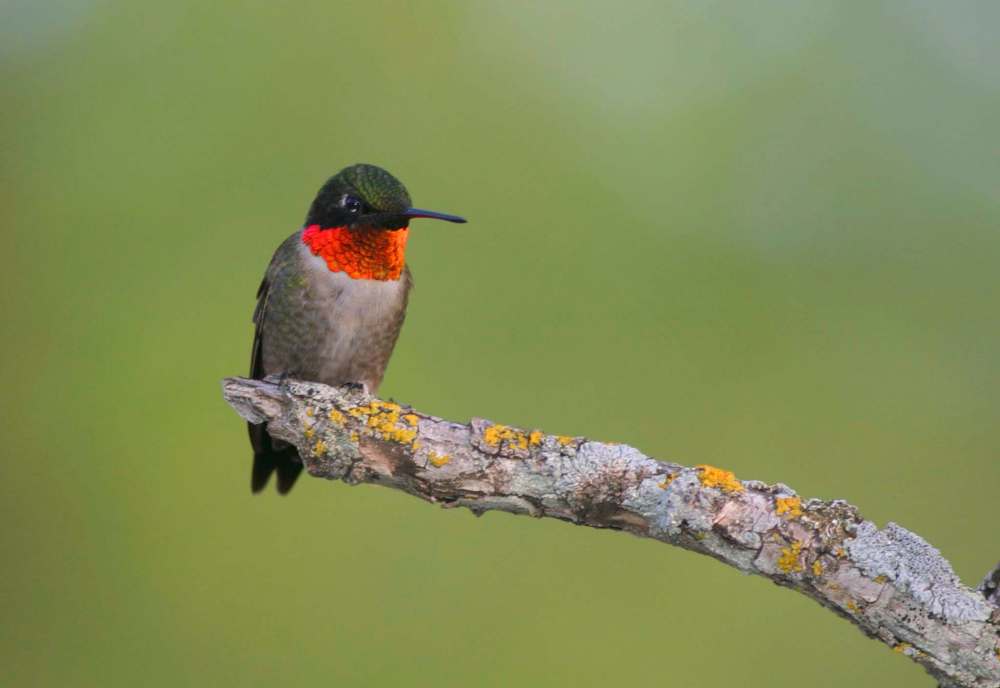
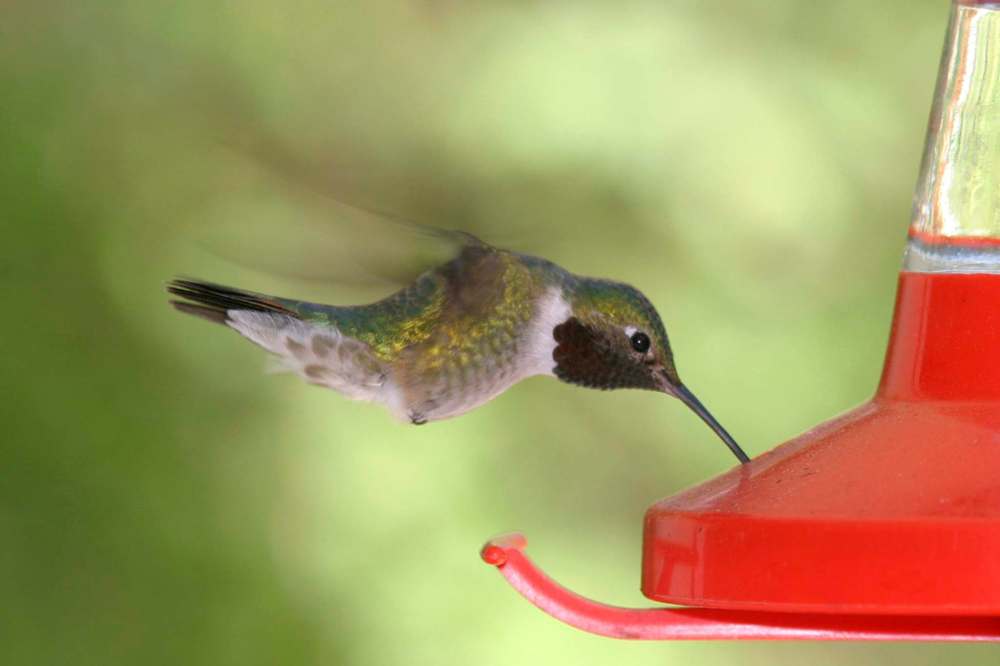
The Ruby-throated hummingbird, an exquisitely tiny bird that weighs little more than 21/2 grams, is the one regularly occurring nesting species of hummingbird in Manitoba. A sighting of a Ruby-throated hummingbird is a thrill for backyard gardeners every time.
Christian Artuso, a conservationist and ornithologist, is the Manitoba program director for Bird Studies Canada and co-ordinator of the Manitoba Breeding Bird Atlas. The hummingbird, he says, belongs to one of the largest families in the world with slightly more than 350 known species. “Hummingbirds occur from Alaska all the way to Tierra del Fuego, an archipelago at South America’s southernmost tip,” Artuso says. In the eastern forests of North America, however, there is really only one hummingbird species and that is the Ruby-throated hummingbird.
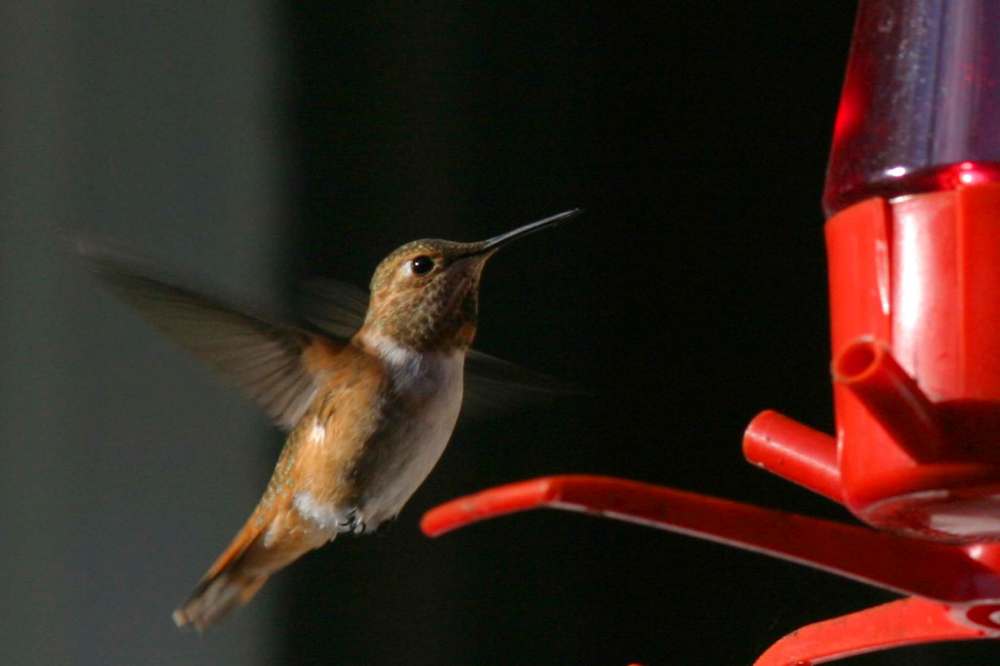
It would be very unusual to see a Ruby-throated hummingbird lingering in Manitoba after the last week of September. There have been rare sightings, however, of the Rufous hummingbird, which is a West Coast species. “Sometimes the Rufous hummingbird wanders east of the Rockies in migration in late fall, usually in October”, Artuso says. Two other reported sightings of rare hummingbird species (for our part of the world) have occurred only once, he says.
There is only one reported sighting of two other rare hummingbird species (in our part of the world), Artuso says. “In May 2006, a very observant feeder-watcher spotted a Broad-tailed hummingbird.” Although the Broad-tailed hummingbird is very similar to a Ruby-throated hummingbird, the homeowner keenly observed differences in the tail pattern.
Another exciting discovery occurred in late October and into early November 2013 when a local bird-watcher photographed what turned out to be the Calliope hummingbird, a species that is even smaller than the Ruby-throated hummingbird and has a shorter tail and a different wing-to-tail ratio, Artuso says.
A female Ruby-throated hummingbird weighs approximately 31/2 grams. The male weighs less at about three grams. The Calliope hummingbird, however, weighs only 21/2 to 2.7 grams.
Hummingbirds have been in the news recently because the species is under threat. Deforestation has reached almost 75 per cent in the hummingbird’s native habitat in Colombia’s Western Andes. The species is also in need of protection. The disturbing and illegal trade of dead, dried hummingbirds as love charms that is prevalent in some parts of Mexico with a black market extending into the United States has caused an alarming decline in the population of the Rufous hummingbird in particular.
The simplest and best approach to the conservation and protection of any species, Artuso says, begins with appreciation. “Translating appreciation for a species into a journey of knowledge is what leads to the conservation of a species,” he says.
We think of the Ruby-throated hummingbird as our bird, but really, Artuso says, they only spend three months of the year here and as much as nine months of the year wintering in the moist forests of the Andean slopes. “The Ruby-throated hummingbird breeds very quickly in our long northern summer days.” The conservation bottleneck, if you will, is not necessarily on the breeding grounds, he says. Sometimes it’s on the wintering grounds or on the migration pathway and sometimes we don’t really know.
Artuso reminds us that the globe is connected. “We need to be working across the hemisphere and we need to recognize our shared mutual inheritance and our shared mutual responsibility. For me, that is the key thing that these tiny little birds remind me of every time I encounter one, whether it’s here in Manitoba or on my winter holiday in Costa Rica.
“More and more the message is about full life-cycle conservation and the need to link what we do here to what’s happening in Central and South America,” Artuso says, “because we can do all the wonderful habitat preservation efforts we want but if the species doesn’t have what it needs to complete its full life cycle, it won’t make it back to Manitoba.”
The hummingbird captivates the imagination of gardeners like no other bird species, spurring the horticulture industry to capitalize on the mystique and aura that surrounds hummingbirds by developing and actively marketing new plant varieties with flower shapes and colours designed to attract these tiny pollinators to your garden.
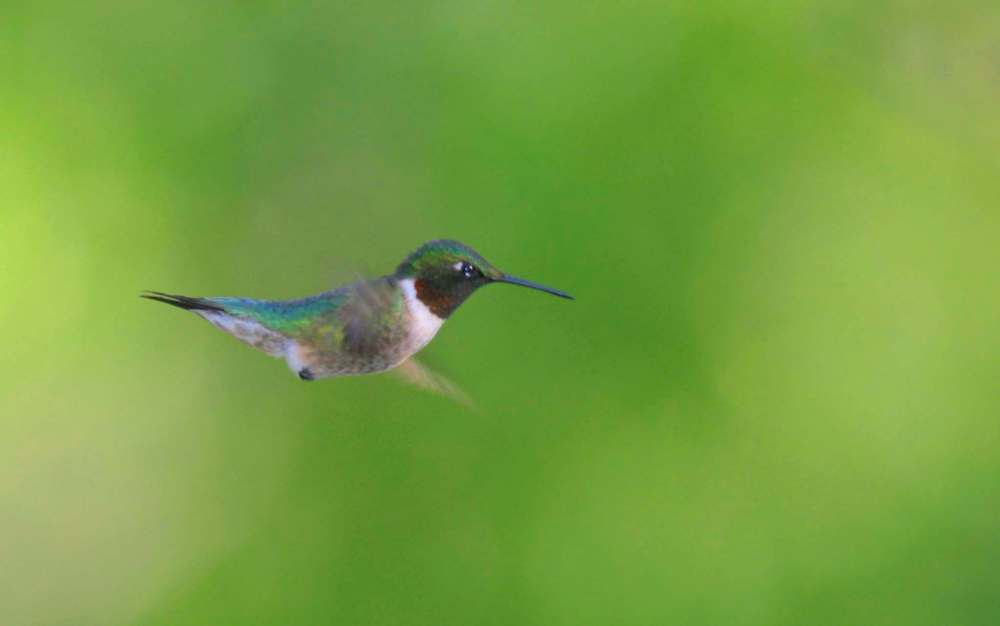
Hummingbirds are predominantly nectar feeders. They have evolved these specialized long bills that support a unique forked tongue apparatus that has two grooves. “They have such tiny feet,” Artuso says, “so they are unable to climb or hop around the same as other bird species, so they have evolved a very energetically demanding way of feeding by foraging during hovering flight.” The Ruby-throated hummingbird averages 53 wing beats per second, but that includes all types of flight, including backward flight, he says. It is higher for some types of flight such as hover-feeding.
Hummingbirds do not vocalize like songbirds; however, their wings create a humming sound. They also perform courtship dives that may be J-shaped or U-shaped. They use spider silk to bind their nest and to secure it to branches. You are not likely to come across these beautifully hidden walnut-size nests, which are often carefully camouflaged by lichens so as to blend into tree branches.
Hummingbirds also feed on insects and spiders, which provide a valuable source of protein. In addition, Artuso says, in early spring when nectar flowers are in short supply, the Ruby-throated hummingbird has an interesting habit of following behind the Yellow-bellied Sapsucker to take advantage of tree sap pooling in the rows of tiny holes made by sapsuckers in trees such as birch.

Their metabolism is extraordinary. “Hummingbirds have an ability to digest and metabolize glucose and fructose far more efficiently than humans can,” Artuso says. In fall, prior to migration, hummingbirds visit our gardens to pack on the pounds. They are not breeding at that time and are able to shrink their reproductive organs.
By the third week in September, the Ruby-throated hummingbird sets out on an amazing and perilous journey to southernmost Mexico and northernmost Panama. Some spend the winter in southern Florida while others cross the vast open water of the Gulf of Mexico, a staggering concept, Artuso says.
Hummingbirds seem to have good memories, Artuso says, and there are lots of anecdotal stories of hummingbirds visiting the same birdfeeder on their return to Manitoba in spring, typically the second week of May. It’s important to clean feeders once a week (one part white vinegar to four parts clean water, rinse thoroughly) as hummingbirds are susceptible to disease. Make sure the windows at your residence and place of work are bird-friendly. Apply tape to prevent bird collisions.
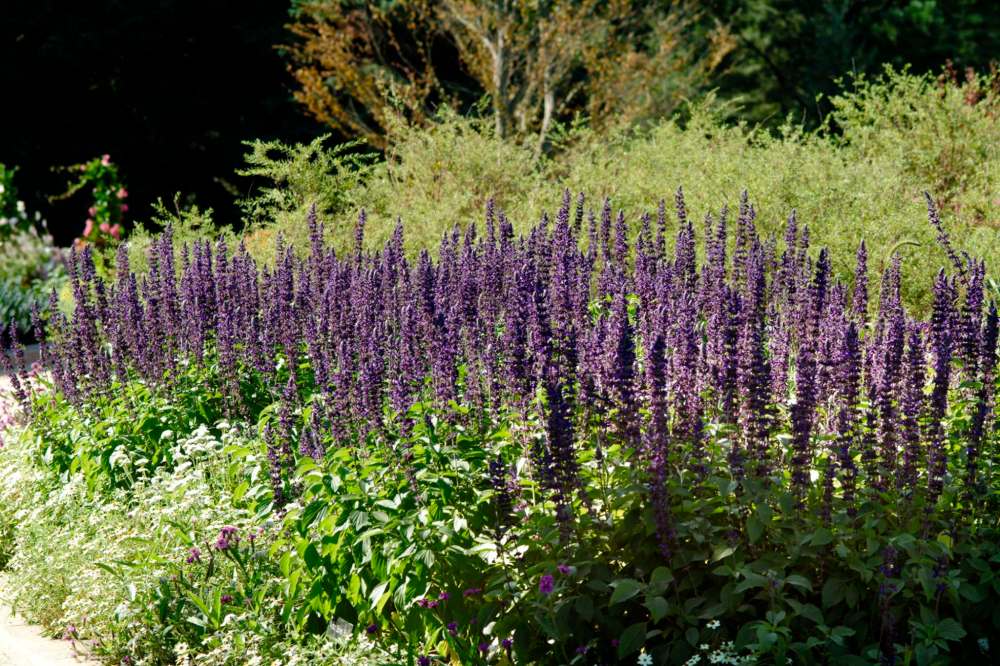
Hummingbirds need different flowers at different times of the year, Artuso says. Plant a range of annuals and perennials. While red tubular flowers are a magnet for hummingbirds, you can’t go wrong with a purple salvia such as Salvia Skyscraper Dark Purple, which blooms June to fall. Avoid the use of harmful insecticides and pesticides.
colleenizacharias@gmail.com
Colleen Zacharias
Gardening columnist
Colleen Zacharias writes about many aspects of gardening including trends, plant recommendations, and how-to information that is uniquely relevant to Prairie gardeners. She has written a column for the Free Press since 2010 and pens the monthly newsletter Winnipeg Gardener. Read more about Colleen.
Every piece of reporting Colleen produces is reviewed by an editing team before it is posted online or published in print — part of the Free Press‘s tradition, since 1872, of producing reliable independent journalism. Read more about Free Press’s history and mandate, and learn how our newsroom operates.
Our newsroom depends on a growing audience of readers to power our journalism. If you are not a paid reader, please consider becoming a subscriber.
Our newsroom depends on its audience of readers to power our journalism. Thank you for your support.
Colleen Zacharias
Gardening columnist
Colleen Zacharias writes about many aspects of gardening including trends, plant recommendations, and how-to information that is uniquely relevant to Prairie gardeners. She has written a column for the Free Press since 2010 and pens the monthly newsletter Winnipeg Gardener. Read more about Colleen.
Every piece of reporting Colleen produces is reviewed by an editing team before it is posted online or published in print — part of the Free Press‘s tradition, since 1872, of producing reliable independent journalism. Read more about Free Press’s history and mandate, and learn how our newsroom operates.
Our newsroom depends on a growing audience of readers to power our journalism. If you are not a paid reader, please consider becoming a subscriber.
Our newsroom depends on its audience of readers to power our journalism. Thank you for your support.
Advertisement Advertise With Us
Advertisement Advertise With Us