

Special request yields positive result for deck
Extra attention to details required for project
Advertisement
Read this article for free:
or
Already have an account? Log in here »
To continue reading, please subscribe:
Monthly Digital Subscription
$1 per week for 24 weeks*
- Enjoy unlimited reading on winnipegfreepress.com
- Read the E-Edition, our digital replica newspaper
- Access News Break, our award-winning app
- Play interactive puzzles
*Billed as $4.00 plus GST every four weeks. After 24 weeks, price increases to the regular rate of $19.95 plus GST every four weeks. Offer available to new and qualified returning subscribers only. Cancel any time.
Monthly Digital Subscription
$4.99/week*
- Enjoy unlimited reading on winnipegfreepress.com
- Read the E-Edition, our digital replica newspaper
- Access News Break, our award-winning app
- Play interactive puzzles
*Billed as $19.95 plus GST every four weeks. Cancel any time.
To continue reading, please subscribe:
Add Free Press access to your Brandon Sun subscription for only an additional
$1 for the first 4 weeks*
*Your next subscription payment will increase by $1.00 and you will be charged $16.99 plus GST for four weeks. After four weeks, your payment will increase to $23.99 plus GST every four weeks.
Read unlimited articles for free today:
or
Already have an account? Log in here »
Hey there, time traveller!
This article was published 26/10/2019 (2382 days ago), so information in it may no longer be current.
A late deck request this fall entailed many uncharacteristic tasks. The client had removed an old, low-level deck between the exterior back wall of the house and the in-ground pool and wanted it replaced in autumn, so it would be ready for use once the pool was reopened the following spring. Low-level decks are a challenge in the best circumstances. This particular scenario upped the ante.
Generally, deck frames are configured and built using very standard features — a ledger board along the an exterior wall of the house, perpendicular joists that extend from the ledger board and rest upon a level beam supported by posts set rigid on the ground.
A low-level deck, however, does not afford the framework a level beam on which the joists can rest. As such, each beam must be self-supported and level not only unto itself, but with the adjacent joists. It is a very time-consuming adventure.
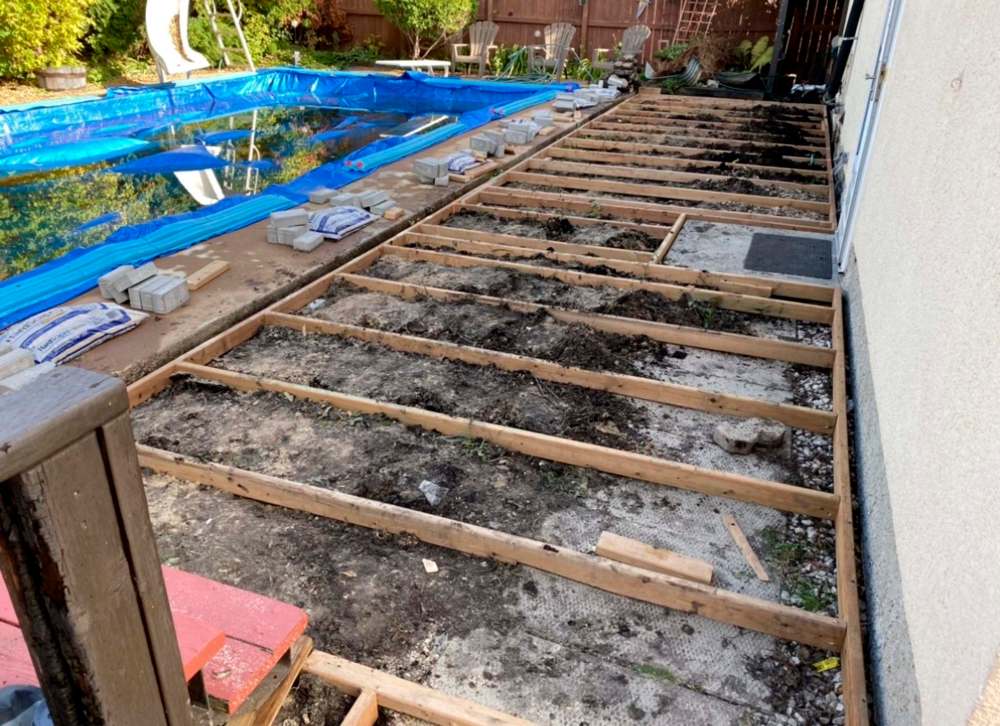
What made this 40-by-10-foot deck-build even more challenging was having to level the outer edge of the deck with the existing concrete pool edge, in keeping level with the houseside of the deck, all the while ensuring that the overall elevation of the deck would allow the back screen door to open outward and over the newly built deck once topped.
Coupled with having to level each joist one at a time, that’s a ton of levelling.
To maximize rigidity of the deck’s framework, 2×4 beams were set on edge at 24-inch intervals.
Support blocks would then be added below every joist at 30-inch intervals. I had pre-determined that in order to allow clearance for the back door and maintain level from the house to the pool, the top of the framework before top-decking must rest roughly 13/4 inches below the concrete edge of the pool.
Once the top-decking was installed, the finished deck’s surface would then sit roughly a quarter-inch lower than the concrete pool edge, and allow around a half-inch of clearance for the back door of the house — the entire process required a high degree of accuracy.
To maintain a consistent elevation of the deck’s framework, channels were dug into the earth for every joist.
One by one, the joists were affixed to a free-floating end board on the house side and pool side. This process continued over the entire 40-foot deck length, until a solid frame was secured and rigid.
Cavities below every joist were then dug out (where required) to allow blocking to be added below the joists at every 30 inches.
When any joist happened to extend above the old concrete sidewalk, the joist was simply shimmed.
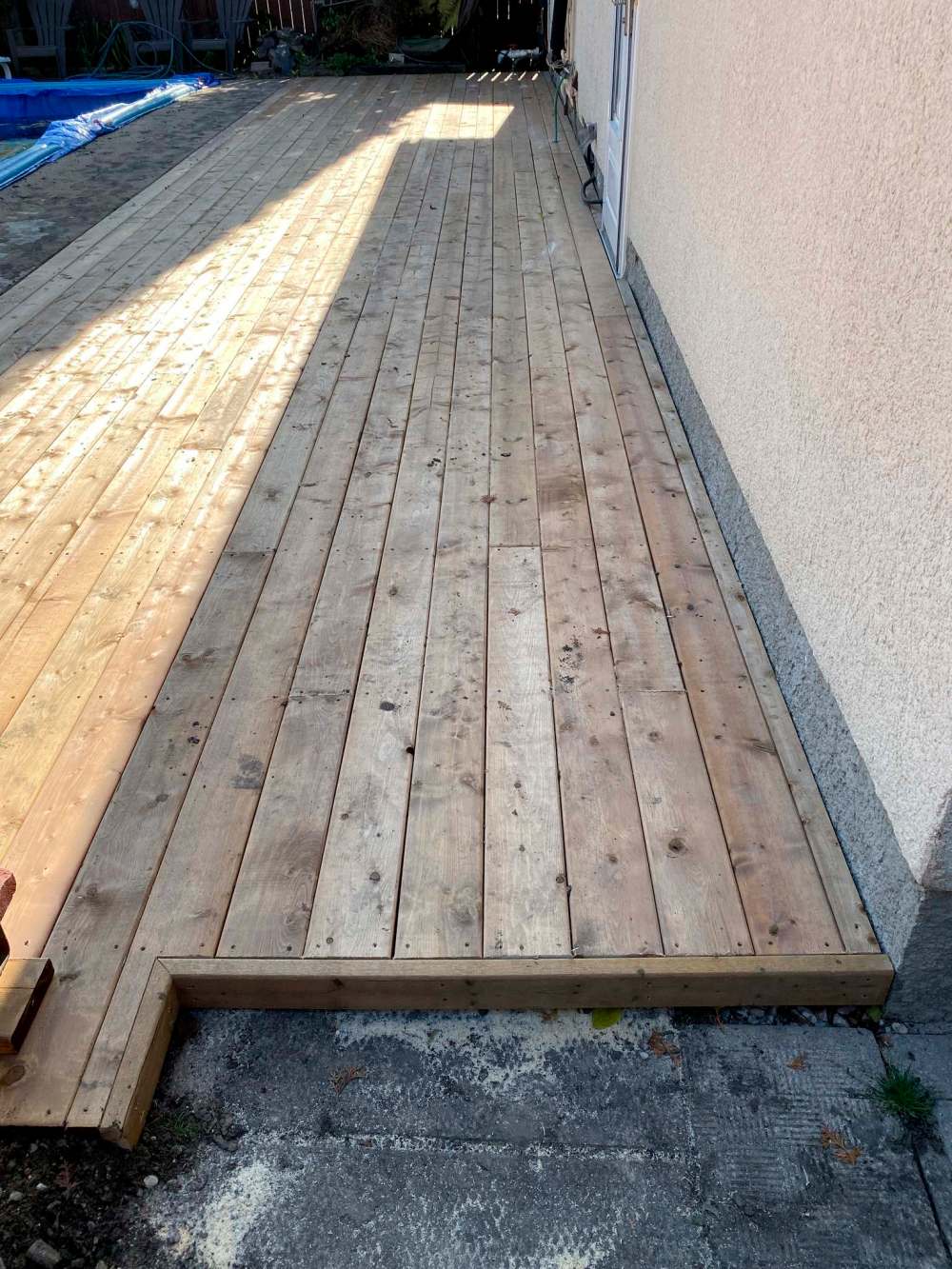
With the framework completed, the top-decking could begin.
Starting from the concrete pool edge, 2×6 boards at 12-foot lengths were used to finish the top.
The boards were staggered in a random placement to avoid patterned seams.
Once the top installation process began to cover the old back door concrete landing, every top board was shimmed to ensure rigidity.
The final row of boards was ripped to match the inconsistent stucco edge of the house, and allocations were made to allow for an underground hose access to the outdoor tap. The only visible deck edge at the yard-entry side of the house was finished with fascia and all the boards were permanently secured into place. Amazingly (and luckily), the entire deck was level from front to back, as well as side to side.
It was a testament to whomever performed the initial levelling process when the in-ground pool was first installed.
For the majority of low-level decks, creating troughs for every joist is not necessary.
The framework is built and set on blocks or pads and the top-decking is applied.
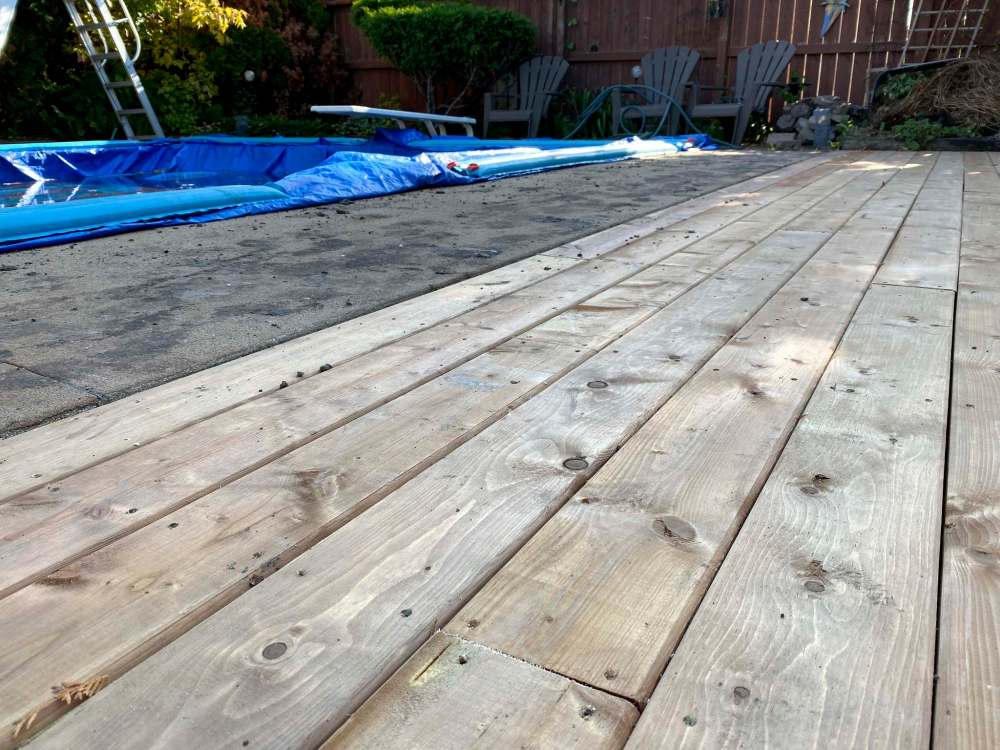
This deck project had exact elevation limitations — the only way to meet these constraints in keeping with a rigid sub-structure was to embed the joists below the ground’s surface.
Good thing I brought a shovel, and thankfully, the weather behaved during the entire build.
The end result speaks for itself.
BossEnterprise@outlook.com