

Carnivorous plants eating their way into our hearts
This Halloween introduce kids to the scariest things growing

Advertisement
Read this article for free:
or
Already have an account? Log in here »
To continue reading, please subscribe:

Digital Subscription
One year of digital access for only $205*
- Enjoy unlimited reading on winnipegfreepress.com
- Read the E-Edition, our digital replica newspaper
- Access News Break, our award-winning app
- Play interactive puzzles
*First annual payment billed as $205.00 + GST for one year. This annual subscription will automatically renew at $233.00 + GST every 52 weeks (10% off the regular annual price of $259.35). Offer available to new and qualified returning subscribers only. Cancel any time.
To continue reading, please subscribe:
Add Free Press access to your Brandon Sun subscription for only an additional
$1 for the first 4 weeks*
- Enjoy unlimited reading on winnipegfreepress.com
- Read the E-Edition, our digital replica newspaper
- Access News Break, our award-winning app
- Play interactive puzzles
*Your next Brandon Sun subscription payment will increase by $1.00 and you will be charged $17.95 plus GST for four weeks. After four weeks, your payment will increase to $24.95 plus GST every four weeks.
Read unlimited articles for free today:
or
Already have an account? Log in here »
Hey there, time traveller!
This article was published 31/10/2020 (2161 days ago), so information in it may no longer be current.
As a young child I grew up on the thrilling and sometimes chilling stories from Grimm’s Fairy Tales, The Arabian Nights and Greek myths. The weird and wonderful characters in these stories have fuelled the imagination of children for generations. Halloween, too, is a childhood tradition filled with spine-tingling stories and spooky characters except that in a pandemic, the fear factor takes on a whole new dimension.
This Halloween, why not introduce the kids in your life to the weirdest plants in the world: carnivorous plants. Carnivorous means meat-eating or flesh-eating. There are nearly 700 species of carnivorous plants in the world, each with its own set of colourful and spine-tingling characters. Carnivorous plants are not exactly meat-eating but there are tropical varieties that trap small types of animals while other carnivorous species make short work of insects that fall into their traps with little chance of escape.
The world of carnivorous plants has all the elements of mystery, intrigue, suspense, and even frightfully delicious horror. Growing your own carnivorous plants at home offers insight into our natural world and the importance of conservation. Introducing children — or adults — to carnivorous plants is also a lesson in plant biology, says Dr. Carla Zelmer, greenhouse manager for the Department of Biological Sciences, University of Manitoba. Zelmer grows several different species of carnivorous plants at Buller Greenhouse and at her Winnipeg home.
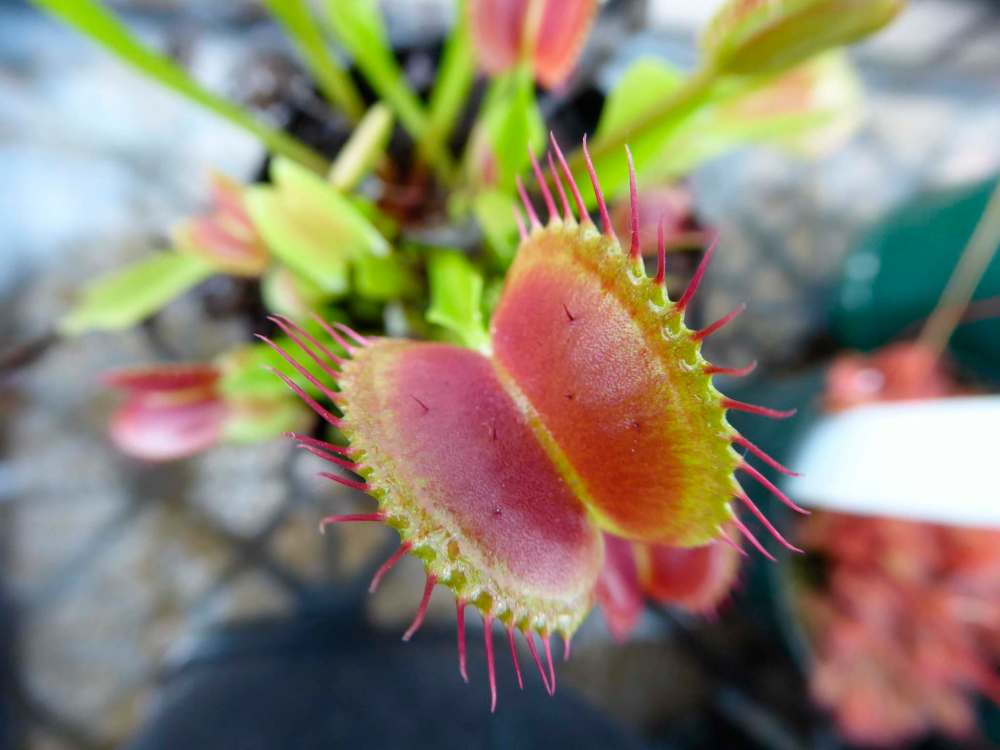
“Carnivorous plants have hairlike structures called trichomes which they use to either capture prey or retain prey,” says Zelmer. Examples of trichomes include the trigger hairs in the Venus fly trap on each half of its inner trap surface or the downward facing hairs in Sarracenia purpurea (commonly known as the purple pitcher plant) that prevents flies from flying out of its trap once caught. Drosera sundews are covered with trichomes that exude a sticky substance. “Some sundews are really tiny but have specialized snap hairs on the outer rim that react very quickly, flinging small prey into the centre of the leaf and onto the adhesive hairs,” says Zelmer.
A new shipment of carnivorous plants that includes two different types of Venus fly trap, Nepenthes tropical pitcher plant hybrids and Sarracenia North American pitcher plant hybrids recently arrived at Shelmerdine Garden Centre.
The Venus fly trap is perhaps the most easily identified carnivorous plant, in part because it is one of the few carnivorous species available at garden centres and sometimes even grocery stores. Charles Darwin was said to be immediately fascinated by the Dionaea muscipula Venus fly trap when he first encountered it. He called it the most wonderful plant in the world. According to Plant Names Simplified by A.T. Johnson, H.A. Smith, and A.P. Stockdale (5m Publishing, 2019), Venus fly trap’s genus name Dionaea comes from the Greek word Dione, the mother of Aphrodite. The species name, muscipula, means fly-catching.
Venus fly trap is native to only a small area of southeastern North Carolina and northeastern South Carolina, specifically the grassy wetlands that occur within a 160-km radius of Cape Fear.
The natural habitat of Venus fly trap is very humid and bright, says Zelmer. When Venus fly trap is grown as a houseplant, it requires bright light. Use supplemental or artificial lighting. Placing Venus fly traps on a windowsill will not provide it with adequate light.

“In many cases, carnivorous plants are temperate plants,” says Zelmer. In the Carolinas where Venus fly traps grow naturally, the environment is very moist and humid and quite hot in the summertime. During the summer months, Zelmer has grown Venus fly traps very successfully in pots with drainage holes at the bottom which she sets inside trays that have a small but consistent amount of water in the bottom (about six to seven mm of water). An extra-deep saucer would work well for a single potted plant. It is best to use distilled water but not spring water, says Zelmer.
Often on social media there are images of Venus fly traps growing in terrariums, however, these plants need some changes to their environment during the wintertime. “Venus fly traps go dormant and need a cooler or drier season,” says Zelmer. A shorter period of exposure to light as well as cooler indoor temperatures is crucial to growing Venus fly trap indoors. Zelmer maintains her Venus fly trap plants in the covered tray that she grows them in but allows for conditions that are cooler and drier. In spring, Venus fly traps start to grow vigorously once again.
Manitoba’s wetlands include boggy swamps and fens which are home to as many as 10 species of carnivorous plants including Sarracenia purpurea purple pitcher plant, Drosera anglica sundews, Pinguicula butterworts, as well as Utricularia bladderworts. Who knew?
Swamps, bogs and fens are wet, nutrient-poor environments. Carnivorous plants have adapted to be able to obtain the vital nitrogen and other mineral nutrients they crave. Insects are a good source of nitrogen for carnivorous plants that grow in the wild. Many carnivorous plants produce digestive enzymes. Some rely on bacteria to break down prey.
So what should you feed your carnivorous plants at home? Check out your local pet shop for freeze dried insects such as bloodworms. Zelmer has also used fish food flakes. Dried products such as these must be rehydrated first. If you happen to have fruit flies or fungus gnats buzzing around indoors, carnivorous plants may catch them but prey capture in the indoor environment is a relatively rare event. The key point to remember, says Zelmer, is that carnivorous plants are not eating because they are hungry. They are only taking in animal material to use as a sort of mineral pill. Overfeeding is ill advised, says Zelmer.
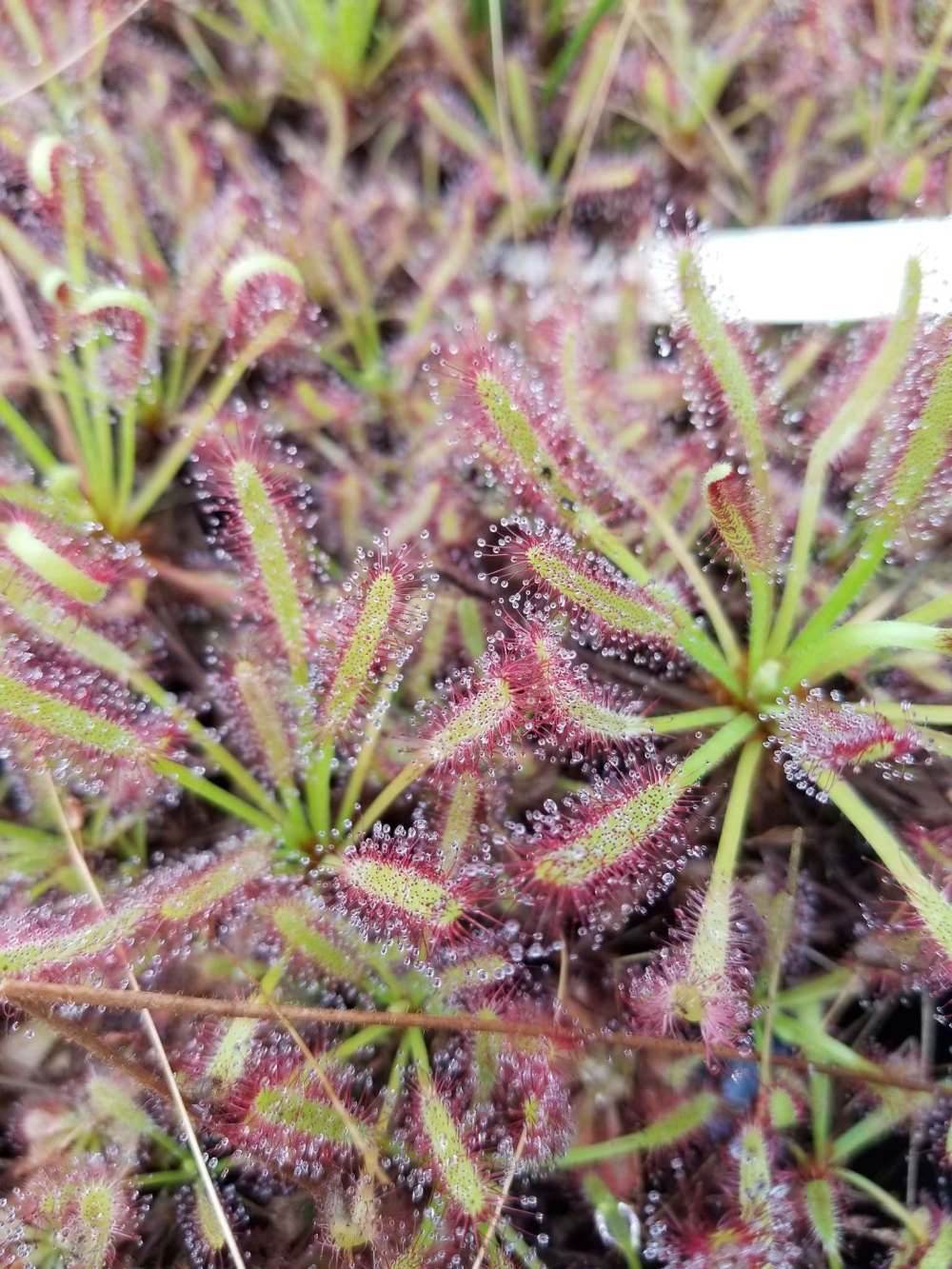

In their natural environments, carnivorous plants grow in wet, low nutrient soils. Indoors, do not use soil, says Zelmer. The International Carnivorous Plant Society is an excellent resource (carnivorousplants.org) with easy to access information about numerous carnivorous species, their natural habitat, and how to grow your own carnivorous plants at home, says Zelmer. The Savage Garden by Peter D’Amato (Ten Speed Press, 2013) is another great resource. It includes a recommended soil recipe for Venus fly traps: one part sand to one part peat. A fine-grade orchid bark can be used for growing Nepenthes pitcher plants.
The carnivorous plant collection at Buller Greenhouse includes spectacular Nepenthes hybrids, Sarracenia species and hybrids, Drosera sundews, butterwort, Venus flytraps, Cephalotus, Byblis, as well as other species. Many of the Drosera sundews, Byblis, and Sarracenia plants have been grown from seed.
There is much more for us to learn about carnivorous plants. Last year it was reported that scientists from the Algonquin Wildlife Research Centre at Ontario’s Algonquin Provincial Park discovered a carnivorous pitcher plant that consumes baby salamanders. Now the scientists are studying how the pitcher plants in the park attract the salamanders and how they break down inside the plants.
Next year, plan a field trip with your family to Brokenhead Wetland Ecological Reserve (just 65 km north of Winnipeg) to see carnivorous plants growing in their natural habitat.
colleenizacharias@gmail.com


Colleen Zacharias
Gardening columnist
Colleen Zacharias writes about many aspects of gardening including trends, plant recommendations, and how-to information that is uniquely relevant to Prairie gardeners. She has written a column for the Free Press since 2010 and pens the monthly newsletter Winnipeg Gardener. Read more about Colleen.
Every piece of reporting Colleen produces is reviewed by an editing team before it is posted online or published in print — part of the Free Press‘s tradition, since 1872, of producing reliable independent journalism. Read more about Free Press’s history and mandate, and learn how our newsroom operates.
Our newsroom depends on a growing audience of readers to power our journalism. If you are not a paid reader, please consider becoming a subscriber.
Our newsroom depends on its audience of readers to power our journalism. Thank you for your support.
Colleen Zacharias
Gardening columnist
Colleen Zacharias writes about many aspects of gardening including trends, plant recommendations, and how-to information that is uniquely relevant to Prairie gardeners. She has written a column for the Free Press since 2010 and pens the monthly newsletter Winnipeg Gardener. Read more about Colleen.
Every piece of reporting Colleen produces is reviewed by an editing team before it is posted online or published in print — part of the Free Press‘s tradition, since 1872, of producing reliable independent journalism. Read more about Free Press’s history and mandate, and learn how our newsroom operates.
Our newsroom depends on a growing audience of readers to power our journalism. If you are not a paid reader, please consider becoming a subscriber.
Our newsroom depends on its audience of readers to power our journalism. Thank you for your support.
Advertisement Advertise With Us
Advertisement Advertise With Us