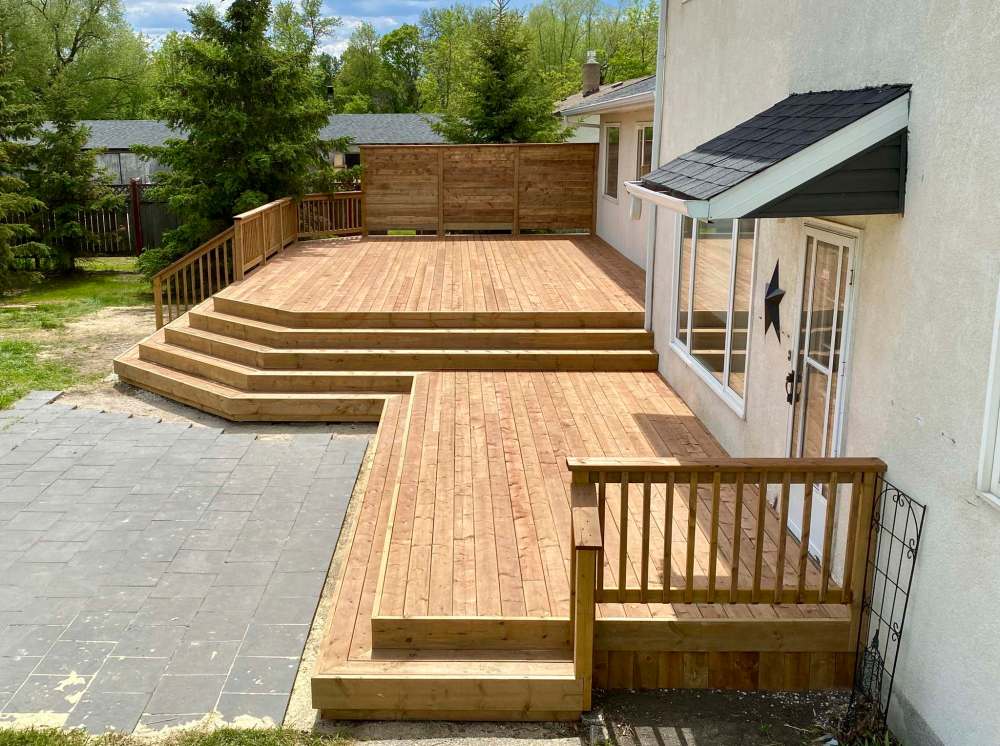
Deck brings a TIER (or two) to your eyes
Splendid split-level design complex and challenging
Advertisement
Read this article for free:
or
Already have an account? Log in here »
To continue reading, please subscribe:

Digital Subscription
One year of digital access for only $205*
- Enjoy unlimited reading on winnipegfreepress.com
- Read the E-Edition, our digital replica newspaper
- Access News Break, our award-winning app
- Play interactive puzzles
*First annual payment billed as $205.00 + GST for one year. This annual subscription will automatically renew at $233.00 + GST every 52 weeks (10% off the regular annual price of $259.35). Offer available to new and qualified returning subscribers only. Cancel any time.
To continue reading, please subscribe:
Add Free Press access to your Brandon Sun subscription for only an additional
$1 for the first 4 weeks*
- Enjoy unlimited reading on winnipegfreepress.com
- Read the E-Edition, our digital replica newspaper
- Access News Break, our award-winning app
- Play interactive puzzles
*Your next Brandon Sun subscription payment will increase by $1.00 and you will be charged $17.95 plus GST for four weeks. After four weeks, your payment will increase to $24.95 plus GST every four weeks.
Read unlimited articles for free today:
or
Already have an account? Log in here »
Hey there, time traveller!
This article was published 12/06/2021 (1915 days ago), so information in it may no longer be current.
A multi-tiered deck is often by design, with a homeowner simply wanting the deck sectioned into several different functional levels.
For a split-level home with exterior access at each level, however, a two-tiered deck is imperative if the deck stretches across both interior floor heights. Setting the elevations of each tier then becomes crucial, as it requires careful measurements to combine proper access, while maintaining stair rise consistency in an aesthetic manner.
For stairs to feel natural and comfortable, the rise of every stair should remain cohesive at all locations of the deck. Typically, the rise of a standard stair is roughly seven-and-a-quarter to seven-and-a-half inches high. The run however, tends to fluctuate depending on the style of stair being built. Although a nine-inch stair top is common, I tend to lean towards an 11-inch stair run, which allows for tandem 2×6 boards as the stair top covering.
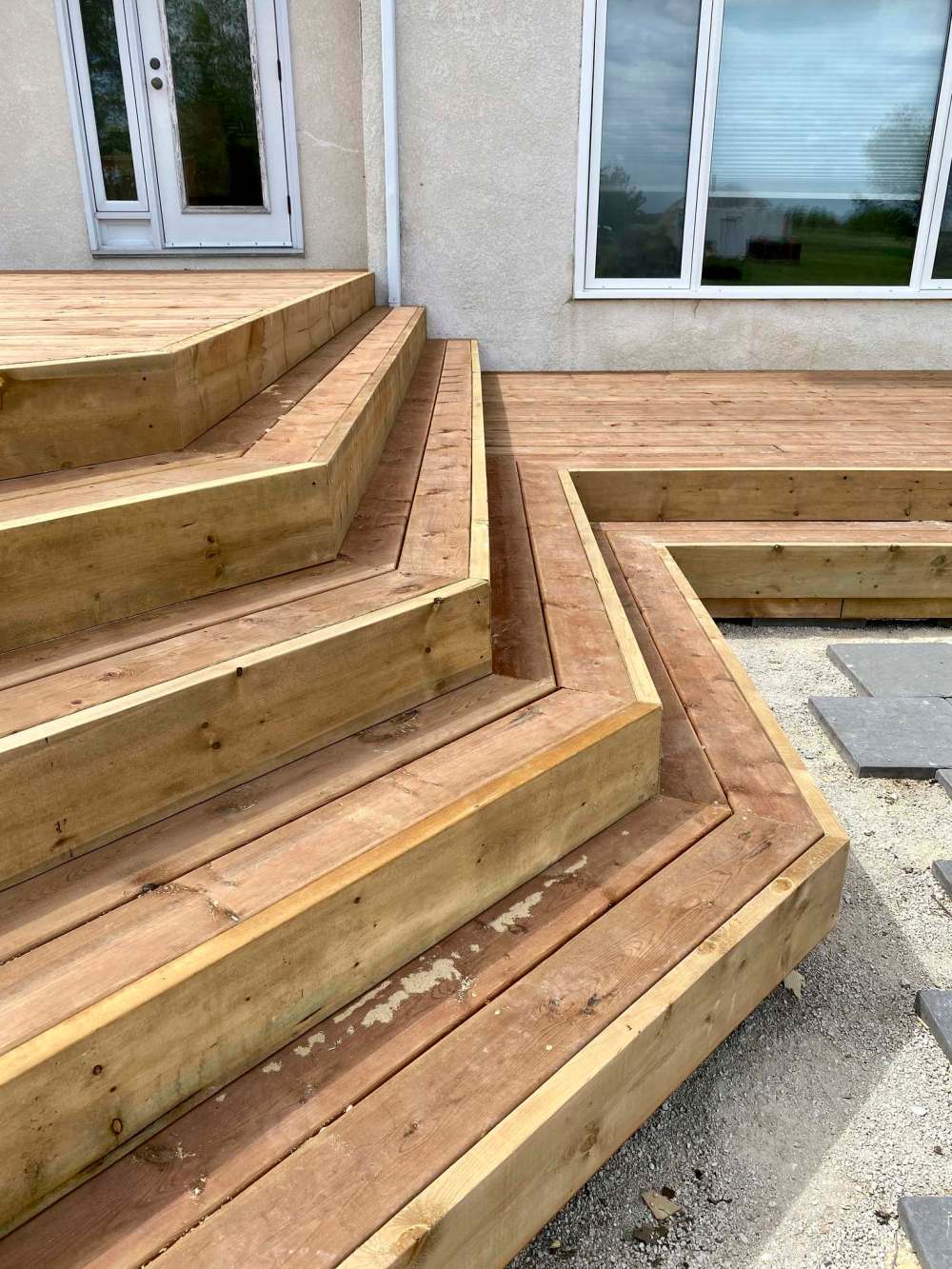
When applying practical building practices to a design, the framing will fall into place once the elevations are set. And although it may seem obvious, setting the elevation is most important, especially when multi-tiers also include dual access at different levels.
To establish the tier elevations at a recent monster of a deck build at just over 800 square-feet of top-decking, that includes intricate wrap stairs between both tiers that also allow access to the backyard at ground level, it is first necessary to determine the height of one tier relative to the door at that tier. In this instance, because the lower elevation was being constructed around an existing concrete step that would also serve as partial support, the framework was built so that the top of the joists rest two-inches below the door threshold, a half inch of clearance once the top-decking is installed.
The ledger board along the house was installed to meet that specification. Rather than install the joists along the low tier, the next step entails a measurement to establish the upper tier that both meets consistency of stair rise in multiples of seven-and-a-quarter inches, to a height that best suits the access door at the upper tier. Once the measurements were carefully conducted, it was determined that two stairs to the upper tier places the upper ledger board at just under four inches below the high door threshold, two-and-a-half inches once the top decking is installed.
With the chosen lower elevation, which subsequently establishes the upper tier height, exactly one stair rise below the lower tier height allowed for nearly the perfect height of a stair rise to ground level. Although it was suggested to the client that the existing patio blocks could be lifted, and the base be re-leveled an inch higher (to allow the first stair rise from ground-level to match the heights of the stairs throughout), an inch of discrepancy would not be noticed when accessing the deck from the yard, and visa versa.
With all of these set elevations in place, the upper 20-foot-deep and 30-foot-wide tier was fully framed, before completing the lower tier’s framework. The multiple and various sizes of stair stringers were all measured and cut on site using 2×12 treated lumber. Once installed and properly supported, the tandem parallel 2×6 stair tops were mitered and secured at every level, and both tiers then received the top-decking throughout. Subsequent steps included notching and affixing all the 4×4 posts for the areas of railing and privacy wall, completing the 2×4 upper and lower supports for the 2×2 wooden balusters, cutting and installing the horizontally placed 1×6 fence boards as privacy panels, not to mention mitering and affixing all 2×8 fascia along the fronts of top tier deck perimeter, as well as all stairs throughout. Finally, the remaining fence boards were installed vertically along the open areas below the upper tier perimeter, while introducing a small door below the privacy wall for access below the upper deck.
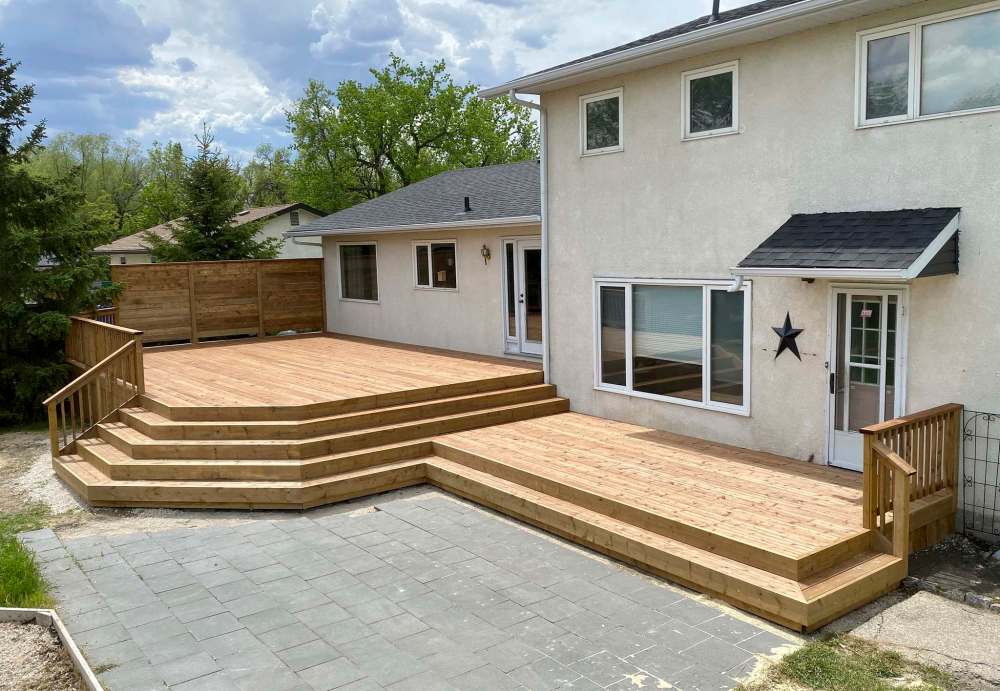
Despite the complexities with this particular deck build, the entire project rolled along quite well once the calculations regarding elevations were determined and confirmed with the existing door heights. Start to finish, the deck was completed mid-way through the sixth-day of building. Familiarization with the deck design well in advance is key. However, until that first day on site, it’s sometimes hard to predict whether things will go as planned. In this case, the math was on my side allowing this beast of a deck to come to life.
BossEnterprise@outlook.com