

And the survey says…
Study focuses on where engineering and geoscientific community is at in dealing with climate change
Advertisement
Read this article for free:
or
Already have an account? Log in here »
To continue reading, please subscribe:

Digital Subscription
One year of digital access for only $205*
- Enjoy unlimited reading on winnipegfreepress.com
- Read the E-Edition, our digital replica newspaper
- Access News Break, our award-winning app
- Play interactive puzzles
*First annual payment billed as $205.00 + GST for one year. This annual subscription will automatically renew at $233.00 + GST every 52 weeks (10% off the regular annual price of $259.35). Offer available to new and qualified returning subscribers only. Cancel any time.
To continue reading, please subscribe:
Add Free Press access to your Brandon Sun subscription for only an additional
$1 for the first 4 weeks*
- Enjoy unlimited reading on winnipegfreepress.com
- Read the E-Edition, our digital replica newspaper
- Access News Break, our award-winning app
- Play interactive puzzles
*Your next Brandon Sun subscription payment will increase by $1.00 and you will be charged $17.95 plus GST for four weeks. After four weeks, your payment will increase to $24.95 plus GST every four weeks.
Read unlimited articles for free today:
or
Already have an account? Log in here »
Hey there, time traveller!
This article was published 20/04/2022 (1638 days ago), so information in it may no longer be current.
This article was curated by editors from the Free Press advertising department.
About three years ago, the federal government launched a new initiative designed to equip provinces and territories with the ability to better deal with the constantly evolving challenges associated with climate change.
The Building Regional Adaptation Capacity and Expertise initiative, or BRACE, was aimed at building the capacity of professionals (primarily engineers and planners) as well as Indigenous organizations and business communities in northern Manitoba to identify and address the risks associated with climate change.
Suffice it to say, it was hard to know where to start. Such an ambitious initiative had never been undertaken before. Project outlines were produced to illustrate what the project would look like, and a request for proposals was to be sent out to select the organizations that would deliver training to participants.
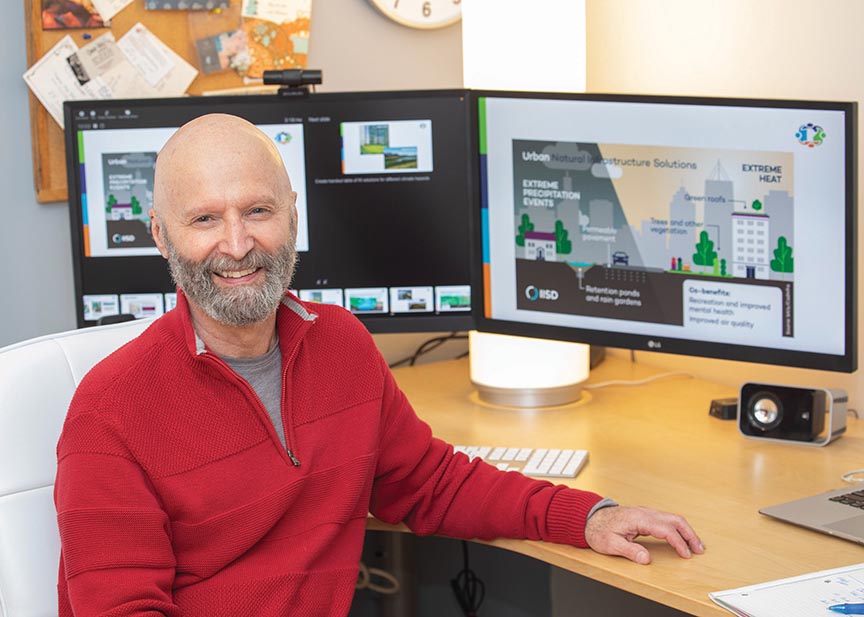
Then, in early 2021, Engineers Geoscientists Manitoba commissioned Winnipeg-based Probe Research to conduct a survey. Simply put, it was focused on identifying where practitioners were at in dealing with climate change, and what tools would be needed to better deal with it as they moved forward in designing infrastructure and systems that would be affected by the anticipated intensification of climate change.
“The survey provided a good benchmark of where they were at in adapting to changing weather patterns, and how much they were embedding it into their day-to-day work,” says Probe’s Mary Agnes Welch, lead researcher on the survey. “It showed they were already doing it but needed to do it a bit more.”
As it turned out, the timing of the survey couldn’t have been better.
“Because it was done about a year ago, it was done even before we went through the drought in the summer of 2021, and the hard winter we’re now going through,” she adds.
Not surprisingly, the survey also indicated that while Manitoba’s engineers and geoscientists were largely familiar with the effects of climate change in the province, they were interested in getting more training.
“More than one-half were especially interested in learning more about new codes and standards and sustainability infrastructure,” Welch notes. “They said they needed to know more so they could fill in the gaps.”
BRACE in Manitoba is called Manitoba’s Climate Resilience Training (MCRT). Curt Hull, a professional engineer, is project manager for the infrastructure section of that project. He says the survey was very useful.
“We got just over 1,000 responses out of 8,500 survey recipients,” he says. “Respondents said they wanted to learn more about how climate change affects their practice. That information was used to identify training provided in the MCRT.”
Hull says that this phase of training delivery focused primarily on climate risk assessment and adaptation strategies.
“We’re looking at the potential impacts of climate change on projects with respect to aspects such as rainfall, temperatures and wind,” he says. “How will those factors affect the design of a bridge or sewer? We’re looking to develop tools to anticipate those effects.”
Or, in this case, update practices so they can be better applied to modern design challenges.
“For example, we used to rely on historical records to try and anticipate the effect of climate on different infrastructure projects,” Hull explains. “However, we now realize that what happened in 1950 doesn’t apply any more. We need to use predictive climate modeling as well as historical data. And those numbers will need to be continually adjusted as we move forward.”
Those adjustments will be critical as the impact of climate change increases in the coming years.

“Take the Coquihalla Highway failure in B.C. as an example. The climate events there were more severe than anticipated with the atmospheric river that dumped all the rain on the area,” Hull says. “It’s important that we consider ways to control flows that exceed design limits, or even to design safe failure mechanisms.”
In a nutshell, that’s what BRACE is all about.
“This phase of BRACE is all about adaptation,” he says. “But our practitioners are also asking us about ways to mitigate greenhouse gas emissions. That’s largely an energy problem. We need to find ways to heat buildings and move cars without using fossil fuels.”
Fortunately, there’s good news on that front.
“Some practitioners have been quantifying if this can be done, and the results of studies I’ve seen have been promising,” he says. “We’ll need to prepare the infrastructure (to be) more electric, particularly more vehicle charging stations and more geothermal. To meet the challenge, Hydro estimates it will need to double the amount of power that’s currently available. On that front, we’re looking to Manitoba Hydro to plan for new generation and enhance the distribution network.”
Meanwhile, other initiatives such as enhanced insulation of structures (from buildings to homes), passive heating (using solar walls to capture heat from sunlight) and geothermal heating and cooling are also viable options.
“At some point in the future, we likely need to have district heating systems with geothermal wells under laneways, roadways, and athletic fields,” Hull says. “Geothermal will be huge, as will wind and solar power. They’re all clean, local, and cheap.”
Increasing our ability to adapt to climate change and use new technologies to reduce our impact on the climate is critical, he adds.
“Climate change is a huge challenge. It’s essential for us to show people a plan so we can have a better future.”