

Assessing the risk
Protocol helping to chart impact of climate change on public infrastructure
Advertisement
Read this article for free:
or
Already have an account? Log in here »
To continue reading, please subscribe:

Digital Subscription
One year of digital access for only $205*
- Enjoy unlimited reading on winnipegfreepress.com
- Read the E-Edition, our digital replica newspaper
- Access News Break, our award-winning app
- Play interactive puzzles
*First annual payment billed as $205.00 + GST for one year. This annual subscription will automatically renew at $233.00 + GST every 52 weeks (10% off the regular annual price of $259.35). Offer available to new and qualified returning subscribers only. Cancel any time.
To continue reading, please subscribe:
Add Free Press access to your Brandon Sun subscription for only an additional
$1 for the first 4 weeks*
- Enjoy unlimited reading on winnipegfreepress.com
- Read the E-Edition, our digital replica newspaper
- Access News Break, our award-winning app
- Play interactive puzzles
*Your next Brandon Sun subscription payment will increase by $1.00 and you will be charged $17.95 plus GST for four weeks. After four weeks, your payment will increase to $24.95 plus GST every four weeks.
Read unlimited articles for free today:
or
Already have an account? Log in here »
Hey there, time traveller!
This article was published 06/04/2022 (1643 days ago), so information in it may no longer be current.
This article was curated by editors from the Free Press advertising department.
Little did professional engineer Jeff O’Driscoll realize that when he was contracted to assess the risk to Portage La Prairie’s water resources infrastructure due to climate change back in 2007 that he would be laying the foundation for a new engineering protocol that would be used throughout the world.
O’Driscoll’s work on behalf of Engineers Canada has evolved to become the Public Infrastructure Engineering Vulnerability Committee (PIEVC) protocol, which assesses climate risk across a range of infrastructure systems including buildings, water systems, roads, electricity and airports.
“It was the early days of climate change and communities like Portage were innovative and wanted to meet the challenge,” says O’Driscoll, a member of Engineers Geoscientists Manitoba.
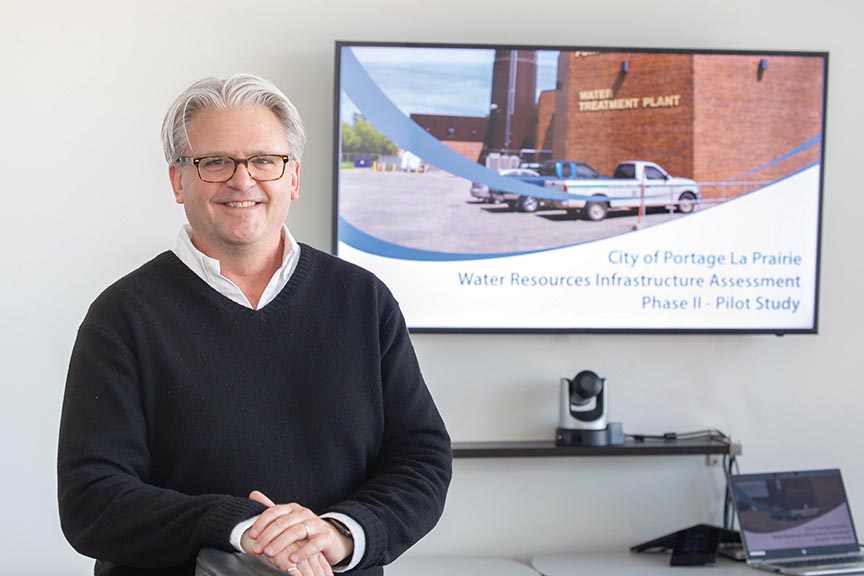
“There’s been a huge amount of development of this process over the years and the acceptance of it along the way from municipalities, provincial agencies, and federal government agencies. In those early days there were 10 or 15 assessments and now its in the hundreds. There’s also a variety of countries around the world where this protocol is being promoted and is a really useful step to understand climate risk for infrastructure.”
The concept began in the early 2000s when climate change was being discussed, but not to the extent that it is today. Engineers Canada created a committee to better understand the potential impacts of climate change on the country’s infrastructure.
The committee brought together stakeholders from across Canada to develop an initial protocol that needed to be tested. Portage La Prairie indicated that it was interested in participating in a pilot project to review their water systems and to mitigate risks due to climate change. A request for proposals was issued for an engineering firm to conduct the assessment and O’Driscoll was part of the successful bidding team.
“We had to build a model of what infrastructure is contained in the waterworks system and then identify the kind of climate hazards that might affect Portage,” says O’Driscoll, who is now Infrastructure Division Manager at Associated Engineering.
This assessment involved several elements of the system including the water treatment facility, water distribution throughout the city, water sources and control water structures, and how they would be impacted by climate hazards such as drought, floods and extreme heat.
“The actual project was about understanding their water system and then looking how climate impacts may affect that. When we talk about climate change, we are not just talking about the current climate, but we also need to look into the future and project ahead for 50, 80 or 100 years, and what the future climate will look like,” O’Driscoll says.
He adds that as the climate changes, there is a greater degree of extreme weather events, such as ice storms and flooding. Engineers must work closely with climate scientists to determine how vulnerable infrastructure will become and develop ways for this infrastructure to become more resilient.
“This is really the process of looking at what infrastructure you have and what kind of climate information you have and then going through a risk assessment process of how these interactions change,” he explains. “Once you identify these risks, you must then plan to mitigate those risks, whether its in the infrastructure or how you operate it, so you can envision the future upgrades to the facility.”

The initial protocol developed after the Portage project has been reviewed and applied to a wider range of infrastructure including bridges, roads, as well as parks and naturalized areas. It has been used on many federally-funded infrastructure projects and aligns with ISO (International Organization for Standardization) frameworks. Closer to home, the protocol has been applied to other Manitoba projects including to assist in government funding support. The Manitoba Climate Resilience Training Project recently featured a protocol training course that can be accessed on from its website.
As climate change becomes a more pressing issue, O’Driscoll says the protocol will continue to be modified and changed to reflect how we are becoming more integrated in how we plan, design and manage our infrastructure. The most recent modification to the process was a high-level screening guide, which is an approach for undertaking vulnerability, risk and resilience assessments. It can be applied to full assets or systems or to a single infrastructure element.
Although climate change may impact various parts of the world in different ways and infrastructure may vary from place to place, O’Driscoll says that protocol can still be applied to projects no matter where they are located. The key is for engineers to understand their local infrastructure and climate, so they can apply the protocol to their situations.
“I’m really excited to be part of this process and having helped to develop this tool to build our resiliency,” he says. “There have been many people involved in this process and there’s many people who can now use this process. I’m also excited that we, as a profession, can do this better and apply it more widely. It’s exciting in terms of our abilities to understand our risks. If we don’t understand our risks, then we can’t take actions to be more resilient.”
The Public Infrastructure Engineering Vulnerability Committee protocol can be used by anyone in any location.