

All fingers crossed for baby ‘roo
Zoo staff care for helpless youngster
Advertisement
Read this article for free:
or
Already have an account? Log in here »
To continue reading, please subscribe:

Digital Subscription
One year of digital access for only $205*
- Enjoy unlimited reading on winnipegfreepress.com
- Read the E-Edition, our digital replica newspaper
- Access News Break, our award-winning app
- Play interactive puzzles
*First annual payment billed as $205.00 + GST for one year. This annual subscription will automatically renew at $233.00 + GST every 52 weeks (10% off the regular annual price of $259.35). Offer available to new and qualified returning subscribers only. Cancel any time.
To continue reading, please subscribe:
Add Free Press access to your Brandon Sun subscription for only an additional
$1 for the first 4 weeks*
- Enjoy unlimited reading on winnipegfreepress.com
- Read the E-Edition, our digital replica newspaper
- Access News Break, our award-winning app
- Play interactive puzzles
*Your next Brandon Sun subscription payment will increase by $1.00 and you will be charged $17.95 plus GST for four weeks. After four weeks, your payment will increase to $24.95 plus GST every four weeks.
Read unlimited articles for free today:
or
Already have an account? Log in here »
Hey there, time traveller!
This article was published 16/05/2009 (6267 days ago), so information in it may no longer be current.
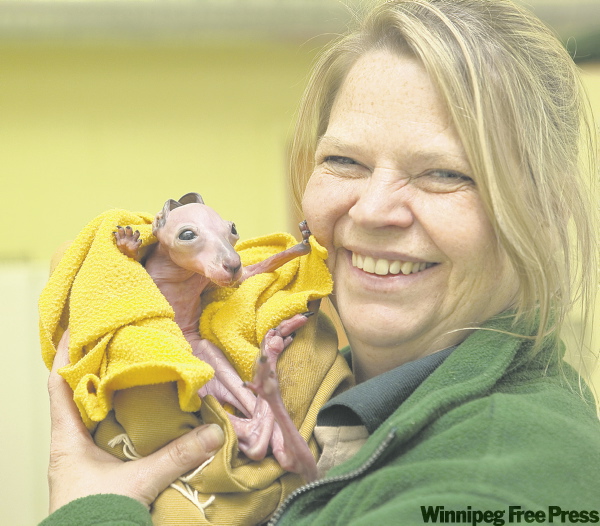
Staff at the Assiniboine Park Zoo in Winnipeg are hopping to keep a baby red kangaroo alive after it was expelled from its mother’s pouch.
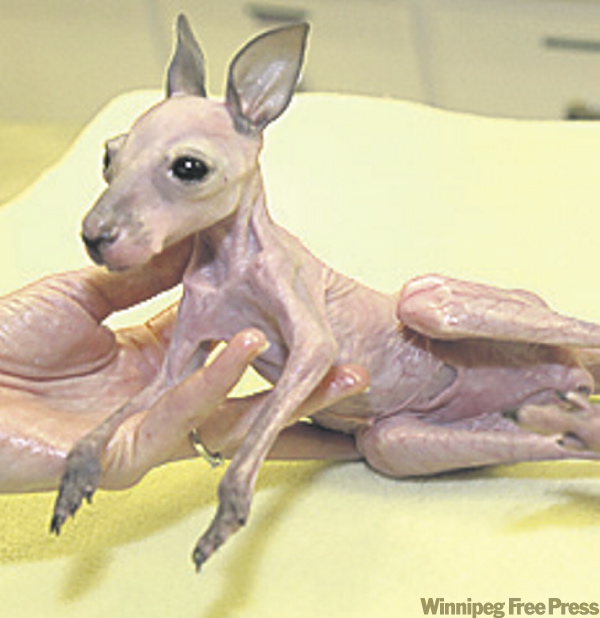
The four-month-old female weighed only 560 grams when it was found lying helpless on the floor of the kangaroo enclosure a few days ago.
"As far as the veterinarian could discern, something probably spooked one of the kangaroos… and this is typical when something scares them like that in the wild," zoo curator Robert Wrigley said. "They’ll eject the joey from the pouch."
Wrigley said it’s a natural adaptation to ensure survival of the mother.
"They can lighten their load and run faster and escape a predator, or the predator may stop and devour the baby and then the mother gets away."
Wrigley said that’s important because she’s probably got two other babies developing in her or is caring for larger joeys that have left the pouch. But he wasn’t sure whether the body somehow expels the joey or the mother removes it herself.
Even if the baby ‘roos don’t become a predator’s lunch, they seldom survive outside the pouch at such a young age because they depend on their mother’s milk inside for up to a year. It’s also difficult to feed them from a bottle because their mouths are so tiny.
Zoo workers have been feeding this baby, which they’ve named Rooby, formula every three hours to improve its chances — and it seems to be working.
"This one seems to be drinking very well and after about four days now it’s putting on some weight, which is a very good sign."
The zoo’s veterinarian said there’s every reason to expect Rooby will keep improving.
She spends most of the time sleeping in a soft towel in a cloth bag to mimic her mother’s pouch.
If Rooby survives, she will still need care for another eight months before she can be reunited with her kangaroo family.
"I’m just hoping that she’ll be accepted back into the group. Sometimes trying to reintroduce animals is a fairly challenging thing," Wrigley said.
"But kangaroos are usually pretty sociable, so I think it’ll be OK."
The red kangaroo, native to most of Australia, is the world’s largest marsupial. Males can stand just over two metres tall and can reach a weight of 95 kilograms.
A female can breed continuously under good habitat conditions. That means she may have one embryo in the womb, a joey in the pouch and another needing care outside the pouch.

Baby kangaroos are born after a gestation of only 33 days and are just 2.5 centimetres long and weigh less than a gram.
The blind and naked joey must climb from the mother’s birth canal to the abdominal pouch and crawl inside. As the joey grows and becomes more active, it gradually spends more and more time outside the pouch. It doesn’t leave its cosy home completely, however, until it is between seven and 10 months old.
Kangaroos, which hang out in groups called "mobs," may live up to 25 years.
— Canadian Press
Related Articles
Wolson plays starring role at Oliphant inquiry
Advertisement Advertise With Us
Advertisement Advertise With Us