

RCMP’s top dog in province wears the big brown boots
Advertisement
Read this article for free:
or
Already have an account? Log in here »
To continue reading, please subscribe:

Digital Subscription
One year of digital access for only $205*
- Enjoy unlimited reading on winnipegfreepress.com
- Read the E-Edition, our digital replica newspaper
- Access News Break, our award-winning app
- Play interactive puzzles
*First annual payment billed as $205.00 + GST for one year. This annual subscription will automatically renew at $233.00 + GST every 52 weeks (10% off the regular annual price of $259.35). Offer available to new and qualified returning subscribers only. Cancel any time.
To continue reading, please subscribe:
Add Free Press access to your Brandon Sun subscription for only an additional
$1 for the first 4 weeks*
- Enjoy unlimited reading on winnipegfreepress.com
- Read the E-Edition, our digital replica newspaper
- Access News Break, our award-winning app
- Play interactive puzzles
*Your next Brandon Sun subscription payment will increase by $1.00 and you will be charged $17.95 plus GST for four weeks. After four weeks, your payment will increase to $24.95 plus GST every four weeks.
Read unlimited articles for free today:
or
Already have an account? Log in here »
Hey there, time traveller!
This article was published 04/07/2009 (6245 days ago), so information in it may no longer be current.
CLAIM TO FAME: His name might not ring the same bell as another Winnipeg police chief (ahem, Keith McCaskill), but Bill Robinson is the top dog of about 900 Manitoba Mounties who work in detachments from Emerson (300 metres north of the U.S. border) to 1,000 kilometres north of Winnipeg in Churchill.
When the Royal Canadian Mounted Police are put in the hot seat, this man is where the buck stops in Manitoba. In May, the 51-year-old marked the end of his first year in the job as D Division commanding officer.
WHY HE SAID NO TO THE BANKER’S LIFE: Robinson grew up in the tiny town of Swan River, about 500 kilometres northwest of Winnipeg. He joined the RCMP at 20 after a year working as a teller for Toronto Dominion Bank in Saskatchewan.
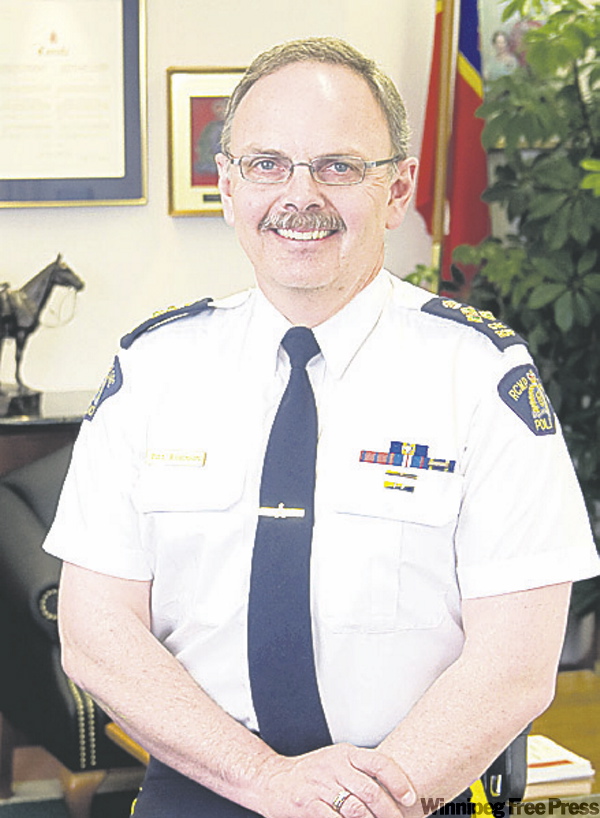
Growing up in a small Manitoba farming community, Robinson remembers the high boots, brown khaki shirts and riding breeches Mounties wore.
“We were from a small town, so of course (the Mounties) were the cornerstone of the community. … When you saw them coming down the street, everybody was in awe of them,” he said. “I wanted a big pair of brown boots too.”
WHY HE RELATES TO NEWBIE MOUNTIES: Robinson spent his first 18 years in the force working in detachments in Alberta and the Yukon, before heading off to Eastern Canada. Those duties ranged from traffic (“highway patrolmen are a special breed”) to major crimes, which he classifies as the toughest psychologically.
Robinson said one of his more unusual postings was in the early 1980s in Fort Chipewyan, Alberta, a former trading post and remote First Nation about 1,000 kilometres northeast of Calgary.
Married Mounties had homes next to the detachment. Unmarried officers slept in rooms off the detachment’s main office where “privacy was at a premium.”
“In the morning, people would wander out to do paperwork with their hair standing up and sleep in their eyes,” Robinson said.
Life in the traditional fishing community of 800 people was centred around the leadership of aboriginal elders, he said.
Robinson said postings in remote communities require family support.
“My wife was the typical northern Mountie’s wife,” he said.
“She would answer complaints at the front door and guide people around the community. … Without the support of your spouse in isolated communities, and in all communities, quite frankly, it’s a hard road.”
HOW MOUNTIES GET A CRASH COURSE IN POLICING: Robinson’s first posting was in Fort McMurray in the early 1980s.
“Fort McMurray in those days was a very happening place. The oil industry was ramping up. There was so much to learn so quickly,” he said. “The challenges that our young people face today with heavy workloads are much the same as what I faced back then. You learn to be a policeman so quickly because you experienced everything right through from traffic work to assaults and sudden deaths and break-ins. It would just come at you continually.”
He said being thrown into the deep end helped him get up to speed.

“I found within two or three years service in Fort McMurray, I probably had the experience of a 10-year member in some smaller spots that weren’t so busy because the workloads were so heavy,” he said.
“I think that’s the strength of the RCMP, is that you get that experience, that broad base of experience very early in your service.”
ON BRINGING THE FAMILY TO WORK: Robinson has two sons in their 20s, both of whom work for the RCMP.
“They grew up in the RCMP,” he said.
— Gabrielle Giroday