

Rescuing the forest, one tree at a time
Assiniboine Park undergoes crucial makeover
Advertisement
Read this article for free:
or
Already have an account? Log in here »
To continue reading, please subscribe:
Digital Subscription
One year of digital access for only $1.44 a week*
- Enjoy unlimited reading on winnipegfreepress.com
- Read the E-Edition, our digital replica newspaper
- Access News Break, our award-winning app
- Play interactive puzzles
*Billed as $5.77 plus GST every four weeks. After 52 weeks, price increases to the regular rate of $19.95 plus GST every four weeks. Offer available to new and qualified returning subscribers only. Cancel any time.
To continue reading, please subscribe:
Add Free Press access to your Brandon Sun subscription for only an additional
$1 for the first 4 weeks*
- Enjoy unlimited reading on winnipegfreepress.com
- Read the E-Edition, our digital replica newspaper
- Access News Break, our award-winning app
- Play interactive puzzles
*Your next Brandon Sun subscription payment will increase by $1.00 and you will be charged $17.95 plus GST for four weeks. After four weeks, your payment will increase to $24.95 plus GST every four weeks.
Read unlimited articles for free today:
or
Already have an account? Log in here »
Hey there, time traveller!
This article was published 06/07/2009 (6181 days ago), so information in it may no longer be current.
A few years ago, the stretch of forest along the river in Assiniboine Park was full of monkey trails from cyclists and overgrown with a stubborn, invasive shrub.
There was “a total lack of understory,” said Kristin Tuchscherer, education co-ordinator of creeks and streams for the City of Winnipeg, referring to the seedlings and other vegetation that grow under the forest canopy. But after planting 5,500 trees over the past three years and digging out thousands of invasive seedlings, Tuchscherer said the riverbank ‘riparian’ forest is regaining its health.
“Now we’re seeing a generation of native understory species where there wasn’t anything.”
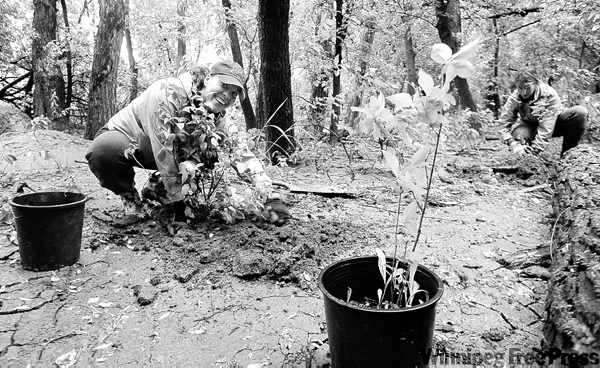
The Assiniboine Park Riparian Forest Project kicked off in 2006 after officials realized the strip of forest hugging the river wasn’t in the best health. Riparian forest is important for erosion control. It provides what Tuchscherer describes as an “oasis feeling” when visitors cross the footbridge into the park.
“When you’re in the park, you’re not in the city,” she said. Without the forest, “that buffer would be gone.”
The project also targets the spread of the European buckthorn, an invasive species introduced in the late 1800s as a hedge row and used in the early 20th century for shelterbelts. The buckthorn is “really prolific,” said Tuchscherer, and easily edges out native maple or ash trees.

Last month, students and volunteers spent time in the park, planting native species and digging up European buckthorn seedlings and small trees. They’ve unearthed thousands since efforts to get rid of the buckthorn started more than a decade ago.
“It’ll probably never be eradicated,” Tuchscherer said. “It’s more of choosing areas that have a possibility of restoration, and ones that are maybe a little more important in terms of biodiversity.”
The project is funded through grants and in-kind support worth about $50,000 per year. Summer students plant a range of species, including Manitoba maples, green ash, chokecherries and saskatoons.
“If we don’t do something about this now, what sort of forest will we have 20 years from now?” she said.
lindsey.wiebe@freepress.mb.ca