

We should eat crow for bird-brain insult
Researchers discover creatures are clever
Advertisement
Read this article for free:
or
Already have an account? Log in here »
To continue reading, please subscribe:
Digital Subscription
One year of digital access for only $75*
- Enjoy unlimited reading on winnipegfreepress.com
- Read the E-Edition, our digital replica newspaper
- Access News Break, our award-winning app
- Play interactive puzzles
*Billed as $5.77 plus GST every four weeks. After 52 weeks, price increases to the regular rate of $19.95 plus GST every four weeks. Offer available to new and qualified returning subscribers only. Cancel any time.
Monthly Digital Subscription
$4.99/week*
- Enjoy unlimited reading on winnipegfreepress.com
- Read the E-Edition, our digital replica newspaper
- Access News Break, our award-winning app
- Play interactive puzzles
*Billed as $19.95 plus GST every four weeks. Cancel any time.
To continue reading, please subscribe:
Add Free Press access to your Brandon Sun subscription for only an additional
$1 for the first 4 weeks*
- Enjoy unlimited reading on winnipegfreepress.com
- Read the E-Edition, our digital replica newspaper
- Access News Break, our award-winning app
- Play interactive puzzles
*Your next Brandon Sun subscription payment will increase by $1.00 and you will be charged $17.95 plus GST for four weeks. After four weeks, your payment will increase to $24.95 plus GST every four weeks.
Read unlimited articles for free today:
or
Already have an account? Log in here »
Hey there, time traveller!
This article was published 05/08/2009 (6138 days ago), so information in it may no longer be current.
It’s long been considered an insult to call a person a “bird-brain.” But experiments with one species of crow suggest that referring to someone this way might actually be a compliment.
Experiments by researchers at Oxford University show that New Caledonian crows in captivity spontaneously used up to three tools in the correct sequence to achieve a goal — a feat never before seen in non-human animals without explicit training.
Five out of seven birds tested figured out how to extract different lengths of sticks from tubes so they could ultimately get one long enough to fish out a morsel of food at the bottom of the deepest tube.
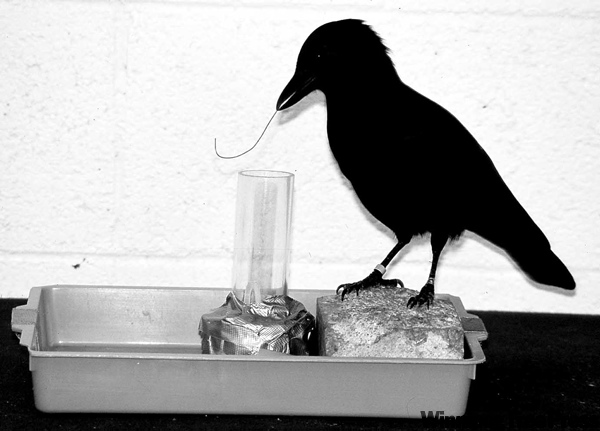
In all, the crows needed three sticks of different lengths to achieve their objective of reaching the food — and four of the five successful birds came up with the sequence needed on the first try.
“It is amazing to see. It was wonderful to watch,” said zoologist Jo Wimpenny, lead researcher of a paper on the experiments published in this week’s issue of PLoS One.
“They use tools naturally in the wild,” she said of the crows (Corvus moneduloides), which populate the New Caledonia and Loyalty islands off the east coast of Australia in the south Pacific. “All members of this particular species make and use tools, and they do so to probe for larvae and grubs and things in rotten wood.”
Wimpenny said the Behavioural Ecology Research Group at Oxford decided to set up an experiment using a number of New Caledonian crows after observing one of the birds, named Betty, fashion a tool to get at some food.
“She was quite famous a few years ago because she spontaneously bent some wire to make a hook,” Wimpenny said. “And in a different experiment, she was doing a task where she had to fit a tool through a little hole, and she managed to wedge a tool… and it was out of reach of her beak. So what she did was she used another tool to bring that tool back to her.”
“It prompted us to ask this question of whether they can actually use tools to retrieve other tools.”
In the experiment, food was placed at a tube depth that made it reachable with only one length of stick. But getting that stick required employing two others in sequence. The crows had to use a short available tool to drag in a longer out-of-reach tool, then use that lengthier tool to retrieve the correct longest one.
They could then use the longest stick to reach for the food stuck way down in a tube.
Chimpanzees and other non-human primates are known to make tools from branches to probe for termites in holes in tree trunks, and they have even been observed fashioning sharpened spears to kill smaller animals.
But using tools to make or retrieve other tools has long been considered a hallmark of human intelligence, and has often been interpreted as evidence of advanced cognitive abilities, such as planning and reasoning.
While the researchers concluded that the crows did not probe for sticks merely at random, they could find no evidence that their sequential tool use was a mark of reasoning or human-like planning.

“It seems that there might be something about this family of birds that is a little bit more similar to our own problem-solving abilities,” acknowledged Wimpenny. “But obviously much more needs to be done in terms of experiments.”
“So it’s hard to make truly comparative conclusions on this now.”
Based on research by her group and others, Wimpenny agreed that the term bird-brained “has definitely become quite outdated.”
“We’re going in the other direction now, because there are a lot of studies coming out showing what birds can do. Very sophisticated things.”
— The Canadian Press