

They are there because they’re needed
Volunteers help flu shot clinics run smoothly
Advertisement
Read this article for free:
or
Already have an account? Log in here »
To continue reading, please subscribe:

Digital Subscription
One year of digital access for only $205*
- Enjoy unlimited reading on winnipegfreepress.com
- Read the E-Edition, our digital replica newspaper
- Access News Break, our award-winning app
- Play interactive puzzles
*First annual payment billed as $205.00 + GST for one year. This annual subscription will automatically renew at $233.00 + GST every 52 weeks (10% off the regular annual price of $259.35). Offer available to new and qualified returning subscribers only. Cancel any time.
To continue reading, please subscribe:
Add Free Press access to your Brandon Sun subscription for only an additional
$1 for the first 4 weeks*
- Enjoy unlimited reading on winnipegfreepress.com
- Read the E-Edition, our digital replica newspaper
- Access News Break, our award-winning app
- Play interactive puzzles
*Your next Brandon Sun subscription payment will increase by $1.00 and you will be charged $17.95 plus GST for four weeks. After four weeks, your payment will increase to $24.95 plus GST every four weeks.
Read unlimited articles for free today:
or
Already have an account? Log in here »
Hey there, time traveller!
This article was published 21/11/2009 (6156 days ago), so information in it may no longer be current.
They are the unpaid front-line workers in the battle against a raging pandemic.
Many are seniors. Some are students. A handful are men. What they have in common is a drive to help others. It’s the same urge that flourishes when our city faces natural disasters, when people go hungry or charities need a boost.
Since the H1N1 clinics opened in October, the Winnipeg Regional Health Authority has been averaging 125 volunteers a day. They usually work four-hour shifts. Some stay longer when necessary.
In the past six weeks, these unsung volunteers have amassed 5,292 hours in the clinics.
"The city of Winnipeg is just amazing," says Suzie Matenchuk, manager of volunteer services for the WRHA. "When there’s a need, people come out."
The staff who administer the vaccine have volunteered to be there. They’re still getting a paycheque.
The folks who register clients, who make sure they know how to fill out their forms, who call out numbers and who watch over people in the recovery area are there because they know they are needed.
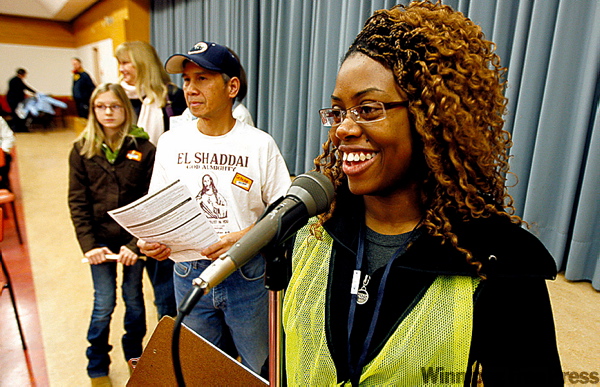
Marsha Stewart, a 28-year-old Winnipeg Technical College student, calls out numbers.
"Forty-five, 46, 47, please line up against the wall."
She’s kitted out in a yellow fluorescent vest, the sort you’d expect to see on a road crew. All the volunteers are easily identifiable.
Stewart says the most common question she gets is how long the wait will be.
"They’ve heard the lines are three or four hours long," she says. "They’re not here, at least not now. We’re really organized."
Her advice?
"The thing they need to do is read the fact sheet. A lot of them are just putting them down. You need to know what to look for."
Stewart had her shot Wednesday. She had to go home. "I was in pain all over. I was cold, I didn’t feel well."
Friday morning, she was back volunteering and feeling fine.
Fern Lee, a grandmother of two, wanted to help in any way she could.
"I like to volunteer. I’m not really sure why I volunteered here. I guess I thought they might have a shortage," says Lee.
She says part of the job is soothing people who are worried about the injection. "Some are a little bit scared," she says. "I usually just laugh it off, relax them. I tell them vampires don’t bite."
With a smile, she hustles back to the registration table at East Kildonan’s Holy Eucharist parish hall.
"Sixty, 61, 62," sings Stewart.
Pam McKechnie is a retiree. She was once an occupational therapist. She also worked at the Selkirk Mental Health Centre.
Because her husband is dependent on home care, she can only volunteer for short periods of time.
"I think it’s important to do this," she says. "I like the challenge."
She has sat on a variety of boards and put in countless hours of volunteer time. The fight against H1N1 seemed to be a good use of her time.
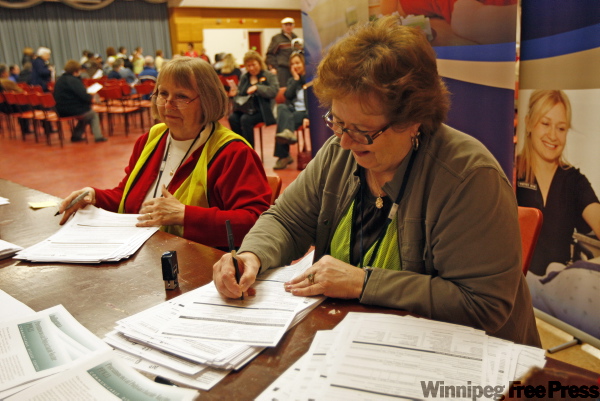
"I felt they needed me."
The clinic is a scene of controlled chaos. Children scream as they get their shot. Most people roll up their sleeves and wait stoically.
Monique Jacques, 29, is a classmate of Stewart’s.
She says she volunteered because she knew health-care workers would need the help.
"I want to work in health care so this seemed like a good idea."
She’s holding a scanner, the sort you’d see in a checkout line.
She runs it over every patient, making sure they’ve had their shot and are spending enough time in the recovery area.
And Marsha Stewart continues: "Sixty-six, 67, 68 …."
John Warkentin, number 67, says he’s grateful for the staff and volunteers. He figures the vaccine is what stands between our city and a devastating health crisis. "If we all get really sick, we don’t have the health-care facilities to take care of all of us," he says.
"The treatment here was excellent. I waited in line about 10 minutes. Everyone in line was very well-behaved. They were quietly moving people with kids to the front. No one minded that."
"Seventy, 71, 72 …."
Dr. Sande Harlos, the WRHA’s medical officer of health, says there was a steep learning curve when the clinics opened.
A vaccination of this magnitude is complex.
"I think the role of the volunteers is huge," she says.

"People are feeling like they’re accompanied and given information and feeling guided. You’re already relaxed.
"We’re so appreciative of the volunteers," she says. "In this city we’re very accomplished at pulling together and helping."
"Eighty-three, 84, 85 ….."
lindor.reynolds@freepress.mb.ca