

Cities eye drones as substitute for costly choppers
Unlikely to appear anytime soon
Advertisement
Read this article for free:
or
Already have an account? Log in here »
To continue reading, please subscribe:

Digital Subscription
One year of digital access for only $205*
- Enjoy unlimited reading on winnipegfreepress.com
- Read the E-Edition, our digital replica newspaper
- Access News Break, our award-winning app
- Play interactive puzzles
*First annual payment billed as $205.00 + GST for one year. This annual subscription will automatically renew at $233.00 + GST every 52 weeks (10% off the regular annual price of $259.35). Offer available to new and qualified returning subscribers only. Cancel any time.
To continue reading, please subscribe:
Add Free Press access to your Brandon Sun subscription for only an additional
$1 for the first 4 weeks*
- Enjoy unlimited reading on winnipegfreepress.com
- Read the E-Edition, our digital replica newspaper
- Access News Break, our award-winning app
- Play interactive puzzles
*Your next Brandon Sun subscription payment will increase by $1.00 and you will be charged $17.95 plus GST for four weeks. After four weeks, your payment will increase to $24.95 plus GST every four weeks.
Read unlimited articles for free today:
or
Already have an account? Log in here »
Hey there, time traveller!
This article was published 18/01/2010 (6092 days ago), so information in it may no longer be current.
As Winnipeg mulls the purchase of a police helicopter, a pair of North American cities has considered the use of remotely operated aircraft similar to the drones deployed in war zones.
The Miami Dade Police Department has purchased a pair of unpiloted aerial vehicles, to evaluate as surveillance tools, while the Houston Police Department conducted a test flight of a military-style spyplane before deciding it had no use for the drone.
Compared to the cost of a police helicopter — Winnipeg plans to spend $3.5 million on a vehicle, hangar, cameras, lights and other equipment — drones come relatively cheap. Winnipeg firm Micropilot has surveillance planes for sale in the $20,000 to $30,000 range.
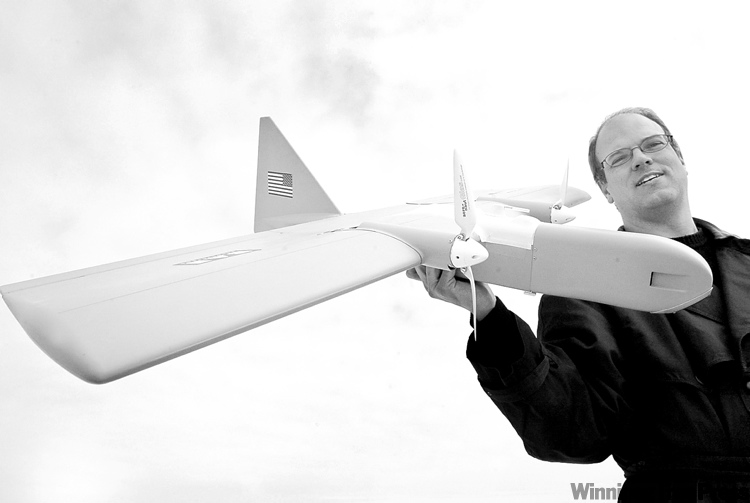
But even though the technology to send remotely operated police vehicles into the skies is inexpensive and available, the civilian world isn’t quite ready.
For starters, both Transport Canada and the U.S. Federal Aviation Administration have concerns about drones falling from the sky in populated areas or crashing into other aircraft.
“Transport Canada doesn’t know how to let unmanned vehicles fly into civilian airspace,” said Howard Loewen, president of Micropilot, which sells the computers that control drones as well as the aircraft themselves. “This is new technology and you don’t want it falling on someone’s head.”
Perhaps more importantly, the North American public doesn’t appear to be thrilled with the privacy implications posed by civilian spy planes. According to Texan TV station KPRC, Houston residents were not amused when their police department conducted an unpublicized test.
Residents of other cities have reacted badly to the appearance of military spy aircraft above their communities. Mike Bradley, the mayor of Sarnia, Ont., has waged a campaign to stop the U.S. from flying a drone security balloon called an Aerostat over the Michigan-Ontario border.
“You hear the word security and no one wants to question it,” said Bradley, who fears that crime-fighting, just like anti-terrorism efforts, can be used as a means to justify invasions of the public’s privacy. “I think the same principles apply. In the new climate of fear around North America, it’s easy for governments and police services to use it for their own benefit.”
Bradley said he’s skeptical of any new technology that purports to improve the efficiency of his police department. And that includes a police helicopter. “You’re always told, ‘When we do this, it’ll be more efficient. But when you do demonstrate the benefits, they’re usually intangible,” he said.
As the chairman of Sarnia’s police board, Bradley said he prefers hiring more police officers instead of purchasing new technology.
“At a time when police budgets are skyrocketing, it’s hard to understand how you can make a rational case for it,” he said.

The Winnipeg Police Service, however, claims a new helicopter will improve its ability to marshall resources on the ground.
The WPS did not consider the use of remotely operated drones instead, even though that question was put to Police Chief Keith McCaskill, said St. James Coun. Scott Fielding, city council’s most vocal police-helicopter proponent.
Micropilot president Loewen surmised the civilian world simply isn’t ready for drones, despite the fact they’re much cheaper than helicopters.
“Anything a helicopter can do, a much smaller vehicle can do, but for much less than what they’re talking about for the helicopter,” he said. “But it’s really still very experimental technology.”
bartley.kives@freepress.mb.ca