

Trappers suing for $64M
Say Hydro, province took away livelihood
Advertisement
Read this article for free:
or
Already have an account? Log in here »
To continue reading, please subscribe:
Digital Subscription
One year of digital access for only $75*
- Enjoy unlimited reading on winnipegfreepress.com
- Read the E-Edition, our digital replica newspaper
- Access News Break, our award-winning app
- Play interactive puzzles
*Billed as $5.77 plus GST every four weeks. After 52 weeks, price increases to the regular rate of $19.95 plus GST every four weeks. Offer available to new and qualified returning subscribers only. Cancel any time.
Monthly Digital Subscription
$4.99/week*
- Enjoy unlimited reading on winnipegfreepress.com
- Read the E-Edition, our digital replica newspaper
- Access News Break, our award-winning app
- Play interactive puzzles
*Billed as $19.95 plus GST every four weeks. Cancel any time.
To continue reading, please subscribe:
Add Free Press access to your Brandon Sun subscription for only an additional
$1 for the first 4 weeks*
- Enjoy unlimited reading on winnipegfreepress.com
- Read the E-Edition, our digital replica newspaper
- Access News Break, our award-winning app
- Play interactive puzzles
*Your next Brandon Sun subscription payment will increase by $1.00 and you will be charged $17.95 plus GST for four weeks. After four weeks, your payment will increase to $24.95 plus GST every four weeks.
Read unlimited articles for free today:
or
Already have an account? Log in here »
Hey there, time traveller!
This article was published 08/02/2010 (5951 days ago), so information in it may no longer be current.
A group of native trappers and elders is suing Manitoba Hydro and the province for $64 million, compensation the trappers say they are owed for flooding that eradicated their livelihood and culture.
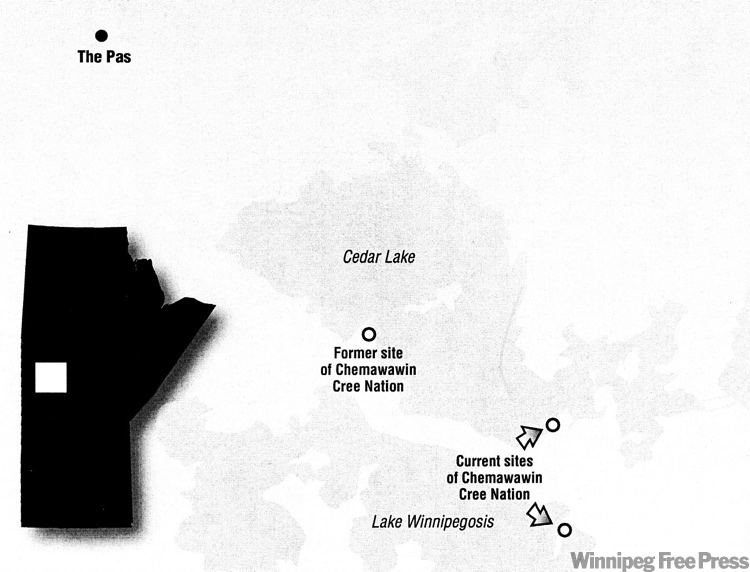
The trappers from the Chemawawin First Nation say flooding from the Grand Rapids dam has led to a 50 per cent drop in their standard of living and cost them and their families at least $64 million in lost income for as many as 118 trappers or their descendents. That’s according to a statement of claim filed last month in the Court of Queen’s Bench in The Pas.
Though Hydro paid to relocate the Chemawawin band in the mid-1960s and paid out millions in compensation since then, trappers like Malcolm Thomas, Fred Thomas and Edward Thomas say they were left out of that process.
But lawyer Brian Maronek, who is acting for the trappers, cautioned the statement of claim is largely a precautionary measure in case a new round of negotiations with Manitoba Hydro fail.
Talks broke off last fall after Hydro offered the trappers $6 million. The trappers were asking for $33 million.
Maronek said he is hoping talks resume later this month. The trappers are claiming a long list of damages spanning decades, including loss of income from trapping, damage to equipment, breach of treaty rights and the duty to consult, bad faith dealings, deceit and negligence on the part of Manitoba Hydro.
"Specifically, they knew that one of the best wildlife areas in North America would be destroyed and the damage would be catastrophic to the trappers," reads the claim.
Those claims have yet to be tested or proven in court and Manitoba Hydro has not yet been served notice of the potential lawsuit or filed a statement of defence. Grand Rapids, one of the first northern dams to be built, is among those that flooded First Nations land and created a costly legacy of mistrust between Hydro and First Nations that has only begun to improve in recent years as Hydro has sought genuine partnerships with northern bands.
Manitoba Hydro did not respond to repeated requests for comment on the lawsuit. Chemawawin Chief Clarence Easter said he’s supportive of the trappers’ attempts to win compensation from Hydro, but he said it might take too long. Many of the men are in their late 60s or 70s and a court case could drag on.
Easter said Hydro has not properly compensated band members for unforeseen impacts from the dam. And he said elders had little option but to relocated the band in the early 1960s.
maryagnes.welch@freepress.mb.ca
Times of trouble
1957: Manitoba Hydro starts planning for the Grand Rapids dam, the first one built up north. It uses Cedar Lake as a forebay or reservoir, causing large-scale flooding that left about 500,000 acres of shoreline underwater.
1960: Manitoba Hydro starts negotiating with the Chemawawin band, a small, isolated community of about 350 people with no road access or electricity but a vibrant traditional trapping and hunting culture built on the fertile marshland where the Saskatchewan River turns into Cedar Lake.

1963: Chemawawin is relocated to a planned townsite at Easterville on the southeast shore of Cedar Lake. The town had power, running water, new homes and a collection of schools and recreation centres. But alcohol and drug abuse took hold as it became clear the new site, built on bedrock, was no good for traditional trapping, hunting and agricultural practices.
1968: The Grand Rapids dam opens, pumping 480 megawatts of power onto the grid.
1990, Manitoba Hydro signs a $13.7 million deal with Chemawawin to compensate the band for the outstanding effects of the dam.
2008: Feeling ignored and overlooked for decades, a group of trappers form a committee and begin negotiations with Hydro for compensation. They ask for $33 million, but Hydro offers $6 million.
Fall 2009: Talks break off.