

Canada sitting pretty compared to other nations
Advertisement
Read this article for free:
or
Already have an account? Log in here »
To continue reading, please subscribe:

Digital Subscription
One year of digital access for only $205*
- Enjoy unlimited reading on winnipegfreepress.com
- Read the E-Edition, our digital replica newspaper
- Access News Break, our award-winning app
- Play interactive puzzles
*First annual payment billed as $205.00 + GST for one year. This annual subscription will automatically renew at $233.00 + GST every 52 weeks (10% off the regular annual price of $259.35). Offer available to new and qualified returning subscribers only. Cancel any time.
To continue reading, please subscribe:
Add Free Press access to your Brandon Sun subscription for only an additional
$1 for the first 4 weeks*
- Enjoy unlimited reading on winnipegfreepress.com
- Read the E-Edition, our digital replica newspaper
- Access News Break, our award-winning app
- Play interactive puzzles
*Your next Brandon Sun subscription payment will increase by $1.00 and you will be charged $17.95 plus GST for four weeks. After four weeks, your payment will increase to $24.95 plus GST every four weeks.
Read unlimited articles for free today:
or
Already have an account? Log in here »
Hey there, time traveller!
This article was published 05/03/2010 (5975 days ago), so information in it may no longer be current.
OTTAWA — From GDP growth to job creation, consumer confidence to the housing sector, the federal budget portrays Canada’s economy as a whirring machine of productivity that’s leaving many of its international allies in the dust.
Private-sector forecasters have Canada’s gross domestic product (GDP) growing between 2.6 and 3.2 per cent a year for the next five years and the unemployment rate dropping from 8.5 per cent this year to 6.6 per cent in 2014.
Finance Minister Jim Flaherty was quick to point out the economic recovery is fragile but so far, he says, so good.
"Canada has faced the global recession from a position of strength," said Flaherty in Thursday’s budget speech, noting Canada’s efforts to balance the books, pay down debt and cut taxes before the recession left the country far more able to withstand the economic hits.
But the $62-billion economic action plan helped too, he claims, pushing consumers to spend more, creating new jobs and preventing existing jobs from disappearing.
Overall, Canada lost 280,000 jobs in 2008 and 2009 as a result of the downturn, about 1.6 per cent of total jobs. Flaherty argues it would have been closer to 410,000 without federal stimulus interventions.
In the United States, 8.4 million jobs were lost, 6.1 per cent of jobs south of the border.
However, the repeated pointers in the budget to Canada’s current economic supremacy over the United States are troubling in part because our economic recovery and balance rely heavily on the Americans, our largest trading partner.
"We need to see more sustainable growth out of the U.S.," said Craig Wright, chief economist at RBC.
But he said where the United States went into the recession already with a huge deficit, Canada had spent years balancing the budget and paying down debt.
"It left us structurally sound and gave us the advantage," he said.
In 1994, when Canada’s deficit peaked before federal spending cuts, including to provincial transfers, started the road to surplus, the only industrialized nation in the world with a worse fiscal picture than Canada was Italy. Canada’s debt-to-GDP ratio was over 70 per cent.
In 2009-10, when the deficit hit a record $53.8 billion, Canada had the best record of any nation in the G7 on most economic indicators, including debt-to-GDP ratio.
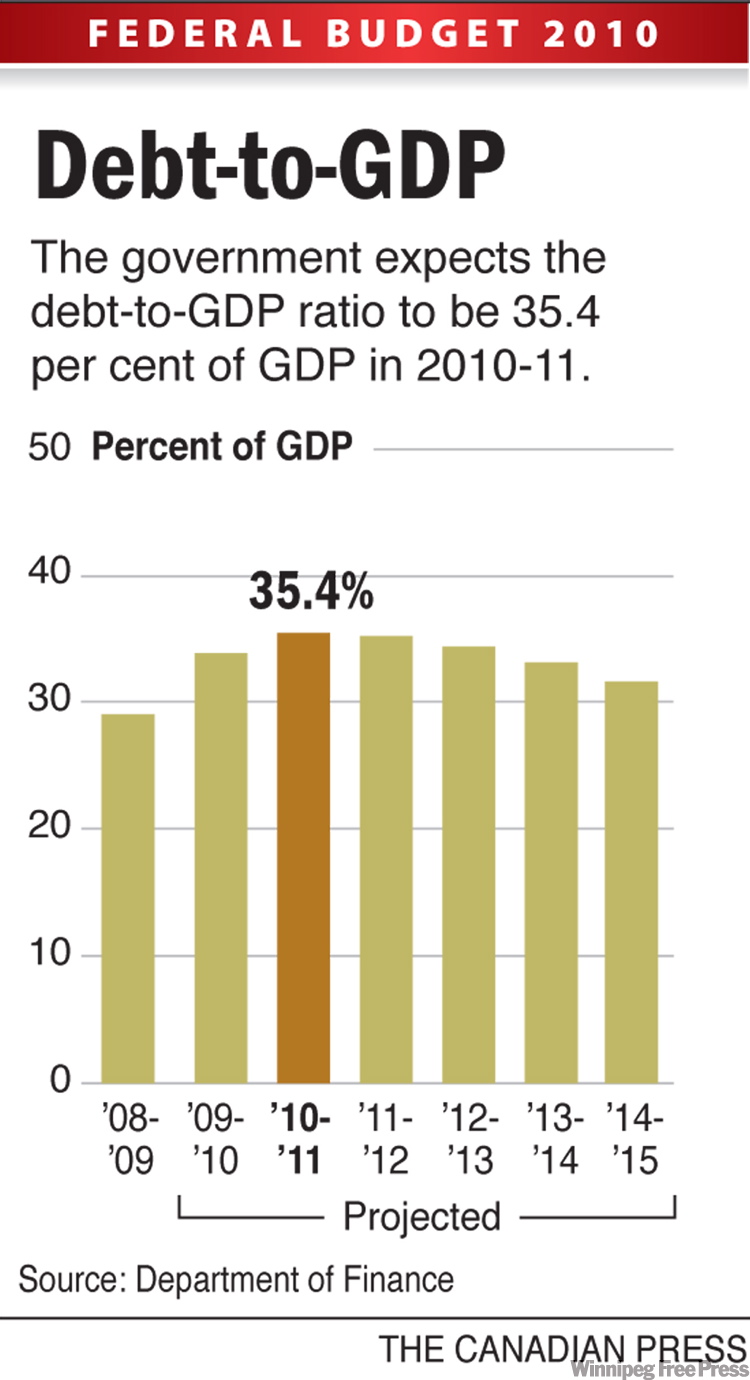
In 2008-09, the debt-to-GDP ratio was 29 per cent, the lowest in 29 years. It will peak at 35.4 per cent in 2010-11 and then begin dropping again slowly hitting 31.9 per cent in 2014-15.
By comparison, that key ratio will be almost 67 per cent in the U.S., 75 per cent in the United Kingdom and 115 per cent in Japan.
Flaherty acknowledges weak consumer confidence and housing markets in the United States are putting pressure on the global economic recovery and could result in lower-than-expected growth here as well.
The explosion of the loonie compared to the U.S. dollar may be good for cross-border shoppers but isn’t so wonderful for manufacturers and exporters in Canada.
However, signs of life in the economy abound for now.
The unemployment rate, at 8.3 in 2009, is expected to drop to 7.9 per cent by 2011, and 6.6 per cent by 2014.
The federal government says 130,000 new jobs have been created or maintained due to economic stimulus since June 2009, including 42,000 from infrastructure spending and 58,000 from direct funding to communities and specific industries such as forestry, tourism and the auto sector.
mia.rabson@freepress.mb.ca
Real GDP Growth
2009: -2.5
2010: 2.6
2011: 3.2
2012: 3.0
2013: 2.8
2014: 2.6
Exchange rate projections (US cents/CDN $)
2009: 87.9
2010: 95.5
2011: 98.3
2012: 97.7
2013: 99.3
2014: 98.5
Unemployment rate
2009: 8.3
2010: 8.5

2011: 7.9
2012: 7.4
2013: 6.9
2014: 6.6
Advertisement Advertise With Us
Advertisement Advertise With Us