

One-way downtown streets legacy of postwar growth
What the Winnipeg? Decoding our City
Advertisement
Read this article for free:
or
Already have an account? Log in here »
To continue reading, please subscribe:

Digital Subscription
One year of digital access for only $205*
- Enjoy unlimited reading on winnipegfreepress.com
- Read the E-Edition, our digital replica newspaper
- Access News Break, our award-winning app
- Play interactive puzzles
*First annual payment billed as $205.00 + GST for one year. This annual subscription will automatically renew at $233.00 + GST every 52 weeks (10% off the regular annual price of $259.35). Offer available to new and qualified returning subscribers only. Cancel any time.
To continue reading, please subscribe:
Add Free Press access to your Brandon Sun subscription for only an additional
$1 for the first 4 weeks*
- Enjoy unlimited reading on winnipegfreepress.com
- Read the E-Edition, our digital replica newspaper
- Access News Break, our award-winning app
- Play interactive puzzles
*Your next Brandon Sun subscription payment will increase by $1.00 and you will be charged $17.95 plus GST for four weeks. After four weeks, your payment will increase to $24.95 plus GST every four weeks.
Read unlimited articles for free today:
or
Already have an account? Log in here »
Hey there, time traveller!
This article was published 17/07/2010 (5846 days ago), so information in it may no longer be current.
Unless you grew up here, learning to navigate Winnipeg’s downtown one-way street system is a challenge.
It wasn’t always that way.
Streetcars were the main mode of transportation after 1892. Where the tracks went, they went.
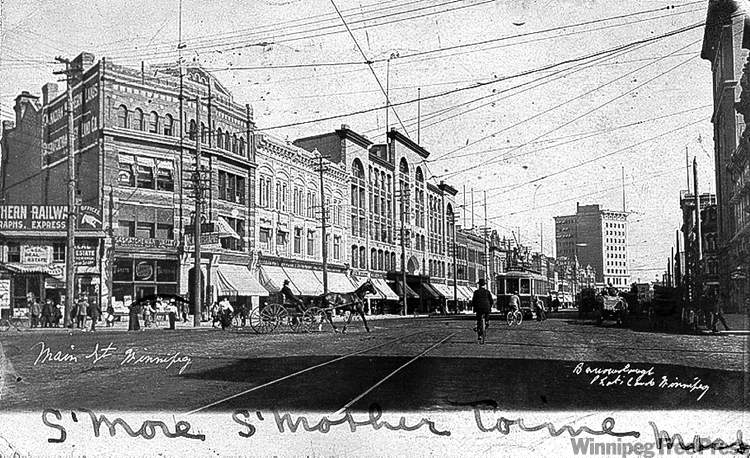
Then something happened after the Second World War ended in 1945. Actually, two things happened: Winnipeg’s suburbs started growing and more people who lived in far-flung places like River Heights and Charleswood started buying cars.
By 1947, traffic congestion was the major issue at city hall.
According to a Free Press report that year, Eric Thrift, director of Winnipeg’s metropolitan town planning committee, explained the widespread traffic problem was, "simply the outward sign of the growing pains of a modern progressive society and that cities, which are rugged and flexible organizations, can adapt themselves to extraordinary stresses."
So, what did the city do?
Not much, at least right away, although in 1951 it did bring westbound traffic off the Provencher Bridge one way to Main Street, and one way west on Notre Dame, a traffic scheme we still enjoy today.
On April 12, 1954, city hall created the nine-member Winnipeg Traffic Commission. Its task was to investigate the regulation and control of traffic within the city and test traffic-control devices under actual traffic conditions.
A decision was made by 1955 to yank the city’s streetcars. One reason was to give more room on the road to cars. Electric trolley buses and diesel buses were also considered more reliable and able to move more people more quickly. Trolley buses were phased out about a decade later.
By March 1955, the traffic commission had released its long-range plan to ease traffic congestion in Winnipeg. It identified a number of downtown thoroughfares to be restricted to one-way travel.
"These regulations are bound to prove irksome to many people," the Free Press editorialized then. "But they are nevertheless practical measures designed to get the best out of our streets — to speed the movement of vehicles. Everyone should, therefore, be prepared to give them a reasonable trial."
Garry, Fort, Hargrave, Carlton, Edmonton and Kennedy streets were to be made one-way in the downtown area that year. Other streets followed. But first, overhead bus trolley wires had to be adjusted so trolley buses could run the right way on those streets.
The traffic commission also made Maryland Street a one-way southbound street from Portage Avenue to Wolseley, beginning when streetcars were removed from Portage on Sept. 5. The goal was to further untangle evening rush-hour traffic caused by downtown workers heading home.
"There would be no parallel northbound street for the time being, the commission decided, though at some future date, Sherbrook may be made one-way north," the Free Press reported 55 years ago.
Creating the one-way street system aided traffic flow only to a limited extent. As the city grew, more cars and trucks travelled into and through the downtown.
Immediately, two other big problems popped up.
There weren’t enough places for all those cars to park downtown and the bridges running over the two rivers in and out of downtown were too narrow, especially at after-work rush hour. Hence, traffic jams.

Bigger, wider and more bridges had to be built. More roads, like the Perimeter Highway, had to be built to divert traffic around the downtown. There was even talk then of dedicated bus lanes so buses could move faster out of the downtown at evening rush hour.
Does any of this sound familiar?
bruce.owen@freepress.mb.ca