

‘Everything is halal’ at Muslim grocery store

Advertisement
Read this article for free:
or
Already have an account? Log in here »
To continue reading, please subscribe:
Monthly Digital Subscription
$1 per week for 24 weeks*
- Enjoy unlimited reading on winnipegfreepress.com
- Read the E-Edition, our digital replica newspaper
- Access News Break, our award-winning app
- Play interactive puzzles
*Billed as $4.00 plus GST every four weeks. After 24 weeks, price increases to the regular rate of $19.95 plus GST every four weeks. Offer available to new and qualified returning subscribers only. Cancel any time.
Monthly Digital Subscription
$4.99/week*
- Enjoy unlimited reading on winnipegfreepress.com
- Read the E-Edition, our digital replica newspaper
- Access News Break, our award-winning app
- Play interactive puzzles
*Billed as $19.95 plus GST every four weeks. Cancel any time.
To continue reading, please subscribe:
Add Free Press access to your Brandon Sun subscription for only an additional
$1 for the first 4 weeks*
*Your next subscription payment will increase by $1.00 and you will be charged $16.99 plus GST for four weeks. After four weeks, your payment will increase to $23.99 plus GST every four weeks.
Read unlimited articles for free today:
or
Already have an account? Log in here »
Hey there, time traveller!
This article was published 12/08/2010 (5730 days ago), so information in it may no longer be current.
Chickens from a local Hutterite colony. Beef burgers from Carman. Quails from Quebec. Jell-O from Egypt.
It’s all halal and for sale at Manitoba’s first grocery store catering to Muslims.
When Yusuf Abdulrehman rented a Maryland Street corner store 22 years ago, he discovered a growing, untapped market.
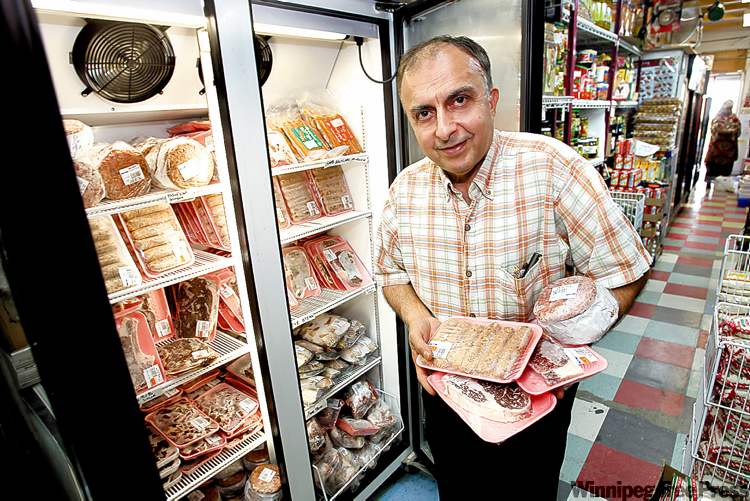
"I realized a need for halal," said the owner of Halal Meat Centre and Specialty Foods.
Earlier this week, the Manitoba government released a market study urging producers in the province to take the bull by the horns and go after the halal and kosher meat market.
The word "halal" means lawful or permitted. In the Islamic faith, pork products, processed foods containing pork-based pepsin and rennet, Jell-O containing animal-derived gelatin, and goods baked with lard are all forbidden.
At first, Abdulrehman’s halal section was limited. "We had some chicken, a bit of hotdogs and bologna. Today, everything is halal."
On Wednesday, the shop was packed floor to ceiling with halal groceries and front to back with shoppers preparing to break their fast on the first day of Ramadan.
In Canada, the total halal meat market is estimated at $214 million a year and the kosher market at $130 million, according to the market study. But fresh meat for the observant Jew or Muslim isn’t readily available, said Jeff Fidyk, business development specialist with Manitoba Agriculture Food and Rural Initiatives.
Selling fresh halal meat requires a hands-on approach for the Winnipeg store owner.
"You make sure your knife is sharp," Abdulrehman said. The idea is to quickly sever the animal’s arteries so it loses consciousness right away and its suffering is limited. "The longer you take, the more painful it is."
The Muslim performing the slaughter is required to say a prayer to Allah.
Abdulrehman gets his meat from an abattoir in Carman and a Hutterite colony, where he has taken part in the slaughter of 1,500 chickens in three hours at Waldner meats.
"At first, it was kind of hard."
For years, Muslim families in Winnipeg have travelled to farms and abattoirs outside the city to slaughter their own halal lamb or a goat, the store owner said.
Others can’t afford that and will buy inexpensive cans of halal corned beef or lamb imported from Australia.
Frozen and canned kosher meats are shipped here from Central Canada and as far away as Uruguay and New Zealand, Fidyk said.
Manitoba should be shipping rather than receiving kosher and halal meat, he said.
"We have the potential to do that here," Fidyk said. "There is an opportunity for import replacements."

It’s not that simple to export meat, said the founder of Keystone Processors. An abattoir needs federal certification to export meat out of province, said Kelly Penner, president of the Marion Street company. The budding Manitoba processor initially sold halal beef. It had a representative of a halal organization take part in the slaughter at a plant in Carman, but the Manitoba market alone isn’t big enough to make it worthwhile, Penner said.
"We do believe it’s a great market here in Winnipeg and throughout North America, but we need a federally-inspected plant to make it viable," Penner said.
Abdulrehman has seen, first-hand, a large-scale halal meat operation in southern Ontario. At the Maple Lodge processing plant, a machine does the cutting, but there are two Muslim representatives on either side of the line praying as the chickens are killed, said Abdulrehman, who sells Maple Lodge cold cuts.
carol.sanders@freepress.mb.ca
Carol Sanders
Legislature reporter
Carol Sanders is a reporter at the Free Press legislature bureau. The former general assignment reporter and copy editor joined the paper in 1997. Read more about Carol.
Every piece of reporting Carol produces is reviewed by an editing team before it is posted online or published in print — part of the Free Press‘s tradition, since 1872, of producing reliable independent journalism. Read more about Free Press’s history and mandate, and learn how our newsroom operates.
Our newsroom depends on a growing audience of readers to power our journalism. If you are not a paid reader, please consider becoming a subscriber.
Our newsroom depends on its audience of readers to power our journalism. Thank you for your support.
Carol Sanders
Legislature reporter
Carol Sanders is a reporter at the Free Press legislature bureau. The former general assignment reporter and copy editor joined the paper in 1997. Read more about Carol.
Every piece of reporting Carol produces is reviewed by an editing team before it is posted online or published in print — part of the Free Press‘s tradition, since 1872, of producing reliable independent journalism. Read more about Free Press’s history and mandate, and learn how our newsroom operates.
Our newsroom depends on a growing audience of readers to power our journalism. If you are not a paid reader, please consider becoming a subscriber.
Our newsroom depends on its audience of readers to power our journalism. Thank you for your support.
Advertisement Advertise With Us
Advertisement Advertise With Us