

Three new MPs, but no deeper truth
Byelections don't tell us much politically

Advertisement
Read this article for free:
or
Already have an account? Log in here »
To continue reading, please subscribe:

Digital Subscription
One year of digital access for only $205*
- Enjoy unlimited reading on winnipegfreepress.com
- Read the E-Edition, our digital replica newspaper
- Access News Break, our award-winning app
- Play interactive puzzles
*First annual payment billed as $205.00 + GST for one year. This annual subscription will automatically renew at $233.00 + GST every 52 weeks (10% off the regular annual price of $259.35). Offer available to new and qualified returning subscribers only. Cancel any time.
To continue reading, please subscribe:
Add Free Press access to your Brandon Sun subscription for only an additional
$1 for the first 4 weeks*
- Enjoy unlimited reading on winnipegfreepress.com
- Read the E-Edition, our digital replica newspaper
- Access News Break, our award-winning app
- Play interactive puzzles
*Your next Brandon Sun subscription payment will increase by $1.00 and you will be charged $17.95 plus GST for four weeks. After four weeks, your payment will increase to $24.95 plus GST every four weeks.
Read unlimited articles for free today:
or
Already have an account? Log in here »
Hey there, time traveller!
This article was published 30/11/2010 (5759 days ago), so information in it may no longer be current.
When someone mentions the topic of federal byelections, the word “obligatory” comes to mind. It’s an election, and we in the media are obligated to cover it and then find some sort of greater meaning in the results. Well, what if there is no greater meaning?
This is, after all, an electoral battle where traditionally only about a third of registered voters actually vote. Where few seats actually change hands. And even when they do change hands, the results seem to have little impact on the grander political scheme. Monday night’s results are a case in point.
Dauphin-Swan River-Marquette was not much of a race. Tory Bob Sopuck won handily. The only intrigue came from allegations the Tories manipulated the nomination process to allow Sopuck to get the nod unopposed.
Winnipeg North was a bit more interesting. The NDP, which has held the seat for years, was desperate to hold it against a spirited challenge by Liberal Kevin Lamoureux, who hoped his high profile as an MLA would vault him past NDP candidate Kevin Chief. It was a real nail-biter but in the end, Lamoureux beat the odds (again) and won.
In Ontario, the Liberals were desperate to retain Vaughn, a seat they have held for 22 years. The Tories pulled out all the stops to win this one, running former Ontario Provincial Police commissioner Julian Fantino. Heck, Fantino even got an endorsement from hockey god Don Cherry. That’s a beauty, and it helped the Tories capture Vaughn. It is an important victory for the Conservatives and Prime Minister Stephen Harper, but it is not a game-changer. Pundits will punish Liberal Leader Michael Ignatieff for failing to hold a long-held seat, but Vaughn was a Grit outpost, a seat almost completely surrounded by Conservatives in a part of the province that long ago abandoned the federal Liberals. It’s a setback for the Liberals, but not a fatal blow.
Not to be a spoil sport, but the ugly fact is that byelections have not, at least in recent history, produced game-changing results. Lord knows, the media would like them to be more profound. It would make a better story. But while there are a few bloody noses and black eyes the morning after byelections, there are very few fatalities.
In September 2007, the narrative was all about Liberal Leader Stéphane Dion and the abysmal performance the Grits had in three Quebec byelections. Dion’s Liberals lost a stronghold (Outremont) and showed poorly in two other ridings. The Tories stole a seat from the BQ. The real-time analysis concluded Dion and the Liberals were a party very much in decline, particularly in Quebec, where it looked as if the federal Conservatives would finally become the federalist party of choice. That would make a majority government for Harper very much a reality. (How did that prediction work out? In the 2008 federal election, the Tories flopped in Quebec and as a result did not win a majority.)
In March 2008, four Liberal seats were up for grabs — one in Vancouver, one in northern Saskatchewan and two in Toronto. When the votes were counted, the Liberals won three of four, with the Tories winning in Saskatchewan. It was quite difficult to determine what those results meant in the grander scheme of things. The Liberals retained three, lost one and remained the official Opposition.
And then last year, four more byelections were held to fill one NDP seat, two Bloc Québécois seats and a single Tory seat. All were retained by the parties that held them before the byelections.
What do all these results, and the results of Monday night’s byelections, tell us? We in the media are trained to detect and report the slightest change in fortune or momentum. But the results in these most recent byelections do not change the fact that this is a country in political gridlock.
The results did not tell us, for example, if Ignatieff and Harper have job security as leaders of their parties. Both head parties that are growing impatient about their lack of progress. Or if either the Liberals or Conservatives are willing to force an election next spring. Did voters punish the NDP in Winnipeg North and the Liberals in Vaughn? Does Lamoureux’s victory in Winnipeg North redeem Ignatieff?
Not really. The Tories captured the last in a series of right-leaning suburban seats in Ontario. And it was the indefatigable Lamoureux, not the Liberal Machine, that triumphed in Winnipeg North. You can search for greater meaning in these results — and Lord knows, we in the media will keep looking — but it’s not really there.
dan.lett@freepress.mb.ca
Dan Lett is a columnist for the Free Press, providing opinion and commentary on politics in Winnipeg and beyond. Born and raised in Toronto, Dan joined the Free Press in 1986. Read more about Dan.
Dan’s columns are built on facts and reactions, but offer his personal views through arguments and analysis. The Free Press’ editing team reviews Dan’s columns before they are posted online or published in print — part of the our tradition, since 1872, of producing reliable independent journalism. Read more about Free Press’s history and mandate, and learn how our newsroom operates.
Our newsroom depends on a growing audience of readers to power our journalism. If you are not a paid reader, please consider becoming a subscriber.
Our newsroom depends on its audience of readers to power our journalism. Thank you for your support.
Dan Lett is a columnist for the Free Press, providing opinion and commentary on politics in Winnipeg and beyond. Born and raised in Toronto, Dan joined the Free Press in 1986. Read more about Dan.
Dan’s columns are built on facts and reactions, but offer his personal views through arguments and analysis. The Free Press’ editing team reviews Dan’s columns before they are posted online or published in print — part of the our tradition, since 1872, of producing reliable independent journalism. Read more about Free Press’s history and mandate, and learn how our newsroom operates.
Our newsroom depends on a growing audience of readers to power our journalism. If you are not a paid reader, please consider becoming a subscriber.
Our newsroom depends on its audience of readers to power our journalism. Thank you for your support.
Related Articles
Lamoureux wins battle of Kevins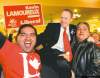
Advertisement Advertise With Us
Advertisement Advertise With Us