

Stonewall’s kilns crumble
Frost damage is getting worse
Advertisement
Read this article for free:
or
Already have an account? Log in here »
To continue reading, please subscribe:
Monthly Digital Subscription
$1 per week for 24 weeks*
- Enjoy unlimited reading on winnipegfreepress.com
- Read the E-Edition, our digital replica newspaper
- Access News Break, our award-winning app
- Play interactive puzzles
*Billed as $4.00 plus GST every four weeks. After 24 weeks, price increases to the regular rate of $19.95 plus GST every four weeks. Offer available to new and qualified returning subscribers only. Cancel any time.
Monthly Digital Subscription
$4.99/week*
- Enjoy unlimited reading on winnipegfreepress.com
- Read the E-Edition, our digital replica newspaper
- Access News Break, our award-winning app
- Play interactive puzzles
*Billed as $19.95 plus GST every four weeks. Cancel any time.
To continue reading, please subscribe:
Add Free Press access to your Brandon Sun subscription for only an additional
$1 for the first 4 weeks*
*Your next subscription payment will increase by $1.00 and you will be charged $16.99 plus GST for four weeks. After four weeks, your payment will increase to $23.99 plus GST every four weeks.
Read unlimited articles for free today:
or
Already have an account? Log in here »
Hey there, time traveller!
This article was published 31/01/2011 (5553 days ago), so information in it may no longer be current.
STONEWALL — The pyramids of Stonewall are in trouble.
The limestone kilns that mark the town’s heritage, that are perfectly framed when you look north down Stonewall’s Main Street, are developing deep frost cracks and are increasingly at risk of falling.
The problem is the price tag to stabilize them — nearly $1 million. “They would throw us all out of office” if councillors approved that kind of expenditure, Coun. Walter Badger, in charge of heritage, said recently.
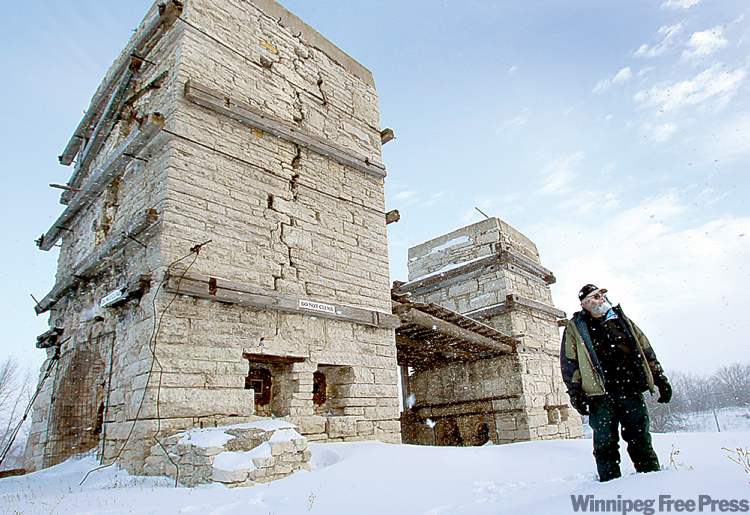
Local historian Allan Webb is one of the most ardent fans for preserving the kilns.
“They’re not going to fall down tomorrow but we need to do something in the next couple years because the frost damage is getting worse,” Webb said on a recent tour. The freezing and thawing of water seepage is widening the cracks.
Webb’s family dates back 125 years in the Stonewall area. He is the fourth generation to work at the quarry, if you include the horse-drawn tours he gives in summer. His great grandfather, Samuel Webb, worked there in 1901, and his grandfather tended up to 14 horses used to haul stone. His father broke rock with a sledge hammer for one year.
“The kilns are the symbol of the town and a big part of its heritage,” said Webb.
A steam-engine-powered derrick lifted rock into the kilns. “They’d dump the rock in the top just like putting it down a chimney,” he said.
Wood fire processed the limestone. The quarry kept 1,000 cords of wood on hand at all times, and went through 10 cords a day. That gave farmers extra income by cutting down their poplar woodlots.
“Until the 1940s, everyone but the well-off heated and cooked with wood,” said Webb.
Fire separated out the carbon dioxide (limestone is calcium carbonate) and left behind a powder called quicklime. Quicklime had many uses including disinfecting outhouses — the prevailing sewage system at the time — and barns. The quicklime was also used to manufacture products like paint, whitewash, masonry mortar and plaster. Many farmers whitewashed their interior barn walls to increase visibility when working by kerosene lantern.
The three kilns remaining in Quarry Park could produce six to 10 tonnes of quicklime per day.
Limestone was used in construction. Many small buildings in Stonewall are made of local limestone including the town hall, built in 1912, the Canadian Imperial Bank of Commerce building (1912), and the post office (1914). “The rock is on the soft side (unlike tyndall) so you don’t want to go over three stories with it,” Webb explained.
The quarries are on the shallow reef of the inland sea that covered Manitoba 450 million years ago. Limestone was created by the natural cementing of the crustacean armours of small sea creatures. Lake Agassiz dumped about 10 feet of clay on top of the limestone.
The quarry closed in 1967 due to drop in demand and supply. Today, the cluster of kilns “is the best example of their kind still standing all in one place,” said Webb. They are Stonewall’s “pyramids,” he said.

Coun. Badger said the town has too many big, expensive projects right now like expansion of its lagoon, repairs to its water and sewer lines, and the $7 million heritage centre.
Webb hopes the town will set aside money for a consultant’s report. Then private money will have to be found, he said. “The problem is the kilns don’t generate any revenue,” he said.
“On the bright side, the kilns have lasted for 100 years and haven’t fallen over yet.”
bill.redekop@freepress.mb.ca