

Andes survivors focus on saving lives
Foundation spreads life-changing message

Advertisement
Read this article for free:
or
Already have an account? Log in here »
To continue reading, please subscribe:
Digital Subscription
One year of digital access for only $1.44 a week*
- Enjoy unlimited reading on winnipegfreepress.com
- Read the E-Edition, our digital replica newspaper
- Access News Break, our award-winning app
- Play interactive puzzles
*Billed as $5.77 plus GST every four weeks. After 52 weeks, price increases to the regular rate of $19.95 plus GST every four weeks. Offer available to new and qualified returning subscribers only. Cancel any time.
To continue reading, please subscribe:
Add Free Press access to your Brandon Sun subscription for only an additional
$1 for the first 4 weeks*
- Enjoy unlimited reading on winnipegfreepress.com
- Read the E-Edition, our digital replica newspaper
- Access News Break, our award-winning app
- Play interactive puzzles
*Your next Brandon Sun subscription payment will increase by $1.00 and you will be charged $17.95 plus GST for four weeks. After four weeks, your payment will increase to $24.95 plus GST every four weeks.
Read unlimited articles for free today:
or
Already have an account? Log in here »
Hey there, time traveller!
This article was published 30/03/2011 (5562 days ago), so information in it may no longer be current.
GUSTAVO Zerbino was a 19-year-old medical student and rugby player when his Uruguayan team’s charter flight crashed in the Andes Mountains in 1972.
One of 16 survivors, he made it through 72 days of freezing, high-altitude hell wearing dress pants, a blazer and a pair of loafers. Not because of a miracle, but because of determination.
“If we want to live, it depends on us,” he recalled thinking. “The first rule was no one was able to complain.”
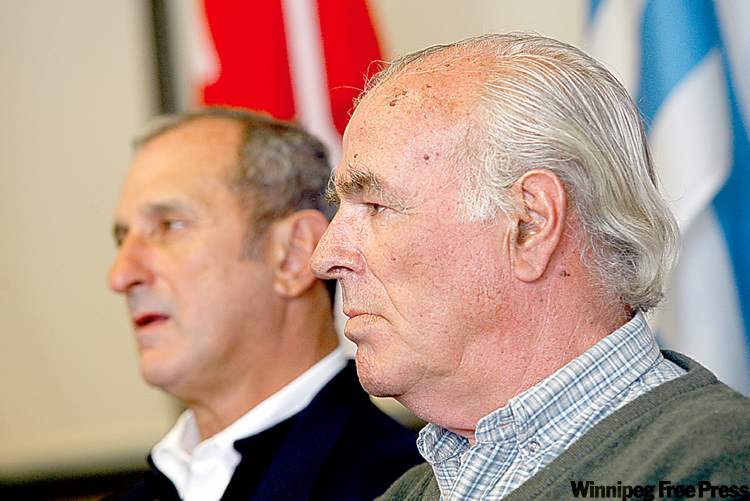
Zerbino and fellow survivor and rugby teammate Coche Inciarte are both in their 60s and in Canada for the first time, speaking at the University of Manitoba tonight. Their talk is sponsored by the U of M’s Student Life office.
Their story was made into a book in 1974 and the 1993 movie Alive! They survived more than two months, eating the dead passengers who had been preserved in the snow.
Zerbino remembers the 10th day of their ordeal, when they heard radio news reports that the search for them had been called off.
“They said we were dead and they’ll come back in February to pick up the bodies.”
Realizing they wouldn’t survive waiting for help, three of them set off to get help. They walked for 10 days until they were spotted by a Chilean cowboy on horseback, said Zerbino. After their plane carrying 45 people crashed on Friday, Oct. 13, they were rescued Dec. 23.
Now, the survivors are saving lives with a foundation called Viven! (Spanish for “alive”). It was set up in 2006 to support communities that struggle for survival daily, to encourage organ and tissue donation, and to spread the message of the Andes survivors: never give up.
They went to Copiapo, Chile, during last year’s mine accident to offer support to the trapped men and their families above ground.
Being in Canada with its cold weather brought back memories for Inciarte.

“It’s a pleasure to see snow again — from the indoors,” he joked. When he went outside to smoke a cigarette, the events of 38 years ago came flooding back. “I remember the noise when you put your foot in the snow,” Inciarte said.
“Something we learned that stays with us is how to appreciate life in another way, not as we did when we were young,” said the man who went on to have three children and manage a dairy farm and co-operative before retiring.
“People complain 24 hours a day about the weather, their family, the dog, the neighbour,” said Zerbino. Now president of the Uruguayan Rugby Union and the country’s pharmaceutical association, he has six grown children.
He and Inciarte speak tonight at 7 p.m. at the U of M. Admission is free for U of M students. Tickets are $24.95.
carol.sanders@freepress.mb.ca
Carol Sanders
Legislature reporter
Carol Sanders is a reporter at the Free Press legislature bureau. The former general assignment reporter and copy editor joined the paper in 1997. Read more about Carol.
Every piece of reporting Carol produces is reviewed by an editing team before it is posted online or published in print — part of the Free Press‘s tradition, since 1872, of producing reliable independent journalism. Read more about Free Press’s history and mandate, and learn how our newsroom operates.
Our newsroom depends on a growing audience of readers to power our journalism. If you are not a paid reader, please consider becoming a subscriber.
Our newsroom depends on its audience of readers to power our journalism. Thank you for your support.
Carol Sanders
Legislature reporter
Carol Sanders is a reporter at the Free Press legislature bureau. The former general assignment reporter and copy editor joined the paper in 1997. Read more about Carol.
Every piece of reporting Carol produces is reviewed by an editing team before it is posted online or published in print — part of the Free Press‘s tradition, since 1872, of producing reliable independent journalism. Read more about Free Press’s history and mandate, and learn how our newsroom operates.
Our newsroom depends on a growing audience of readers to power our journalism. If you are not a paid reader, please consider becoming a subscriber.
Our newsroom depends on its audience of readers to power our journalism. Thank you for your support.
Advertisement Advertise With Us
Advertisement Advertise With Us