

Another year, another crisis
Peguis First Nation wishes for permanent end to misery

Advertisement
Read this article for free:
or
Already have an account? Log in here »
To continue reading, please subscribe:

Digital Subscription
One year of digital access for only $205*
- Enjoy unlimited reading on winnipegfreepress.com
- Read the E-Edition, our digital replica newspaper
- Access News Break, our award-winning app
- Play interactive puzzles
*First annual payment billed as $205.00 + GST for one year. This annual subscription will automatically renew at $233.00 + GST every 52 weeks (10% off the regular annual price of $259.35). Offer available to new and qualified returning subscribers only. Cancel any time.
To continue reading, please subscribe:
Add Free Press access to your Brandon Sun subscription for only an additional
$1 for the first 4 weeks*
- Enjoy unlimited reading on winnipegfreepress.com
- Read the E-Edition, our digital replica newspaper
- Access News Break, our award-winning app
- Play interactive puzzles
*Your next Brandon Sun subscription payment will increase by $1.00 and you will be charged $17.95 plus GST for four weeks. After four weeks, your payment will increase to $24.95 plus GST every four weeks.
Read unlimited articles for free today:
or
Already have an account? Log in here »
Hey there, time traveller!
This article was published 15/04/2011 (5622 days ago), so information in it may no longer be current.
PEGUIS FIRST NATION — Ed Spence cut the boat motor and let his flat-bottomed craft bump to a stop against the gravel that glints up from beneath the shallow waves.
A week ago, this spot used to be the road to his cousin Ronnie Spence’s house. Now, it is only a narrow waterway, a path sketched by the line of trees poking up through the water that has claimed this land near the southern edge of Peguis First Nation.
Stranded on a thin ribbon of dry road, Ron Spence’s two horses nibbled at a mound of hay piled inches from the edge of the flood. “It’s the only place I had to take them,” Spence said.

A short slog further, Spence’s house sat surrounded by a sandbag dike and, beyond that, more water. Spence’s wife, children and grandchildren left the house on Tuesday night, among the first wave of 622 evacuees that have left the reserve as the swollen Fisher River burst its banks.
But Spence stayed behind to tend to his animals and man the gasoline-powered pump that runs day and night, sucking seepage out of his house.
“It’s been a really rough two days,” a tired-sounding Spence said on Thursday afternoon, after picking up more gasoline from the reserve’s flood office.
More like a really rough few years. This is the sixth time Peguis has flooded since 2008. This year’s flooding isn’t as severe as it was in 2009, when more than 800 people had to be evacuated from the 4,400-person reserve, located about 200 kilometres north of Winnipeg.
Still, with the crest not yet over — water levels fell a few inches in the south part of the reserve overnight on Thursday, but rose in its northern half — and with 40 roads breached, including the First Nation’s main artery, Highway 224, Chief Glenn Hudson is worried more damage is still to come.
“Certainly, it is a very stressful time in the community,” Hudson said after taking a break from a morning meeting to visit the Peguis flood office.
This year, though, there is hope. For the first time, Peguis has a sandbag machine, an addition that allows crews to push out 4,000 sandbags an hour.
“They help us quite a bit,” said Peguis assistant emergency co-ordinator Keith Sinclair, as he surveyed the damage from Ed Spence’s boat. “It’s just such a big reserve, it’s hard to keep up.”
And in the end, some are lost. Up the road — or rather, river — from Ronnie Spence’s house, a white bi-level home was tended only by two dogs that rested on the porch. A few sandbags sat lonely in a metre of water at the house’s edge: Emergency crews couldn’t sandbag this house in time.
Inside, children’s toys bobbed in the black water that filled the basement. This isn’t the first time the house has flooded; plywood panels on the walls show where they were replaced after previous years’ flooding. This time may not be the last.
Raising houses like this may not be an option; many have been so damaged by wet years their basements are rotten, their foundations cracked, Sinclair said. He believes it’s better to replace the house and relocate the families to higher ground — but that takes time.
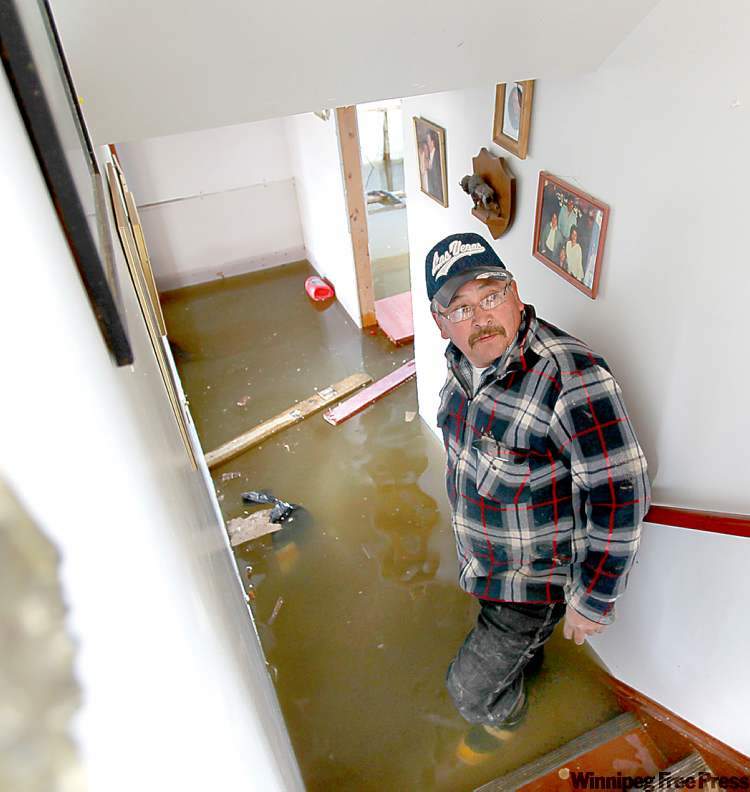
Time and patience that, for some residents, is running out. “I’m hoping I get some kind of help, of moving us out of here, or diking it up,” Spence said. “Something’s gotta be done.”
Back near the band office, the chief agreed. “To put our families through this is unacceptable,” Hudson said.
The chief would like to see permanent protection for Peguis, which is Manitoba’s most populous reserve. But while the idea of a permanent diversion has been considered, it would take years to complete. In the meantime, permanent dikes could be a short-term solution, he said — like the $2.5-million plan the province recently announced for the RM of St. Andrews.

“Why aren’t we getting that type of announcement?” Hudson said, noting flood barriers in Peguis would also protect communities north of the reserve, including Fisher River. “We’re down in numbers (from 2009), but we’re the most impacted (community), combined, of the entire province.”
The community continues to stand together to fight back the waters. Volunteers with the humane society have boated around the inundated homes, leaving food and water for dogs left behind and rescuing sicker ones after their owners had to flee to Winnipeg hotels.
And on the north side of the reserve, almost 30 volunteers — mostly teens in hoodies and muddy jeans — clambered over a sandbag dike, building it up to save a tidy white house from the nearby river. Their team has already sandbagged 20 houses.
The mood on the line was jovial, as volunteers cracked jokes and tamped down the dike. “People needed help, so we decided to come out,” said volunteer Travis Letexier. “Even people from other reserves come to help. We’re just trying to do as many houses as we can.”
melissa.martin@freepress.mb.ca
Melissa Martin
Reporter-at-large
Melissa Martin reports and opines for the Winnipeg Free Press.
Every piece of reporting Melissa produces is reviewed by an editing team before it is posted online or published in print — part of the Free Press‘s tradition, since 1872, of producing reliable independent journalism. Read more about Free Press’s history and mandate, and learn how our newsroom operates.
Our newsroom depends on a growing audience of readers to power our journalism. If you are not a paid reader, please consider becoming a subscriber.
Our newsroom depends on its audience of readers to power our journalism. Thank you for your support.
Melissa Martin
Reporter-at-large
Melissa Martin reports and opines for the Winnipeg Free Press.
Every piece of reporting Melissa produces is reviewed by an editing team before it is posted online or published in print — part of the Free Press‘s tradition, since 1872, of producing reliable independent journalism. Read more about Free Press’s history and mandate, and learn how our newsroom operates.
Our newsroom depends on a growing audience of readers to power our journalism. If you are not a paid reader, please consider becoming a subscriber.
Our newsroom depends on its audience of readers to power our journalism. Thank you for your support.
Related Articles
Ice jam breaks west of Winnipeg; rivers expected to rise in city
Advertisement Advertise With Us
Advertisement Advertise With Us