

Selkirk’s transit system makes first run Monday

Advertisement
Read this article for free:
or
Already have an account? Log in here »
To continue reading, please subscribe:
Digital Subscription
One year of digital access for only $1.44 a week*
- Enjoy unlimited reading on winnipegfreepress.com
- Read the E-Edition, our digital replica newspaper
- Access News Break, our award-winning app
- Play interactive puzzles
*Billed as $5.77 plus GST every four weeks. After 52 weeks, price increases to the regular rate of $19.95 plus GST every four weeks. Offer available to new and qualified returning subscribers only. Cancel any time.
To continue reading, please subscribe:
Add Free Press access to your Brandon Sun subscription for only an additional
$1 for the first 4 weeks*
- Enjoy unlimited reading on winnipegfreepress.com
- Read the E-Edition, our digital replica newspaper
- Access News Break, our award-winning app
- Play interactive puzzles
*Your next Brandon Sun subscription payment will increase by $1.00 and you will be charged $17.95 plus GST for four weeks. After four weeks, your payment will increase to $24.95 plus GST every four weeks.
Read unlimited articles for free today:
or
Already have an account? Log in here »
Hey there, time traveller!
This article was published 25/05/2011 (5491 days ago), so information in it may no longer be current.
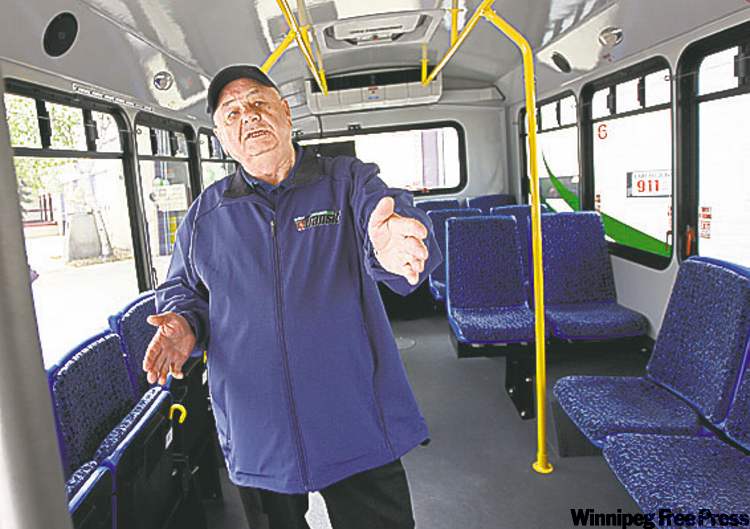
SELKIRK — At 6 a.m. Monday, driver Roy Sveinson will make history behind the wheel of Selkirk’s first public transit bus run.
“I was a highway driver for 35 years,” said Sveinson, one of Selkirk Transit’s three drivers, who is looking forward to being closer to home and the first to welcome Selkirk transit riders aboard.
“Age before beauty,” joked fellow driver Dean Bird, who would’ve liked the inaugural run. Sveinson, Bird and Gerald Mayo will operate Selkirk’s transit bus six days a week — from 6 a.m. to 6 p.m. Monday to Friday and 8 a.m. to 6 p.m. Saturday.
There will be no service on Sunday or holidays.
And there will be no charge until Canada Day.
Starting July 2, fares are $2 for everyone, except children five and under.
“It signals a coming of age for our city,” said Duane Nicol, the deputy mayor who led the project. It’s taken more than six years to get Selkirk residents a municipal bus service. Selkirk’s population has decreased from 9,752 in 2001 to 9,515 in 2006, according to the last census.
Nicol said the community will attract more people and investment — whether seniors housing or industry — with reliable municipal transit.
“Now, you either walk, cab it, or get a friend to drive you,” said Selkirk resident Joe Swieszko. The retired Winnipeg bus driver was on the task force trying to get a transit system for Selkirk six years ago.
“I volunteered because they really needed help,” he said. He left after one year because he found the process agonizingly slow. “They discussed things to death.”
Swieszko is glad the idea didn’t die, though.
“This will be an added convenience here for lots of people,” he said at the Selkirk fire hall, where he watched the ribbon-cutting ceremony with the mayor, a cabinet minister, the area MLA and Nicol, who saw the project through to the end.
“When this whole thing started, I didn’t have grey hair,” said Nicol.
The province’s funding commitment is what sealed the deal, he said.
The province will cover half of the $180,000 annual operating cost, Nicol said.
Manitoba’s 50-50 transit funding partnership also provides financial support to public transit in Flin Flon, Thompson, Brandon and Winnipeg.
Selkirk doesn’t have Winnipeg’s traffic or crowds but its bus drivers will still have a challenge, said Winnipeg Transit’s John Vagi, who trained them.
“Selkirk is a small town where everybody knows everybody,” said Vagi.
He figures it won’t be long before one of the drivers will be asked by a passenger, “Can you just drop me off at my house?”

They’ll have to say no unless it’s on the route, Vagi said.
The federal gas tax and public transit trust allocations are providing startup capital funding of $187,500 for a new bus, bus stops and shelters.
The municipality has two Handi-Transit-sized and wheelchair-accessible buses, and will use one at a time except during peak periods.
They will collect real-time data to determine peak demand times.
carol.sanders@freepress.mb.ca
Carol Sanders
Legislature reporter
Carol Sanders is a reporter at the Free Press legislature bureau. The former general assignment reporter and copy editor joined the paper in 1997. Read more about Carol.
Every piece of reporting Carol produces is reviewed by an editing team before it is posted online or published in print — part of the Free Press‘s tradition, since 1872, of producing reliable independent journalism. Read more about Free Press’s history and mandate, and learn how our newsroom operates.
Our newsroom depends on a growing audience of readers to power our journalism. If you are not a paid reader, please consider becoming a subscriber.
Our newsroom depends on its audience of readers to power our journalism. Thank you for your support.
Carol Sanders
Legislature reporter
Carol Sanders is a reporter at the Free Press legislature bureau. The former general assignment reporter and copy editor joined the paper in 1997. Read more about Carol.
Every piece of reporting Carol produces is reviewed by an editing team before it is posted online or published in print — part of the Free Press‘s tradition, since 1872, of producing reliable independent journalism. Read more about Free Press’s history and mandate, and learn how our newsroom operates.
Our newsroom depends on a growing audience of readers to power our journalism. If you are not a paid reader, please consider becoming a subscriber.
Our newsroom depends on its audience of readers to power our journalism. Thank you for your support.
Advertisement Advertise With Us
Advertisement Advertise With Us