

City pair to track exotic whales
Will brave Arctic ice to trace migration
Advertisement
Read this article for free:
or
Already have an account? Log in here »
To continue reading, please subscribe:

Digital Subscription
One year of digital access for only $205*
- Enjoy unlimited reading on winnipegfreepress.com
- Read the E-Edition, our digital replica newspaper
- Access News Break, our award-winning app
- Play interactive puzzles
*First annual payment billed as $205.00 + GST for one year. This annual subscription will automatically renew at $233.00 + GST every 52 weeks (10% off the regular annual price of $259.35). Offer available to new and qualified returning subscribers only. Cancel any time.
To continue reading, please subscribe:
Add Free Press access to your Brandon Sun subscription for only an additional
$1 for the first 4 weeks*
- Enjoy unlimited reading on winnipegfreepress.com
- Read the E-Edition, our digital replica newspaper
- Access News Break, our award-winning app
- Play interactive puzzles
*Your next Brandon Sun subscription payment will increase by $1.00 and you will be charged $17.95 plus GST for four weeks. After four weeks, your payment will increase to $24.95 plus GST every four weeks.
Read unlimited articles for free today:
or
Already have an account? Log in here »
Hey there, time traveller!
This article was published 27/05/2011 (5530 days ago), so information in it may no longer be current.
One week from today, Chris Debicki and Kristin Westdal will begin the ultimate summer gig — if your idea of a dream job involves a chance of getting crushed between sheets of Arctic ice.
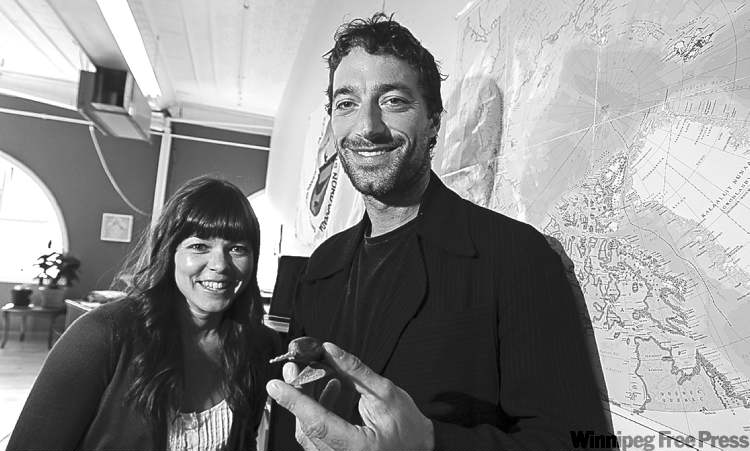
The two Winnipeg-based staffers with Oceans North Canada will spend a month on a converted crab trawler as part of the first scientific attempt to follow the migration of most of the planet’s narwhals through channels of ice between the coasts of Greenland and Nunavut.
About 65,000 of the world’s estimated 80,000 narwhals — small members of the whale family, known for their unicorn-like tusks — migrate across a vein of open ocean known as the North Water Polynya to Nunavut’s Lancaster Sound every spring, along with thousands of bowhead and beluga whales.
Although Inuit have known about the gathering for centuries, nobody has attempted to study the migration up close. The main obstacle has been the threat posed by the shifting ice in this stretch of Baffin Bay, only navigable during a narrow window between the spring thaw and a rush of ice from the north later in the summer.
Winnipeggers Debicki and Westdal are among a crew of eight who will attempt to make the crossing on a 15-metre trawler equipped to navigate through icy channels. In Newfoundland, the crabber was retrofitted with sails.
“We got a lot of funny looks from the fishermen at the docks,” said expedition leader Debicki, a lawyer who serves as the Nunavut director for Oceans North Canada, a wing of the international Pew Environment Group.
Weather permitting, the $500,000 expedition plans to leave the Greenland port if Ilulissat on June 3 and spend a month edging along across Baffin Bay to Lancaster Sound, a summer gathering place for seabirds, whales and other animals attracted to schools of turbot and other fish.
“You can think of it as an Arctic oasis,” said Debicki, whose organization would like to see Lancaster Sound protected as a marine preserve, both to ensure the survival of the animals and the Inuit who rely on them.
“We’re a different kind of non-governmental organization in that we’re not just advocating marine conservation for conservation’s sake. We’re also advocating for the Inuit,” Debicki said.
The expedition’s main goal is to survey the numbers of narwhals, belugas, bowheads and other whales. It will also monitor migrating whale sounds, survey seabirds and trawl for plankton as part of a polar bear food-chain study.
“We don’t know a lot about this area, so we’re trying to fill in the holes,” said biologist Westdal, a University of Manitoba environmental science graduate. She and Debicki will be joined by a Finnish biologist, a mechanic from Nunavut, two Norwegian sailors and a pair of documentary filmmakers from Halifax.
They’ve equipped their trawler with a kayak and a three-metre tin boat to enter narrow channels. The ship also has survival suits, flotation suits, several satellite phones, GPS beacons and radios. Ice can disable or even crush the trawler, which is capable of moving through slush but cannot break through sheets of ice.

“We’ve got advice about how to deal with bad weather: You head into the ice as far as you can,” said Debicki, explaining that fast-moving sheets of ice are the most dangerous. “It’s OK to get stuck.”
The narwhals themselves won’t pose a danger, despite tusks that average two to three metres long.
“We think they’re secondary sexual characteristics,” said Westdal, explaining the purpose of the tusks. “They’re like feathers on a peacock.”
You can monitor the progress of the expedition at www.oceansnorth.org/2011-arctic-whale-survey.
bartley.kives@freepress.mb.ca