

Ceremony recognizes treaty rights
Symbols of nationhood central to yearly event
Advertisement
Read this article for free:
or
Already have an account? Log in here »
To continue reading, please subscribe:
Monthly Digital Subscription
$1 per week for 24 weeks*
- Enjoy unlimited reading on winnipegfreepress.com
- Read the E-Edition, our digital replica newspaper
- Access News Break, our award-winning app
- Play interactive puzzles
*Billed as $4.00 plus GST every four weeks. After 24 weeks, price increases to the regular rate of $19.95 plus GST every four weeks. Offer available to new and qualified returning subscribers only. Cancel any time.
Monthly Digital Subscription
$4.99/week*
- Enjoy unlimited reading on winnipegfreepress.com
- Read the E-Edition, our digital replica newspaper
- Access News Break, our award-winning app
- Play interactive puzzles
*Billed as $19.95 plus GST every four weeks. Cancel any time.
To continue reading, please subscribe:
Add Free Press access to your Brandon Sun subscription for only an additional
$1 for the first 4 weeks*
*Your next subscription payment will increase by $1.00 and you will be charged $16.99 plus GST for four weeks. After four weeks, your payment will increase to $23.99 plus GST every four weeks.
Read unlimited articles for free today:
or
Already have an account? Log in here »
Hey there, time traveller!
This article was published 15/06/2011 (5407 days ago), so information in it may no longer be current.
Under the tent, $5 bills are stacked in neat rows on a long table, the Canadian Maple Leaf to one side, a Mountie in red serge on the other.
A polite crowd sits in a dozen or so plastic folding chairs facing the table, the flag and the Mountie.
Babies nestle in a couple of strollers. They don’t cry.
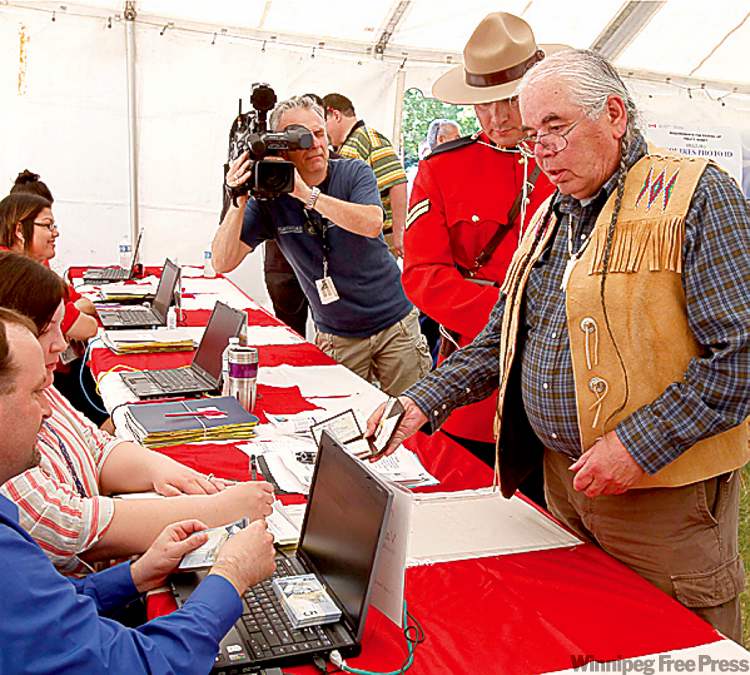
The event is the opening ceremony of the Urban Treaty Payments, celebrated Tuesday at The Forks National Historic Site, one of dozens of events where $5 bills will be paid out, one by one, to as many of the 130,000 treaty Indians in Manitoba who line up to collect them this summer. Some 8,000 will attend the ceremonies at The Forks this month.
The ceremony is a solemn occasion, with dignitaries and federal officials from Parks Canada and the newly renamed Aboriginal Affairs and Northern Development department. James Wilson, Manitoba’s treaty commissioner, waits for his turn to speak.
For young dad Stan Monias and his partner, Chantelle Day, the event is tradition.
“It’s a yearly thing you expect from the government. I grew up doing this with my parents on the reserve,” Monias says.
He’s from Garden Hill First Nation, a remote Oji-Cree community in northeastern Manitoba waiting for indoor plumbing.
This day, Monias brought his two-year-old daughter, Britany Day, in a stroller.
Gary Robson, an Anishinabe elder, steps forward, greying braids brushing a beaded moosehide vest, and starts to talk about the treaty.
Robson points out the flag, the $5 bills and the Mountie as ceremonial symbols to government officials and the treaty Indians watching him.
“These treaty payments are ceremonies,” Robson says, “a recognition of the relationship of nation to nation. We have to understand this flag means something,” he says, and gestures to the Maple Leaf.
The first treaty was signed in 1871 in front of the British Union Jack during Queen Victoria’s reign. Robson’s ancestors, from Peguis, may have been among the 3,000 people who witnessed the first treaty.
At the time, witnesses were handed medals engraved with Victoria’s image. The flag and the medals were symbols of the Crown’s commitment to honour the treaties: tokens of nationhood.
Same with the Mountie.
“These treaty payments are ceremonies, a recognition of the relationship of nation to nation. When those treaties were signed, they were signed as nation to nation. It has to be recognized that as First Nations, we never gave up our rights,” Robson says.

The first ceremony opened up tracts of land in Winnipeg and southern Manitoba to settlement. Another 10 treaties opened up the rest of the West, and were followed by a century of mistreatment.
The treaty ceremony is vital because it is the one day a year when First Nations are recognized as founding nations, Robson says.
Robson breathes a prayer to seal his words and turns the podium over to treaty commissioner Wilson, who picks up the thread of the speech and seamlessly stitches up the rest of the theme.
“We all know that since the treaties were signed, the relationship hasn’t been as strong as it could be,” Wilson says. “Treaties are the fundamental building blocks of Canada as a country and by going through this ceremony, we recognize the importance of that.”