

Honey crop bitter and sweet
Some farms endure unprecedented bee deaths
Advertisement
Read this article for free:
or
Already have an account? Log in here »
To continue reading, please subscribe:
Digital Subscription
One year of digital access for only $75*
- Enjoy unlimited reading on winnipegfreepress.com
- Read the E-Edition, our digital replica newspaper
- Access News Break, our award-winning app
- Play interactive puzzles
*Billed as $5.77 plus GST every four weeks. After 52 weeks, price increases to the regular rate of $19.95 plus GST every four weeks. Offer available to new and qualified returning subscribers only. Cancel any time.
Monthly Digital Subscription
$4.99/week*
- Enjoy unlimited reading on winnipegfreepress.com
- Read the E-Edition, our digital replica newspaper
- Access News Break, our award-winning app
- Play interactive puzzles
*Billed as $19.95 plus GST every four weeks. Cancel any time.
To continue reading, please subscribe:
Add Free Press access to your Brandon Sun subscription for only an additional
$1 for the first 4 weeks*
- Enjoy unlimited reading on winnipegfreepress.com
- Read the E-Edition, our digital replica newspaper
- Access News Break, our award-winning app
- Play interactive puzzles
*Your next Brandon Sun subscription payment will increase by $1.00 and you will be charged $17.95 plus GST for four weeks. After four weeks, your payment will increase to $24.95 plus GST every four weeks.
Read unlimited articles for free today:
or
Already have an account? Log in here »
Hey there, time traveller!
This article was published 24/08/2011 (5385 days ago), so information in it may no longer be current.
Honeybees convey a homespun image of beeswax candles and glass jars filled with gooey, sweet, amber liquid.
The honeybee is a $20-million dollar industry in Manitoba, which is also credited with another $60 million in annual unpaid crop pollination.
But this has been one of the strangest years ever for Manitoba beekeepers. The industry came out of the winter with an unprecedented number of bee losses — the average die-off was 34 per cent.
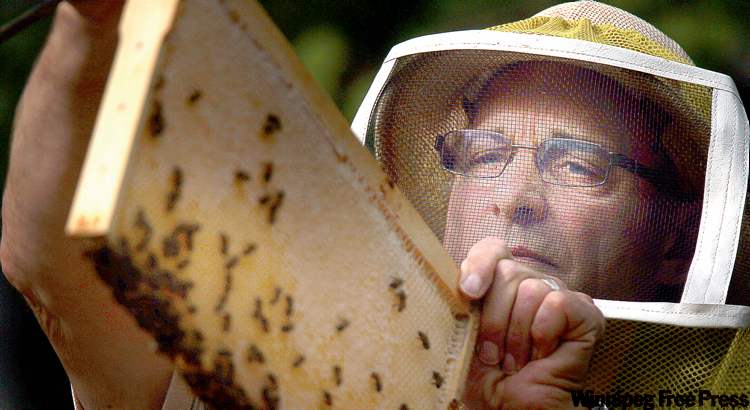
“I don’t think anyone knows what’s going to happen this year,” Murray Lewis, president of the Manitoba Beekeepers’ Association, said. “Some areas are going to have a better-than-average year, and for some areas it’s going to be a disaster.”
Honeybees collect their nectar from farmers’ fields, yet the wet spring and June resulted in late-planted crops and, in some areas, no crops at all. Fewer crops and a shorter growing season translates into a lot less honey for beekeepers.
Brian Ash is not having a good year. He is a second-generation beekeeper who operates the province’s largest honeybee operation, Ash Apiary in Gilbert Plains, with about 5,500 hives.
The year started with a disaster, when 70 per cent of Ash’s bees died during the winter — and he doesn’t know why.
Widespread die-offs have been common in the U.S. since 2007, where they’ve been blamed on a concept called colony collapse disorder. But die-offs of this size are rare in Canada and restricted to local areas. This year, some operators lost all of their bees in the northwestern part of Manitoba.
“The scary part is I don’t know what’s in store for next year if I don’t know what killed them this year,” Ash said.
Provincial apiarist Rheal Lafreniere said winter die-offs in Manitoba used to range between 15 and 25 per cent but have crept up higher lately, averaging closer to 30 per cent for the last five years. The average die-off rate last year was 24 per cent.
Lafreniere said he has no explanation as to what killed Ash’s bees and those of his neighbours — some reported 100 per cent die-off — but attributes it to a combination of factors including stress, disease and parasitic mites.
Lewis, who has 650 honey-producing hives in Austin, said the south-central part of the province had a good year, but noted that for beekeepers in Dauphin — unprecedented die-offs — and Souris — no crops planted because fields were too wet — it will be a disaster.
Lewis explained he experienced a die-off rate coming out of this winter of about 12 to 15 per cent — less than half of the provincial average — and he attributes it to bad management. Lewis said he didn’t deal quickly enough with the varroa mite and it took its toll on his bees. Despite that however, he said his operation still expects to have a better than average year — a scenario he said will be repeated throughout the Red River Valley and south-central area of the province.

Lafreniere said beekeepers can accommodate losses of under 25 per cent, usually by splitting their hives. They will need to buy replacement bees with losses greater than that.
Ash said he replaced his dead colony with bees from New Zealand and Australia but those hives won’t produce the amount of honey in typical years.
Manitoba-born bees are considered among the best in the world and best for Manitoba conditions.
“Queen bees from Australia and New Zealand aren’t subjected to the -40 (C) winters we have here,” Lewis said. “Bees that are produced here are better for our area.”
aldo.santin@freepress.mb.ca