

He knew when to threaten and charm
'Tough hombre' an intellectual giant who served public

Advertisement
Read this article for free:
or
Already have an account? Log in here »
To continue reading, please subscribe:

Digital Subscription
One year of digital access for only $205*
- Enjoy unlimited reading on winnipegfreepress.com
- Read the E-Edition, our digital replica newspaper
- Access News Break, our award-winning app
- Play interactive puzzles
*First annual payment billed as $205.00 + GST for one year. This annual subscription will automatically renew at $233.00 + GST every 52 weeks (10% off the regular annual price of $259.35). Offer available to new and qualified returning subscribers only. Cancel any time.
To continue reading, please subscribe:
Add Free Press access to your Brandon Sun subscription for only an additional
$1 for the first 4 weeks*
- Enjoy unlimited reading on winnipegfreepress.com
- Read the E-Edition, our digital replica newspaper
- Access News Break, our award-winning app
- Play interactive puzzles
*Your next Brandon Sun subscription payment will increase by $1.00 and you will be charged $17.95 plus GST for four weeks. After four weeks, your payment will increase to $24.95 plus GST every four weeks.
Read unlimited articles for free today:
or
Already have an account? Log in here »
Hey there, time traveller!
This article was published 15/10/2011 (5447 days ago), so information in it may no longer be current.
I was with Reg Alcock the first time he broke 100 on a golf course.
It was the late 1990s and Alcock, then still a backbench MP, was having the round of his life. We had played golf quite a bit when I was in Ottawa for three years as the Free Press national correspondent, and he had never threatened this magic threshold. An alarmingly low percentage of all golfers ever break the century mark. Alcock seemed sure to join that group.
On the 18th tee of the Charleswood Golf and Country Club, I scanned the scorecard and saw that he needed a 10 to shoot 99. The way he was playing, I thought that was a comfortable cushion, so I said nothing. Right after he hit his fifth shot on that final hole — a wayward iron from the fairway that found the bush — I told him the situation. Regrouping, he finished the hole in 10 strokes, and shot 99. It was then that Alcock, all 350 pounds of him, did a little jig that I will surely never forget.
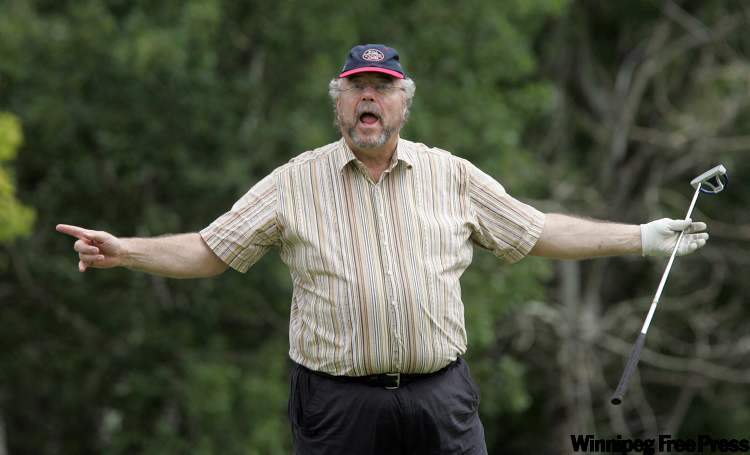
It’s a special moment to share with a fellow golfer. What I remember most was how Alcock maintained his cool when he found out he was perilously close to breaking the magic century mark. He did not panic, but rather put his considerable intellectual powers to work. Having watched many a golfer evaporate under the pressure of reaching a personal best, it was a pretty amazing display of composure.
That tale would come as no surprise to those who knew Reg Alcock during his life. Love him or hate him or fear him, it would be hard to find a person who did not recognize him as an intellectual giant.
Educated at Simon Fraser and Harvard universities, Alcock enjoyed several entirely different but successful careers in his life. He was a former superintendent of the Seven Oaks Youth Centre. He once owned and operated the Royal Albert Hotel in downtown Winnipeg. He was a politician elected to long terms in both the Manitoba legislature and federal House of Commons. He was an educator who taught at both the University of Manitoba and at Harvard. He was a consultant who travelled throughout the world talking about how to make government more accountable, more efficient and more modern through information technology.
There are many people who believe true public servants cannot have political ambition. Reg Alcock was the proof that good men can serve the public and their own ambition, and make the world a better place.
As a partisan politician, Alcock was a “tough hombre” as one prominent Manitoba Grit put it. He had the capacity to involve himself in just about everybody’s party business, and made sure his influence was felt. He was at the forefront of the campaign to dump former prime minister Jean Chrétien and replace him with Paul Martin. He used charm to lure those who could be charmed, and threatened those who needed an extra push. He ultimately became Manitoba’s regional minister in the Martin cabinet, establishing himself as a force to be reckoned with. Liberals will tell you he accomplished as much or more in his two-year stint as regional minister as most of those who came before him.
And yet it would be wrong to say Alcock’s political career was about seizing and maintaining power. He believed strongly in protecting the entire Liberal team in Manitoba, a trait not shared by some of the previous regional Grit ministers.
It is important to note that when he was defeated in 2006, most Liberals believed it was because he did not spend enough time defending his own riding. After the defeat, he admitted he just did not knock on enough doors, shake enough hands and make enough phone calls in Winnipeg South to turn back the Conservative surge. Why? Because he was out knocking on doors, shaking hands and making phone calls to shore up the campaigns of other Liberals in Manitoba.
A political defeat like that can humble, even destroy a weaker man. Although it took time for Alcock to rationalize his sudden departure from elected office, he did not wilt. He instead channelled his dedication to public service to education, teaching innovative MBA classes at the U of M’s Asper School of Business and lecturing at Harvard’s Kennedy School of Governance.
More recently, he had undertaken intensive research into the area of public-sector board governance. A subject far too arcane for the average legislator, Alcock had fast become one of the country’s leading authorities on how boards of directors in government-controlled entities should function. In the world of public administration, where more and more of what government does is controlled by Crown entities, that is surely God’s work.
Reg Alcock was a brilliant man. He was a dedicated public servant. He had visited the inner sanctums of power, and came out a better and more enlightened man. Manitoba, and Canada, are simply less without him.
dan.lett@freepress.mb.ca
HE SAID IT: A politician’s soundbites over a decade
“It’s just one more misrepresentation and complete distortion of reality.”
— Alcock, criticizing the Mulroney government’s claims the West was getting a larger slice of the economic pie, April 4, 1989
“They’re too arrogant and pigheaded.”
— Criticizing Filmon government MLAs for walking out of a committee meeting, Oct. 4, 1989
“You’d think by now I’d know better.”
— Rushing back from a teaching position at Harvard after a provincial election was suddenly called,
Aug. 21, 1990
“It’s the Liberal experience in this province that nothing worth having comes easy.”
— After getting the Liberal nod to run for MP in Winnipeg South by five votes,
March 22, 1993
“It’s a little bit scary. We have a huge majority and now we have a lot of work to do.”
— After winning a seat as MP and watching his Liberal party rack up a majority victory over the Reform party, Oct. 25, 1993
“I think if he wants to serve the country, the party and his own legacy, he would be wise to step down.”
— Calling for PM Jean Chrétien to resign, Dec. 17, 2002
“Frankly, if I was going to recruit somebody I’d go a little higher up the gene pool.”

— Dismissing claims by Tory Inky Mark he had offered the MP an ambassadorship to increase Liberal chances of surviving a non-confidence vote, May 4, 2005
“I was surprised. I didn’t see it coming. I made a choice to go out and campaign in other ridings. I spent two days door-knocking in my riding. I made a gamble and I lost.”
— After losing his seat to Tory MP Rod Bruinooge on Jan. 23, 2006
“This puts me on campus within an exceptionally talented faculty and allows me the time to continue my research on how public-sector management must change to meet the challenges of a rapidly changing community.”
— After being hired by the University of Manitoba, Jan. 30, 2007
Dan Lett is a columnist for the Free Press, providing opinion and commentary on politics in Winnipeg and beyond. Born and raised in Toronto, Dan joined the Free Press in 1986. Read more about Dan.
Dan’s columns are built on facts and reactions, but offer his personal views through arguments and analysis. The Free Press’ editing team reviews Dan’s columns before they are posted online or published in print — part of the our tradition, since 1872, of producing reliable independent journalism. Read more about Free Press’s history and mandate, and learn how our newsroom operates.
Our newsroom depends on a growing audience of readers to power our journalism. If you are not a paid reader, please consider becoming a subscriber.
Our newsroom depends on its audience of readers to power our journalism. Thank you for your support.
Dan Lett is a columnist for the Free Press, providing opinion and commentary on politics in Winnipeg and beyond. Born and raised in Toronto, Dan joined the Free Press in 1986. Read more about Dan.
Dan’s columns are built on facts and reactions, but offer his personal views through arguments and analysis. The Free Press’ editing team reviews Dan’s columns before they are posted online or published in print — part of the our tradition, since 1872, of producing reliable independent journalism. Read more about Free Press’s history and mandate, and learn how our newsroom operates.
Our newsroom depends on a growing audience of readers to power our journalism. If you are not a paid reader, please consider becoming a subscriber.
Our newsroom depends on its audience of readers to power our journalism. Thank you for your support.
Related Articles
Province loses faithful servant
Advertisement Advertise With Us
Advertisement Advertise With Us