

Local research advancing genome sequence testing
Promises to revolutionize disease detection
Advertisement
Read this article for free:
or
Already have an account? Log in here »
To continue reading, please subscribe:
Digital Subscription
One year of digital access for only $1.44 a week*
- Enjoy unlimited reading on winnipegfreepress.com
- Read the E-Edition, our digital replica newspaper
- Access News Break, our award-winning app
- Play interactive puzzles
*Billed as $5.77 plus GST every four weeks. After 52 weeks, price increases to the regular rate of $19.95 plus GST every four weeks. Offer available to new and qualified returning subscribers only. Cancel any time.
To continue reading, please subscribe:
Add Free Press access to your Brandon Sun subscription for only an additional
$1 for the first 4 weeks*
- Enjoy unlimited reading on winnipegfreepress.com
- Read the E-Edition, our digital replica newspaper
- Access News Break, our award-winning app
- Play interactive puzzles
*Your next Brandon Sun subscription payment will increase by $1.00 and you will be charged $17.95 plus GST for four weeks. After four weeks, your payment will increase to $24.95 plus GST every four weeks.
Read unlimited articles for free today:
or
Already have an account? Log in here »
Hey there, time traveller!
This article was published 22/11/2011 (5318 days ago), so information in it may no longer be current.
When a catastrophic earthquake struck the impoverished Caribbean nation of Haiti in early 2010, it sparked a massive international humanitarian response.
One of the unfortunate consequences of that effort, though, was an outbreak of cholera in October of that year. The disease was unwittingly introduced by members of a helping agency.
The result was tragic. The disease has killed more than 6,600 Haitians and hospitalized a quarter million more. Before the outbreak, Haiti had been free of cholera for at least 100 years.
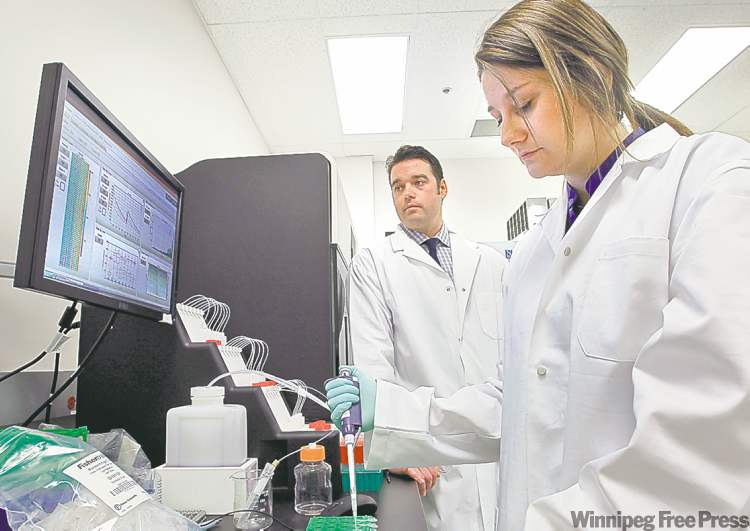
For scientists on two continents — including researchers in Winnipeg — the outbreak provided an opportunity to employ the new field of genome sequence testing to a live problem on an international scale.
Cholera is spread by consuming water tainted by human waste. The outbreak in Haiti occurred after the quake destroyed the country’s ability to provide clean drinking water.
The disease was detected using traditional scientific methods, but researchers also saw the opportunity to use genomic sequencing to pinpoint its source. Officials with the U.S. Centers for Disease Control and Prevention (CDC) did the sequencing and sent the raw data to the Public Health Agency of Canada’s National Microbiology Lab (NML) in Winnipeg for analysis.
The Winnipeg lab had already received international recognition for carrying out genomic testing during Canada’s 2008 listeriosis crisis.
With the Haitian cholera epidemic, the research pointed to the Indian subcontinent as the source of the disease. A third team of researchers, based in Denmark, flew to Nepal, where they analyzed 23 strains of the disease there. The strains proved to be a match to those found in Haiti. It’s believed Nepalese-based UN soldiers had unwittingly carried cholera with them to the Caribbean.
While the genomic sequencing had few immediate benefits for the people of Haiti — detection and treatment of cholera is pretty routine stuff — it marked a step forward for a scientific procedure that promises to revolutionize the way we detect diseases — and learn how to treat them — in the future, according to one of the Winnipeg scientists involved in the Haitian project.

“This is one of these technologies that in the near future is going to massively revolutionize our ability to do these investigations,” said Matthew Gilmour, chief of the Arlington Street lab’s enteric disease program.
Gilmour is one of the authors of a new scientific paper prepared by the Winnipeg-based lab in conjunction with several other international agencies. It was presented at an international conference of academics and public health experts earlier this month in Spain. Its lead author, Aleisha Reimer, heads the Winnipeg lab’s six-person Listeria Genomics Project, which turned its attention to cholera research when the Atlanta-based CDC came calling. (Reimer was not authorized by the Public Health Agency of Canada to be interviewed by the Free Press.)
Gilmour uses a book analogy to explain how more information can be gleaned by employing genome sequence testing in the study of diseases compared with traditional methods. He said the old methods reveal the table of contents on a subject while genomic sequence testing serves up the whole book.
He expects in the next decade it will be the “defacto lab test” used across Canada and around the world to sleuth out and combat unknown organisms that make people sick. The goal for local and international researchers now is to speed up testing and analysis from days and weeks to a single day.
larry.kusch@freepress.mb.ca