

Getting small
Cuts less than advertised, but Tory trend is clear

Advertisement
Read this article for free:
or
Already have an account? Log in here »
To continue reading, please subscribe:

Digital Subscription
One year of digital access for only $205*
- Enjoy unlimited reading on winnipegfreepress.com
- Read the E-Edition, our digital replica newspaper
- Access News Break, our award-winning app
- Play interactive puzzles
*First annual payment billed as $205.00 + GST for one year. This annual subscription will automatically renew at $233.00 + GST every 52 weeks (10% off the regular annual price of $259.35). Offer available to new and qualified returning subscribers only. Cancel any time.
To continue reading, please subscribe:
Add Free Press access to your Brandon Sun subscription for only an additional
$1 for the first 4 weeks*
- Enjoy unlimited reading on winnipegfreepress.com
- Read the E-Edition, our digital replica newspaper
- Access News Break, our award-winning app
- Play interactive puzzles
*Your next Brandon Sun subscription payment will increase by $1.00 and you will be charged $17.95 plus GST for four weeks. After four weeks, your payment will increase to $24.95 plus GST every four weeks.
Read unlimited articles for free today:
or
Already have an account? Log in here »
Hey there, time traveller!
This article was published 30/03/2012 (5285 days ago), so information in it may no longer be current.
Let’s face it, this federal budget is going to be difficult to decipher.
We know the broad strokes of Finance Minister Jim Flaherty’s plan — $5.2 billion in spending cuts, 20,000 jobs to be eliminated along with the penny — but more than previous budgets, it is a budget encased in mystery.
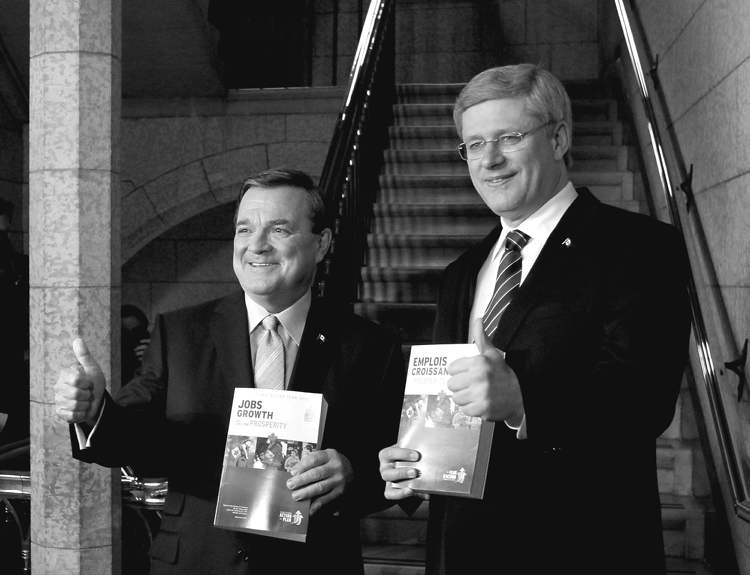
Hundreds of pages of tables are dumped on journalists, who are asked to make sense of it all in just a few hours. And many of the specific measures needed to realize the government’s budget plan are not revealed on budget day; the specific jobs that will be lost, the specific programs that will be discontinued and the new programs that will be framed will not be known for months, if not years.
This inescapable reality allows the government a fighting chance to frame this as a “jobs and growth” budget, focused on strategic investments and programs designed to make the Canadian economy more dynamic. Opposition critics counter with the allegation this is really an “austerity” budget, with mean-spirited cuts to spending and civil servants.
Of course, everything is relative. In a clever move, the Tories leaked details of an austerity budget that never materialized. Reports in the last week, most claiming to have inside information about the details of the budget, predicted total cuts of up to $8 billion in spending and up to 60,000 jobs.
In contrast, we get cuts of $5.2 billion in spending and nearly 20,000 jobs. These are both significant reductions in both spending and federal jobs, but they seem so much more reasonable than the numbers floated in the last month. Well played, Mr. Flaherty.
So beyond the hyperbole flying on all sides, what is this budget all about? It’s starting to look a lot like an opportunistic budget, one that took advantage of a recessionary window of opportunity to exact long-desired reductions in the footprint of the federal government.
It is important to remember Ottawa was making significant progress in reducing its budget deficit through growth in revenues. Ottawa will end the current fiscal year nearly $10 billion ahead of its deficit target. As a result, the government likely did not need to cut spending or jobs this deep just to address the deficit. So if this is an austerity budget, it is an austerity of want rather than an austerity of need. That does not make the cuts evil, but it is important to understand the context.
It should come as no surprise this budget is, ultimately, part of a long-term plan, the main goal of which is to make government smaller. This process actually began in the minority years with the two-point reduction in the GST. Now, with less capacity to grow revenue, smaller government just seems to make a lot of sense.
In the future, robust revenue years are opportunities to lower taxes; lean years become opportunities to shrink government. And the cycle continues. With lower taxes, it is essential to have an ever-smaller government. Smaller government means lower costs, which creates an opportunity to lower taxes.
This is a dream scenario for many small-c conservatives who believe the road to prosperity for all Canadians is paved with lower taxes that are only possible with smaller government. These Canadians do not believe federal job cuts will affect government services. They reject the notion government services and entitlements, which are only possible if the government generates enough tax revenue to pay for these programs, are essential for the lowest-income earners to maintain any semblance of a reasonable standard of living. They would suggest lower taxation on business leads to greater job creation and higher standards of living.
It is hard to find anyone who doesn’t welcome a cut in taxes. But just as it is difficult to find the truth in a federal budget on the day it is released, so too is it trying to assess the impact of those tax cuts on core government services. We might imagine the only people who will lose their jobs are faceless, paper-pushing bureaucrats with no real purpose. The Tories claim these cuts, less than a five per cent reduction in the civil service, is “hardly severe.” But surely some of those 20,000 jobs will mean reductions in important government services. The Tories will say smaller government is more efficient government. And that could be true, although in many instances, it just means less government.
The best example of this is the delay in old age security eligibility. Flaherty said moving the OAS benefit age to 67 from 65 is a big deal. Clearly, however, there are thousands of Canadians who, once they stop working, have no pension plan or retirement savings. A 24-month delay in accessing OAS is a big deal for them. That isn’t better or more efficient, it is just less.
Belt-tightening in the interests of efficiency is something we should expect of government regardless of political stripe. That kind of austerity can, ultimately, benefit all citizens. But it will take many years, and a lot of intensive digging, to prove this is indeed the main impact of this budget.
For now, it is a mystery wrapped in wildly conflicting hyperbole.

Wish us luck.
dan.lett@freepress.mb.ca
The Manitoba analysis
Manitoba Finance Minister Stan Struthers will offer his analysis of the federal budget this morning at 10 a.m. at the Free Press News Café. Join Struthers and Free Press political columnist Dan Lett live on www.winnipegfreepress.com as they discuss the impact of the federal budget on Manitoba and how it might affect the upcoming provincial budget.
Dan Lett is a columnist for the Free Press, providing opinion and commentary on politics in Winnipeg and beyond. Born and raised in Toronto, Dan joined the Free Press in 1986. Read more about Dan.
Dan’s columns are built on facts and reactions, but offer his personal views through arguments and analysis. The Free Press’ editing team reviews Dan’s columns before they are posted online or published in print — part of the our tradition, since 1872, of producing reliable independent journalism. Read more about Free Press’s history and mandate, and learn how our newsroom operates.
Our newsroom depends on a growing audience of readers to power our journalism. If you are not a paid reader, please consider becoming a subscriber.
Our newsroom depends on its audience of readers to power our journalism. Thank you for your support.
Dan Lett is a columnist for the Free Press, providing opinion and commentary on politics in Winnipeg and beyond. Born and raised in Toronto, Dan joined the Free Press in 1986. Read more about Dan.
Dan’s columns are built on facts and reactions, but offer his personal views through arguments and analysis. The Free Press’ editing team reviews Dan’s columns before they are posted online or published in print — part of the our tradition, since 1872, of producing reliable independent journalism. Read more about Free Press’s history and mandate, and learn how our newsroom operates.
Our newsroom depends on a growing audience of readers to power our journalism. If you are not a paid reader, please consider becoming a subscriber.
Our newsroom depends on its audience of readers to power our journalism. Thank you for your support.

Advertisement Advertise With Us
Advertisement Advertise With Us