

It’s a small amount, but a big symbol
Payment honours treaties dating back to 1871
Advertisement
Read this article for free:
or
Already have an account? Log in here »
To continue reading, please subscribe:

Digital Subscription
One year of digital access for only $205*
- Enjoy unlimited reading on winnipegfreepress.com
- Read the E-Edition, our digital replica newspaper
- Access News Break, our award-winning app
- Play interactive puzzles
*First annual payment billed as $205.00 + GST for one year. This annual subscription will automatically renew at $233.00 + GST every 52 weeks (10% off the regular annual price of $259.35). Offer available to new and qualified returning subscribers only. Cancel any time.
To continue reading, please subscribe:
Add Free Press access to your Brandon Sun subscription for only an additional
$1 for the first 4 weeks*
- Enjoy unlimited reading on winnipegfreepress.com
- Read the E-Edition, our digital replica newspaper
- Access News Break, our award-winning app
- Play interactive puzzles
*Your next Brandon Sun subscription payment will increase by $1.00 and you will be charged $17.95 plus GST for four weeks. After four weeks, your payment will increase to $24.95 plus GST every four weeks.
Read unlimited articles for free today:
or
Already have an account? Log in here »
Hey there, time traveller!
This article was published 13/06/2012 (5139 days ago), so information in it may no longer be current.
Five dollars may not seem like a lot. But to the estimated 136,800 First Nations people in Manitoba who can collect this money as an annual treaty payment, it represents centuries of painful history.
“For me personally, because I have a couple of elders in my family that lived through residential schooling, I think it’s pretty fair for what they’re doing. It’s pretty horrific what they went through back in the day,” says Vincent Catagas, a Cree man who, along with his common-law partner, Kathy Sinclair, and three-year-old daughter Kyla, is eligible to collect a treaty annuity payment.
The family attended Tuesday’s opening ceremony event of Urban Treaty Days at The Forks. A crisp, white tent stood on the historic site where four federal government officials sat behind laptops, ready to hand out payments to registered First Nations people.
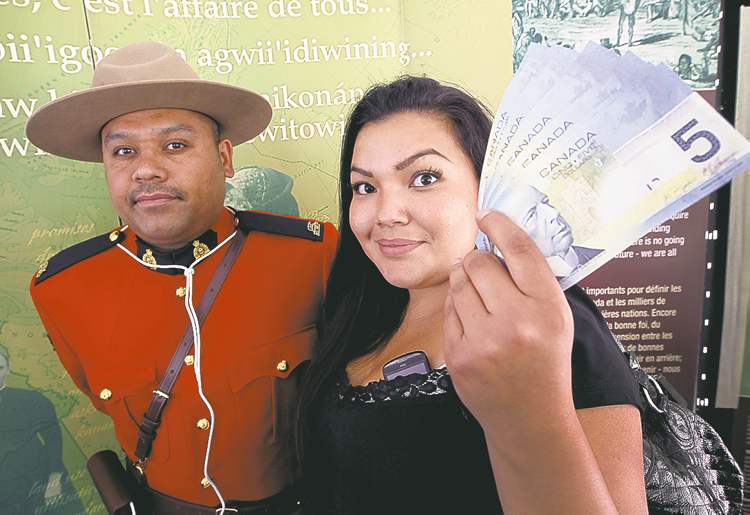
Officials from Aboriginal Affairs and Northern Development Canada, RCMP, Parks Canada and Treaty Relations Commission for Manitoba were on hand to open the annual payments of Treaty Days.
“The treaties were originally between us as aboriginal people and the Crown. Later on, Canada took on the obligation of the treaty, with no consultation with our side,” said elder Garry Robson during the opening ceremony to a solemn crowd of about 30. “I think that Canada has to understand some of what those treaties represent and what they mean. With the treaty commission, I think that we are going in the right direction to try and understand what that relationship means.”
Treaty Days commemorates the payments that are distributed to registered First Nations throughout Manitoba. These payments are meant to reaffirm the treaty relationship between Canada and First Nations people. The first treaty was signed in 1871 during Queen Victoria’s reign.
There are seven numbered treaties in Manitoba that were formed between 1871 and 1910.
Anna Fontaine, regional director general for Aboriginal Affairs and Northern Development Canada, says she hopes that Treaty Days will educate the general public on the history of First Nations people in Manitoba, as well as to welcome the urban First Nations population to receive their payments.
Aboriginal Affairs and Northern Development Canada and Parks Canada have worked together since 2003 to deliver treaty payments at the historical site. The Forks is part of Treaty One territory.
Registered First Nations people can collect their $5 with a piece of identification. Funds can also accumulate from years when treaty payments were not received.
Alfred Guimond is happy to bring his daughter, Leeanne to collect their treaty annuity. She has been living out of the country for two years and hasn’t collected her payment in 12.
“It’s a social event for some people. I see people I haven’t seen in a long time and I’m happy to bring my daughter,” Alfred said. “I’ve been through a lot in the past that’s been resolved through healing. So for me, it’s not anything emotional. It’s a good thing for me to come and collect this money.”
Leeanne says she plans to save her $60 in accumulated treaty payments.
But for Wayne Blondeau, an Ojibwe father of five, the money isn’t enough.
“It’s not really sufficient. It’s five bucks,” said Blondeau plainly. His son Sebastian, 2, sat quietly in a stroller. “But it’s still important for us to come get this money. It’s part of our history. It’s something that was promised to us by the government years ago.”
Urban Treaty Days will continue at The Forks until June 28. Treaty payments are also being delivered to many First Nations communities throughout Manitoba, including in Brandon for the first time.
katherine.dow@freepress.mb.ca
By the numbers:
2011 Manitoba treaty payment facts:
92,032 $5 bills distributed

$460,160 in total treaty payments
$103,835 paid out at The Forks
45,768 individuals received payment
— Source: Aboriginal Affairs and Northern Development Canada