

‘Loved his city and the people’
Former mayor generous with time, humble
Advertisement
Read this article for free:
or
Already have an account? Log in here »
To continue reading, please subscribe:

Digital Subscription
One year of digital access for only $205*
- Enjoy unlimited reading on winnipegfreepress.com
- Read the E-Edition, our digital replica newspaper
- Access News Break, our award-winning app
- Play interactive puzzles
*First annual payment billed as $205.00 + GST for one year. This annual subscription will automatically renew at $233.00 + GST every 52 weeks (10% off the regular annual price of $259.35). Offer available to new and qualified returning subscribers only. Cancel any time.
To continue reading, please subscribe:
Add Free Press access to your Brandon Sun subscription for only an additional
$1 for the first 4 weeks*
- Enjoy unlimited reading on winnipegfreepress.com
- Read the E-Edition, our digital replica newspaper
- Access News Break, our award-winning app
- Play interactive puzzles
*Your next Brandon Sun subscription payment will increase by $1.00 and you will be charged $17.95 plus GST for four weeks. After four weeks, your payment will increase to $24.95 plus GST every four weeks.
Read unlimited articles for free today:
or
Already have an account? Log in here »
Hey there, time traveller!
This article was published 07/07/2012 (5119 days ago), so information in it may no longer be current.
Bill Norrie, the soft-spoken Winnipeg mayor who oversaw the Core Area Initiative and the creation of The Forks during the 1980s, died Friday at the age of 83.
Winnipeg’s second-longest-serving mayor died in hospital from respiratory failure, following several months of illness, wife Helen Norrie said.
“I think we’ll remember him chiefly as someone who loved his city and the people of this city,” she said. “He loved being mayor; he said it was the best job he ever had.”
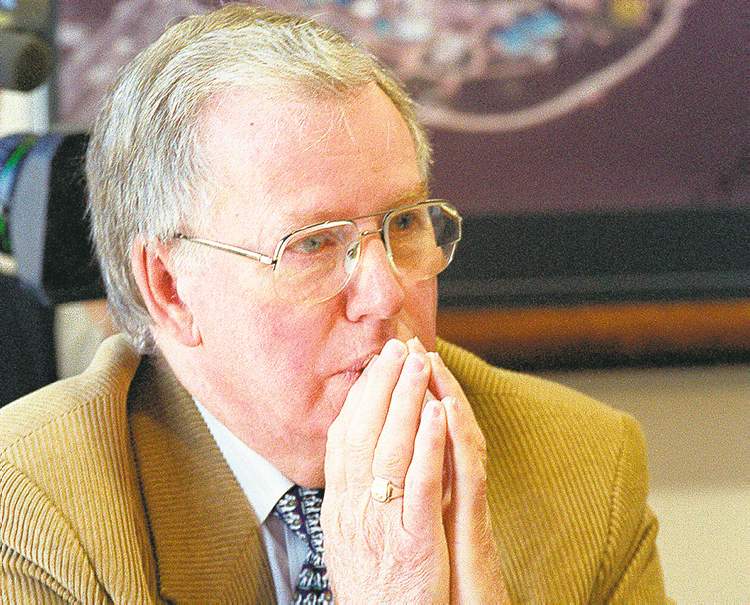
Norrie served as Winnipeg’s mayor from 1979 to 1992, winning five consecutive terms at a time when municipal elections were held once every three years. In 1983, he garnered more votes than any other politician in Winnipeg history — 154,513 — during his second mayoral race.
Born in St. Boniface in 1929, William Norrie received a BA from United College and studied at Oxford University as a Rhodes Scholar before obtaining his law degree from the University of Manitoba.
He entered public life in 1965, when he began a six-year stint as a trustee on the Winnipeg School Board. After the amalgamation of Winnipeg with its suburbs, Norrie joined the first Unicity council as the representative for the now-defunct Kelvin ward in 1971.
Norrie first ran for mayor in 1977, when he narrowly lost to Robert Steen in the race to replace Stephen Juba, Winnipeg’s longest-serving mayor. Steen died in office and Norrie won the ensuing byelection, dispatching Joe Zuken by a four-to-one margin.
Norrie had the misfortune of inheriting leadership of Winnipeg at a time when the North American economy was changing, placing mid-sized, midcontinental cities at a disadvantage. Winnipeg suffered as the once all-important railway industry declined, meat-packing plants closed and the city’s growth lagged.
He was also helpless to watch as the province allowed Headingley to secede from Winnipeg, hampering the city’s already flailing efforts to control urban sprawl.
Undaunted, Norrie spearheaded the $200-million Core Area Initiative, an ambitious plan to revitalize downtown. It involved razing three square blocks north of Portage Avenue to make room for Portage Place, new housing towers and a YM-YWCA and the reclamation of industrial land at The Forks.
“The downtown of this city is different today because of Bill Norrie,” said Ernie Gilroy, who served six years as a city councillor under Norrie and is now CEO of the Manitoba Floodway and East Side Road Authority.
Gilroy recalled Norrie as a statesman who listened to his political opponents. “He came from an era when people respected each other far more than they do in today’s politics,” Gilroy said.
Susan Thompson, who succeeded Norrie as mayor in 1992, said she admired the courage and leadership Norrie displayed during 27 years in public office.
“I always felt that in Bill’s heart, he always had the best interests of the city,” she said.
Glen Murray, who became mayor in 1998, said few politicians accomplished as much as Norrie.
“His detractors used to have a joke about him: They used to say his leadership style was ‘Follow me, I’m right behind you.’ But this was a man who had very little ego. Many of the things he pulled together and organized, he put in the hands of other people to lead,” Murray said.
“He was somebody who never worried about getting credit for things. He worked very hard to get things done. He was a selfless man, in an extraordinary way.”
Sam Katz, Winnipeg’s current mayor, praised Norrie’s “phenomenal dedication” to the city, noting how the former mayor served as chancellor of the University of Manitoba, sat on many boards and attended numerous public functions following retirement.
Katz also praised Norrie’s political skills, noting his predecessor was able to achieve consensus on a 29-member city council.
Norrie was an honest broker who wasn’t beholden to either labour-union or business interests, said Daniel McIntyre Coun. Harvey Smith, the only current member of council who served with Norrie.
Manitoba Premier Greg Selinger, who served one term as a city councillor under Norrie, described the former mayor as generous with his time, perhaps to a fault.
“He was notorious for letting his meetings with the public go on longer than the actual time allowed. He was always under pressure from his office to wind it up and he wouldn’t,” Selinger said.
Chris Lorenc, another former city councillor, said Norrie’s civility in the face of challenge served as a model for his own life. “Above all, he was an honourable gentleman,” he said. “He is one of those rare individuals who enters politics wishing to make a difference and leaves politics having made a difference.”
Members of the public can sign a book of condolence at city hall until Wednesday, when a memorial will be held at Crescent Fort Rouge United Church at 1 p.m. The memorial is open to the public.
An online book of condolence is at winnipeg.ca .
— with files from Jen Skerritt, Alexandra Paul and Bruce Owen
bartley.kives@freepress.mb.ca
Bill Norrie
1929-2012
Born: 1929, in St. Boniface.
Education: Bachelor of arts from United College in 1950. Studied at Oxford as a Rhodes Scholar in 1953-54. Graduated from the University of Manitoba faculty of law in 1955.
School trustee: Served on the Winnipeg School Board from 1965 to 1971.
City councillor: Joined the first Unicity council following the amalgamation of Winnipeg with its suburbs, in 1971, as councillor for the former Kelvin ward. Lost the 1977 mayoral race to Robert Steen by fewer than 2,000 votes.
Mayor: First elected in 1979 when he defeated Joe Zuken in the byelection to replace Steen, who died while in office. Won five consecutive terms before his retirement in 1992. His 1983 election saw him collect 154,513 votes — the largest number in a mayoral race in Winnipeg’s history.
Accomplishments in office: Oversaw the Core Area Initiative, a $200-million effort by all three levels of government to revitalize downtown. It included the replacement of three city blocks with Portage Place, the construction of nearby housing and a new YM-YWCA, the creation of The Forks, the renovation of Chinatown and the establishment of the Assiniboine Riverwalk. He also signed a water-protection deal with First Nations at Shoal Lake and oversaw Grey Cup festivities in Winnipeg in 1992.
Major honours: Recipient of the Order of Canada and the Order of Manitoba. Appointed as Queen’s Counsel in 1977. In 1980, he received an honorary LL.D. from the University of Winnipeg. Appointed as chancellor of the University of Manitoba in 2001. In 2005, the University of Manitoba’s building at 485 Selkirk Ave. was named the William Norrie Centre.
Other awards: Inducted into the Citizen’s Hall of Fame in 1995 and has a bust by sculptor Leo Mol in Assiniboine Park. Honorary member of the Carpenter’s Union. Is a Paul Harris Fellow, Rotary International.
Named to the Legion of Honour Degree by the Canadian Order of DeMolay. Recipient of the Phillippine-Canada Friendship Medal of Honour, the Taras Shevchenko Medal of the Ukrainian Canadian Committee and the B’Nai Brith Canadian Humanitarian Award.
Other public service (selected): Served 24 years on the University of Winnipeg’s board of regents. In 1993, chaired the Jimmy Carter Work Camp blitz that saw 18 homes built in Winnipeg by Habitat for Humanity. Served on numerous boards, including the Winnipeg Foundation and the Winnipeg Arts Advisory Council. Served as conflict-of-interest commissioner for the Province of Manitoba, honorary consul-general of Japan in Manitoba and chairman of the Forks-North Portage Partnership.
Personal tragedy: In 1992, Norrie’s son, Duncan, was killed at age 34 in a plane crash in Nepal. In 2001, his other son, Mark, died in Bali at age 36.
“I think the scope of it will surprise people.”
— A typically understated Bill Norrie, describing the Core Area Initiative on March 18, 1981.
“Giving people access to the rivers is ideal. We’ve really turned our backs on the rivers for a long time.”
– Norrie on the creation of The Forks, on June 4, 1988.
“This is it. I’ve done enough.”

– Norrie announcing his retirement from the mayor’s office on Sept. 6, 1992.
— sources: Winnipeg Free Press archives, Citizen’s Hall of Fame, University of Manitoba and news services
— compiled by Alexandra Paul and Bartley Kives
A look back at former Winnipeg mayor Bill Norrie's career.