

In Conversation with… Gen. Walter Natynczyk
Advertisement
Read this article for free:
or
Already have an account? Log in here »
To continue reading, please subscribe:
Monthly Digital Subscription
$1 per week for 24 weeks*
- Enjoy unlimited reading on winnipegfreepress.com
- Read the E-Edition, our digital replica newspaper
- Access News Break, our award-winning app
- Play interactive puzzles
*Billed as $4.00 plus GST every four weeks. After 24 weeks, price increases to the regular rate of $19.95 plus GST every four weeks. Offer available to new and qualified returning subscribers only. Cancel any time.
Monthly Digital Subscription
$4.99/week*
- Enjoy unlimited reading on winnipegfreepress.com
- Read the E-Edition, our digital replica newspaper
- Access News Break, our award-winning app
- Play interactive puzzles
*Billed as $19.95 plus GST every four weeks. Cancel any time.
To continue reading, please subscribe:
Add Free Press access to your Brandon Sun subscription for only an additional
$1 for the first 4 weeks*
*Your next subscription payment will increase by $1.00 and you will be charged $16.99 plus GST for four weeks. After four weeks, your payment will increase to $23.99 plus GST every four weeks.
Read unlimited articles for free today:
or
Already have an account? Log in here »
Hey there, time traveller!
This article was published 30/11/2012 (4817 days ago), so information in it may no longer be current.
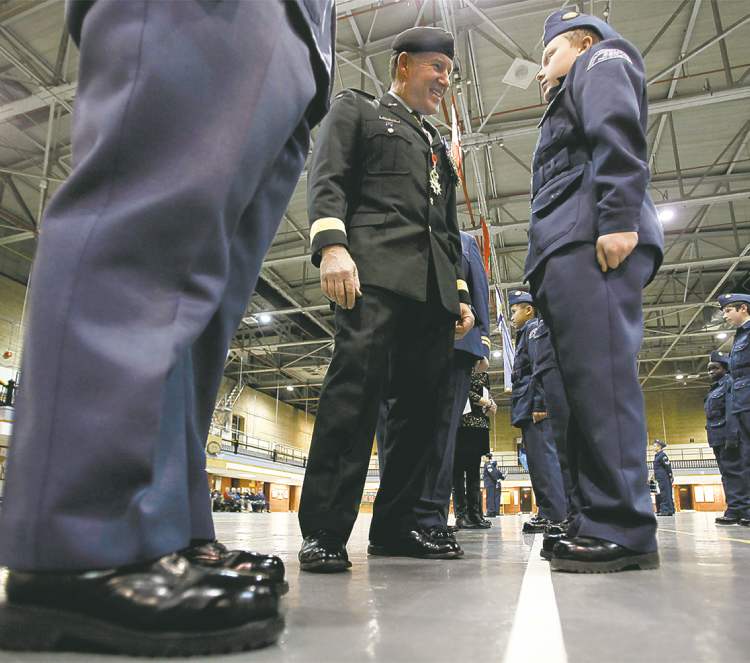
A Winnipeg air cadet squadron hosted its 70th anniversary earlier this week with a very notable alumnus in attendance — Gen. Walter Natynczyk, Canada’s former chief of defence staff.
Natynczyk, who recently stepped down after four years at his post, is a former air cadet with the 220 Red River Royal Canadian Air Cadet Squadron. In celebration of his alma mater’s 70th birthday, Natynczyk led an anniversary parade and helped award long-service medals to six young cadets.
Q: What are you doing since ending your term?
A: I’m doing all those little things I should have done before, like all my medical checkups, physiotherapy appointments — all the things I should have been doing during the last 37 years. I turn in my ID card and become a civilian, a normal person in a week’s time. It will be an adjustment.
Q: What was the best experience from your time as chief of defence staff?
A: You know, I always reflect on visiting Afghanistan in December of 2009. It was Christmas Eve and we were on top of a mountain, and it was a Leopard 2 tank, part of the Lord Strathcona Horse, and there were two sergeants on duty and all was peaceful. It was about 11 o’clock at night on Christmas Eve and that night, there was peace throughout the land. And I kind of reflect over my four years as chief of defence, and I always keep on going back to that memory. Now unfortunately, one of the people with me was Michelle Lang, that employee from the Calgary Herald and four days later, she passed away. And so, in my mind it taught me about the fragility. It was all peaceful and then still so fragile.
Q: How do you think we should better handle the stress and mental-health issues in our soldiers?

A: I think the one thing that we can continue to do is reinforce the culture so that if people have a problem, they’ll come forward and ask for help. One of the things I was really surprised about, especially in the past two years, is to find out we still have veterans coming and asking for help from the Korean War and for the first time asking for help. You know, we who put on the uniform, men and women, kind of have this warrior ethos, and then we put on a game face. And the sooner people ask for help, the sooner their problems can be diagnosed, receive the professional assistance they need, get the support from their family and friends and start recovery. And so I know that in the Canadian Forces, we’ve actually made a huge effort of getting more professional people to help us out. But nothing will work unless the people with issues come forward.
Q: Is Canada’s military really different today than it was a decade or two ago?
A: I think the Canadian Forces is probably at a tremendous level of professionalism, capability and agility. I think that’s what we have proven through the events in Afghanistan, through the support to the RCMP in the Vancouver Olympics, in our agility getting to Haiti (within a day of the 2010 earthquake) as quickly as we did and in our effort as part of NATO and with the UN mandate in protecting civilians in Libya. And whether we do all of that or we’re sandbagging the Assinboine River at Portage la Prairie, we were there within hours and so there is a real operational culture and a sense of ‘can do.’ No matter what we’re given, whether it’s here at home sandbagging the Red or the Asssiniboine or in fact helping people on the other side of the world.
katherine.dow@freepress.mb.ca