

The Free Press that was
Carlton Street newsroom harboured eccentrics along with legends like my Dad
Advertisement
Read this article for free:
or
Already have an account? Log in here »
To continue reading, please subscribe:
Monthly Digital Subscription
$1 per week for 24 weeks*
- Enjoy unlimited reading on winnipegfreepress.com
- Read the E-Edition, our digital replica newspaper
- Access News Break, our award-winning app
- Play interactive puzzles
*Billed as $4.00 plus GST every four weeks. After 24 weeks, price increases to the regular rate of $19.95 plus GST every four weeks. Offer available to new and qualified returning subscribers only. Cancel any time.
Monthly Digital Subscription
$4.99/week*
- Enjoy unlimited reading on winnipegfreepress.com
- Read the E-Edition, our digital replica newspaper
- Access News Break, our award-winning app
- Play interactive puzzles
*Billed as $19.95 plus GST every four weeks. Cancel any time.
To continue reading, please subscribe:
Add Free Press access to your Brandon Sun subscription for only an additional
$1 for the first 4 weeks*
- Enjoy unlimited reading on winnipegfreepress.com
- Read the E-Edition, our digital replica newspaper
- Access News Break, our award-winning app
- Play interactive puzzles
*Your next Brandon Sun subscription payment will increase by $1.00 and you will be charged $17.95 plus GST for four weeks. After four weeks, your payment will increase to $24.95 plus GST every four weeks.
Read unlimited articles for free today:
or
Already have an account? Log in here »
Hey there, time traveller!
This article was published 01/12/2012 (4907 days ago), so information in it may no longer be current.
Last month, deputy editor Julie Carl asked for a favour.
Would I help the Free Press celebrate its 140th anniversary?
The Free Press wanted readers to write in with their favourite memories of the newspaper they love to read, and she wondered if I would write my memories.
Perhaps including reflections of my growing up at the paper with my late Free Press editor father and my younger brother David, who also works here as a senior copy editor.
How could I say no?
— — —
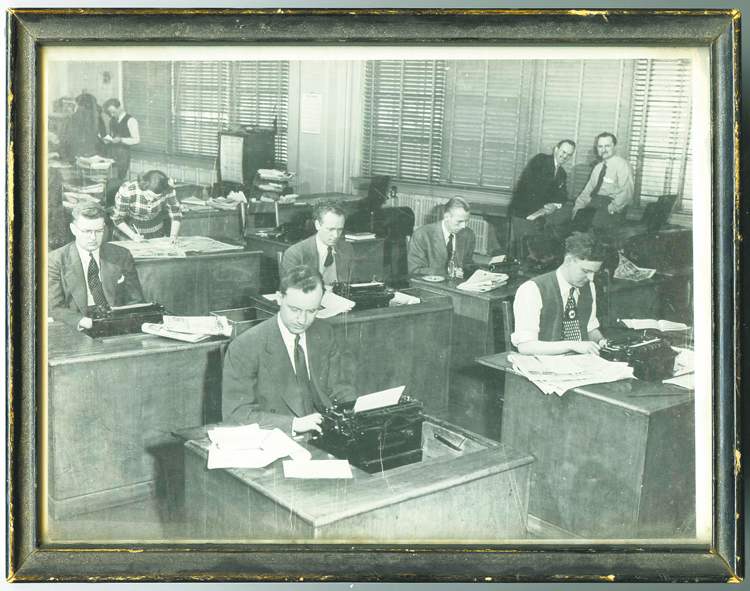
As I begin to write this, I am using an imaginary typewriter — a Remington, if that detail matters — and I am staring into a black-framed family heirloom.
Within the frame is a black-and-white photo of the Free Press newsroom and its inhabitants, most of them in jackets and ties and hunched over typewriters.
Yes, Remington typewriters.
On the frame’s fragile and peeling parchment back are the printed names of most of the people in this obviously posed portrait. One of them — the one in the middle of the second row of reporters — is a young man identified as “Gord Sinclair.”
He was my father.
The date is also on the back, printed in what appears to be in my father’s hand.
“Circa 1948.”
That was the year I was born.
So far as I know, all the people in the photograph are gone now, as is the downtown newsroom at 300 Carlton St.
Back then, the newsroom had an unkempt, sodden, carefree character that symbolized a time — and a newspaper lifestyle — long gone.
By the summer of 1991, that newsroom was gone, too.
The Free Press was relocated to a drab and distant industrial plant in the city’s northwest.
More than two decades after the move, it is still the Free Press newsroom my younger brother David and I were born into that I remember most.
Most fondly, I mean.
— — —
I was probably eight or nine the first time my dad took us to the Free Press newsroom on a Saturday.
There was no one there, but it sounded as if there was, what with the squawk of the police radio that some newsroom character had dressed up. He topped it with a London bobby’s helmet.
It was that kind of fun place for a kid.
There was a spiral staircase in the middle that led to the composing room, but that we treated like a play structure. And our dad would let us explore the library and the photo files of our heroes, the Winnipeg Blue Bombers.
But my favourite childhood memory of those Saturdays in the newsroom is rolling small sheets of copy paper into the Remingtons and pretending to be a reporter like my Dad.
It was to this place right out of The Front Page that my 18-year-old future father arrived in 1939 as a newly hired copy boy. And it would be to this place, almost 30 years later, having been a copy boy at the Tribune, that I would be hired as a sports reporter.
My stay was brief at the Free Press that first time — about a year — but I got to know the place in a way I hadn’t as a child. I remember a man from the street who wore a long, dark coat and regularly climbed four flights of stairs after the elevator operator had left for the night. He never introduced himself or even said anything. He simply marched into the sports department as if he worked there, took a seat at whichever desk was unoccupied, picked up the phone and started dialing.
We never knew who he was talking to, or even if there was really anyone on the other end of the telephone line. But we never said anything.
I remember hearing other stories like that. About how Free Press librarians, arriving in the newsroom early in the morning, would find homeless people sleeping in the carts where old, mattress-soft newspapers were piled. The librarians would never say anything either.
As you might now understand, amid all the deadly serious deadline newsgathering, the Free Press of that era was a place that operated at times like an open-door club for eccentrics and misfits and those on the margins of society. Perhaps because those are the kind of people the Free Press newsroom often hired.
My father wasn’t an eccentric or a misfit, but like so many in the newsroom, he drank heavily, in his case to relieve the stress at work and home. By the early 1970s, as assistant managing editor and news editor, he essentially managed the newsroom.
Then one day everything seemed to change.
It was a snowy, slippery, late-January morning in 1976 — a month after his 54th birthday — when my father made his way to the back of the newsroom.
He was looking for reporter Ritchie Gage.
Ritchie still remembers what happened next on that stressful winter morning nearly 37 years ago.
“I was the last person he spoke to. I was writing a deadline story on a transit strike. He walked over to my desk and asked me very politely and easily, as he usually was with reporters, if I was the one doing the story.
“Have you got the transit story, Ritchie?”
“I said, ‘Yes.’ “
Then Ritchie watched as my Dad walked over to a nearby filing cabinet, put his hand to his head in obvious distress and headed for a couch in the boardroom.
He was having a fatal stroke.
“I never saw him again,” Ritchie said. “He was tall, with red, curly hair and blue eyes and always walked quickly. He had the heart, the soul and the intelligence at a moment in time and in a newsroom that would never come again. To see him at a typewriter was like seeing a pianist perform at a keyboard.”
That’s how I remember my dad, too.
And, on this our 140th birthday, that’s the kind of Free Press newsroom I remember most.
Most fondly, I mean.
gordon.sinclair@freepress.mb.ca
Nov. 30, 1872

The brand-new Manitoba Free Press hit the streets of Winnipeg and beyond. The only Canadian daily paper west of Toronto printed on the only cylinder press north of Minnesota, it was truly one of a kind. Soon, its 900 subscribers were paying 25 cents a week for all the local news fit to print and then some.
In 1931, it became the Winnipeg Free Press and continued to live up to its motto of “Freedom of Trade, Liberty of Religion, Equality of Civil Rights,” those words still gracing the paper’s editorial pages today.
On Friday, the Free Press marked 140 years of telling Manitobans’ stories. Now we are inviting you to tell us your memories of the newspaper. Did you have your own paper route? Did you enter the Christmas colouring contest? Did your group do something special for the paper’s Pennies from Heaven campaign? What about that time your team got its photo in the paper?
We want to know. Visit winnipegfreepress.com/140 and tell us your best story about the paper. If you have a photo, even better. We’ll run a few in the paper and all of them online.
We’re calling this memory project Your Lives, Our Pages. But really, think of them as your pages, too. Because that’s what they are.