

Prairie boys made the best sailors
HMCS Chippawa celebrates 90 years
Advertisement
Read this article for free:
or
Already have an account? Log in here »
To continue reading, please subscribe:
Digital Subscription
One year of digital access for only $1.44 a week*
- Enjoy unlimited reading on winnipegfreepress.com
- Read the E-Edition, our digital replica newspaper
- Access News Break, our award-winning app
- Play interactive puzzles
*Billed as $5.77 plus GST every four weeks. After 52 weeks, price increases to the regular rate of $19.95 plus GST every four weeks. Offer available to new and qualified returning subscribers only. Cancel any time.
To continue reading, please subscribe:
Add Free Press access to your Brandon Sun subscription for only an additional
$1 for the first 4 weeks*
- Enjoy unlimited reading on winnipegfreepress.com
- Read the E-Edition, our digital replica newspaper
- Access News Break, our award-winning app
- Play interactive puzzles
*Your next Brandon Sun subscription payment will increase by $1.00 and you will be charged $17.95 plus GST for four weeks. After four weeks, your payment will increase to $24.95 plus GST every four weeks.
Read unlimited articles for free today:
or
Already have an account? Log in here »
Hey there, time traveller!
This article was published 02/04/2013 (4808 days ago), so information in it may no longer be current.
In August 1943, with a war raging in Europe, an 18-year-old Winnipegger named Bob Watkins joined the Royal Canadian Navy because “it was just the thing to do.”
More than six decades later, on Jan. 12, 2010, a 19-year-old Winnipegger named Clay Ridd joined for adventure and a summer job.
What do they have in common?
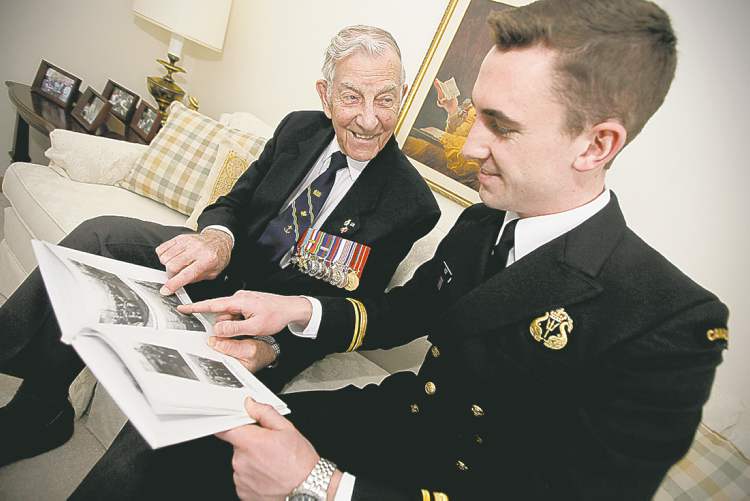
They both joined the naval reserve unit — Her Majesty’s Canadian Ship Chippawa, stationed in downtown Winnipeg.
This year, HMCS Chippawa is celebrating its 90th birthday.
Manitoba’s only naval reserve unit was created in 1923. To celebrate 90 years since its inception, Vice-Admiral Paul Maddison, commander of the Royal Canadian Navy, has made the trip from the National Defence headquarters in Ottawa to Winnipeg. This morning, he will be at a breakfast speaking to community leaders, then at the Free Press for an editorial meeting, meeting with provincial leaders, and finally at HMCS Chippawa for a private ceremonial parade, march past and inspection.
The naval reserve company was created by Lt. James Hibbard, who first located the unit in the McGregor Armories. On opening night, the unit welcomed 100 applicants, half of whom were veterans of the First World War. Most were accepted and the unit has grown from there — today there are more than 100 reservists at the unit. Moving to a number of different locations, the unit finally settled at 1 Navy Way near the shores of the Assiniboine River.
Over the decades, the reserve unit has helped during major Manitoba flooding and sent sailors overseas to war. Watkins, from a long line of British navy men on his father’s side, was one of those sailors.
In 1943, Watkins did his basic training in Winnipeg, naval training in Halifax, and then was sent to Londonderry, Northern Ireland. There he was assigned to HMCS Loch Achanalt as a radar operator.
“We were in an escort group,” said Watkins, “which meant we were travelling around looking for trouble.”
Though he lost four Winnipeg friends with whom he went through training, Watkins’ claim to fame was sinking a mine in the English Channel. “I started to shoot at it; it wouldn’t blow, but it sunk,” said Watkins.
Today the unit has the important job of raising awareness of its existence and the importance of the Canadian Navy.
“Canadians seem to suffer from some maritime blindness,” said Lt.-Cmdr. Paul Stiff, commanding officer of HMCS Chippawa. “The Navy is important, because about 90 per cent of our trade comes from the sea.”
Ridd joined the reserve unit as a maritime surface and sub surface operations officer while completing a double major in history and politics at the University of Manitoba, and plans on becoming a teacher.
“I’ve had the opportunity to sail on all three of Canada’s coasts,” Ridd said of his adventures in the Navy. “I’ve visited ports and had the opportunity to meet people that have really opened up my eyes to the world in general.”
On top of the adventure and spending his summers in the Maritimes for training, Ridd gets $2,000 toward his tuition every year.
Despite being in the middle of the country and about as far from a coast as you can get in Canada, during the Second World War, HMCS Chippawa produced 297 naval officers, 7,567 sailors and the second-largest contingent of the Women’s Royal Naval Service. Chippawa was the third-greatest supplier of personnel after the main ports of Halifax and Esquimalt. Stiff said it was commonly known “Prairie boys” made the best sailors.

“It is a phenomenon left over from the Second World War,” said Stiff. “I personally think it’s because guys from the Prairies didn’t know what they were getting into.”
Though he was one of those sailors, Watkins doesn’t know why they were so good either.
“Some of the commanding officers, if they are getting a ship, they prefer to have boys from the Prairies because they knew for some reason they were the best sailors,” said Watkins. “Nobody seems to know why. I don’t know why.”
steph.crosier@freepress.mb.ca