

Running a hog farm they thought she’d sell
Dealt with death of husband with 'work therapy'
Advertisement
Read this article for free:
or
Already have an account? Log in here »
To continue reading, please subscribe:
Monthly Digital Subscription
$1 per week for 24 weeks*
- Enjoy unlimited reading on winnipegfreepress.com
- Read the E-Edition, our digital replica newspaper
- Access News Break, our award-winning app
- Play interactive puzzles
*Billed as $4.00 plus GST every four weeks. After 24 weeks, price increases to the regular rate of $19.95 plus GST every four weeks. Offer available to new and qualified returning subscribers only. Cancel any time.
Monthly Digital Subscription
$4.99/week*
- Enjoy unlimited reading on winnipegfreepress.com
- Read the E-Edition, our digital replica newspaper
- Access News Break, our award-winning app
- Play interactive puzzles
*Billed as $19.95 plus GST every four weeks. Cancel any time.
To continue reading, please subscribe:
Add Free Press access to your Brandon Sun subscription for only an additional
$1 for the first 4 weeks*
*Your next subscription payment will increase by $1.00 and you will be charged $16.99 plus GST for four weeks. After four weeks, your payment will increase to $23.99 plus GST every four weeks.
Read unlimited articles for free today:
or
Already have an account? Log in here »
Hey there, time traveller!
This article was published 09/05/2013 (4723 days ago), so information in it may no longer be current.
NEAR LANDMARK — Everyone grieves differently, and Margaret Rempel’s way, after her husband, Ron, died of a brain hemorrhage 10 years ago, was to ramp up her workload.
She would work late into the night on the hog farm near Landmark, 40 kilometres southeast of Winnipeg. “The barn was spotless,” said Rempel.
“I have been accused of being a workaholic. I call it work therapy,” she said.
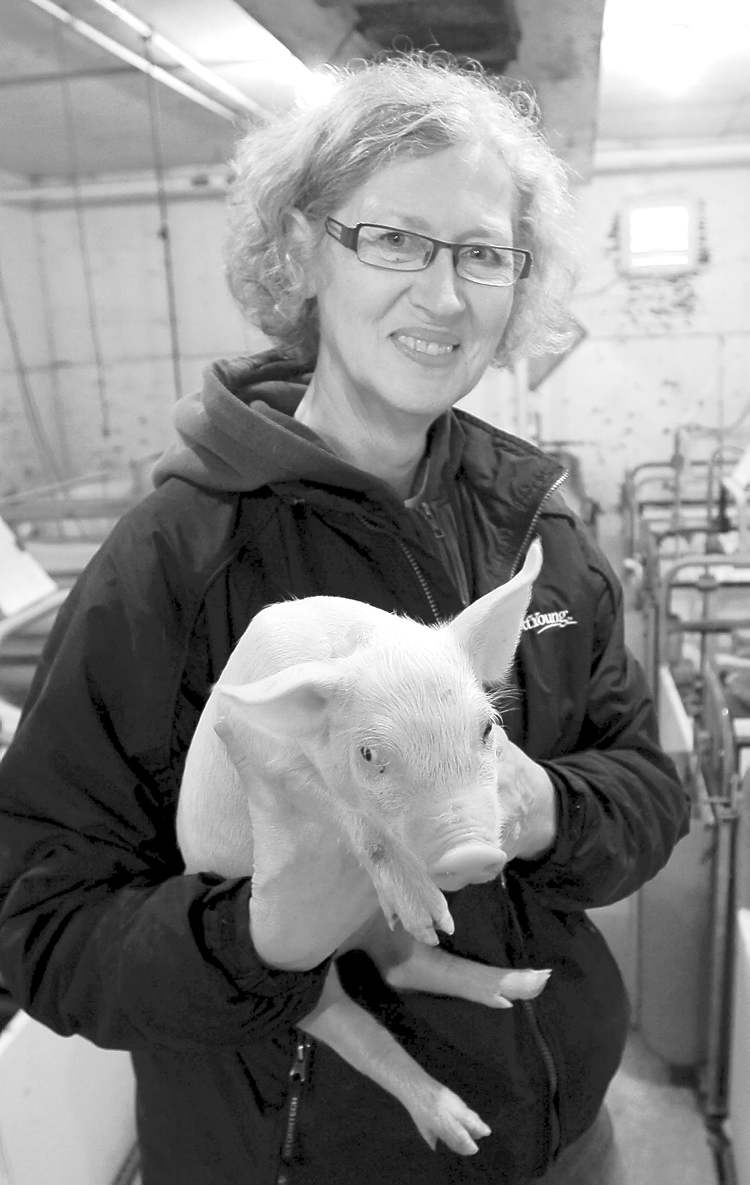
Single, white, female, hog farmer — to riff on a movie title from years ago.
“Lots of people assumed I would sell the farm (after Ron died) and do some other thing. But I enjoy farming or I wouldn’t be doing it,” she said. “I’d always fed the sows, tilled the fields, hauled finished pig… “
Selling the farm “wasn’t the right psychological option,” she said. Others thought she should at least take a leave away from the farm. “When you’re self-employed, you don’t get to take a leave of absence,” she said.
Today, Rempel runs Rempelco Acres, a 500-sow farrow-to-finish operation, and 1,600 acres of cropland. She is part of a small but growing number of women running farms on their own in Manitoba.
Farming is changing with society where more women are breaking the “grass ceiling.”
Andrew Dickson, Manitoba Pork Council general manager, knows of one or two other single-female hog producers in the province who took over after their husbands died. More women tend to run cattle or horse ranches.
One reason more women are farming is there isn’t as much “brawn” required as 50 years ago, thanks to modern technology, said Rempel. “We’re not feeding animals by hauling pails around. It’s automated,” she said. She has three employees. Her oldest son, Jason, is now coming back to the farm, too.
Her situation was also different because farm wives are usually older when they become widowed, so it makes more sense to sell the farm and retire. But Rempel was just 50.
It’s not just single women who are farmers. People overlook the fact many women, if not most, are full partners on today’s farm. “There are lots of husband-and-wife teams. If one doesn’t have off-farm work, they automatically divide up the farm work,” she said.
Women in farming can get interesting reactions. “The thing that happens so much when you’re part of a farming couple is people assume it’s still the man who’s responsible for making decisions. When Ron and I were farming together, salesmen would say, ‘Can I speak to the boss?’ I’d say ‘Go ahead, you’re speaking to her.’ “
‘When Ron (my late husband) and I were farming together, salesmen would say, “Can I speak to the boss?” I’d say “Go ahead, you’re speaking to her” ‘ — Landmark-area farmer Margaret Rempel
Running a mixed farm (crop and livestock) is intensive. Rempel’s morning, before the 9:30 a.m. newspaper interview, included bottle-feeding a baby goat rejected by its mother, feeding the chickens, putting the goats out to pasture, hauling culled sows into a stock trailer and relocating them to a collection pen, and 45 minutes doing email — and not to chit-chat. Her email includes placing a premix feed order, checking grain prices and clearing up business with Canadian Agrifood Policy Institute board members, of which she is one.

“Farming allows such a large spectrum of job descriptions,” she says. It’s not a nine-to-five job, either. “In winter, I try to keep it to 12-hour days. The rest of the time, it’s 14- to 16-hour days. Lots of mixed farmers work those hours.”
There are always internal deadlines to meet, such as regular feeding of animals and shipping to market. Mondays are shipping days, when finished hogs are transported for processing.
Rempel, who grew up on a dairy farm near Brandon and is a few credits short of a bachelor of arts degree in English and history, has distinguished herself among her peers. She has been a Keystone Agricultural Producers director, a founding board member of the Manitoba Rural Adaptation Council, an international trade adviser and served on the Canadian Foodgrains Bank board.
Hog farming has had enormous struggles the past five years due to country-of-origin labelling (COOL) in the U.S., which has slashed Manitoba exports to that market from nearly five million weanlings per year to just one million. High feed prices, and the province’s moratorium on hog expansion, which Rempel believes is a government response to urban misconceptions of the tightly regulated hog sector, have also set back producers.
bill.redekop@freepress.mb.ca