

Some revelations in debate over PST hike

Advertisement
Read this article for free:
or
Already have an account? Log in here »
To continue reading, please subscribe:

Digital Subscription
One year of digital access for only $205*
- Enjoy unlimited reading on winnipegfreepress.com
- Read the E-Edition, our digital replica newspaper
- Access News Break, our award-winning app
- Play interactive puzzles
*First annual payment billed as $205.00 + GST for one year. This annual subscription will automatically renew at $233.00 + GST every 52 weeks (10% off the regular annual price of $259.35). Offer available to new and qualified returning subscribers only. Cancel any time.
To continue reading, please subscribe:
Add Free Press access to your Brandon Sun subscription for only an additional
$1 for the first 4 weeks*
- Enjoy unlimited reading on winnipegfreepress.com
- Read the E-Edition, our digital replica newspaper
- Access News Break, our award-winning app
- Play interactive puzzles
*Your next Brandon Sun subscription payment will increase by $1.00 and you will be charged $17.95 plus GST for four weeks. After four weeks, your payment will increase to $24.95 plus GST every four weeks.
Read unlimited articles for free today:
or
Already have an account? Log in here »
Hey there, time traveller!
This article was published 31/05/2013 (4822 days ago), so information in it may no longer be current.
It didn’t change anyone’s mind and no one said “uncle.”
Even so, a special debate on the NDP government’s July 1 increase to the PST to eight per cent from seven per cent — hosted live at the Free Press News Caf© and online — did produce some interesting revelations.
The panel for the debate covered a wide spectrum of parties. The panel included Infrastructure Minister Steve Ashton, PC byelection candidate Shannon Martin, Portage Mayor Earl Porter and Jim Carr, CEO of the Business Council of Manitoba. Taken together, the panellists covered the government initiating the tax increase, the opposition trying to stop it, municipalities that need more money for infrastructure and business leaders who were among the first to publicly propose a tax increase dedicated to hard infrastructure.
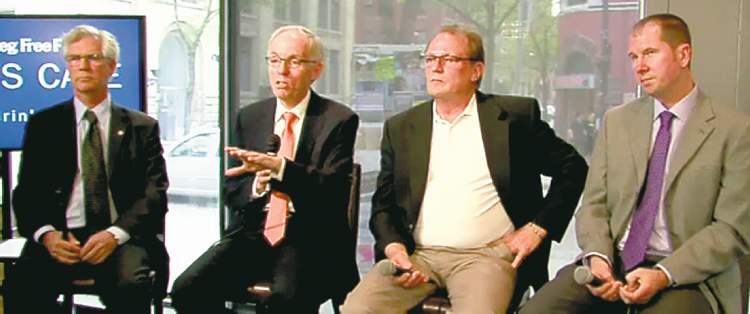
The debate participants reinforced their positions by uttering the same points they have been using for much of the last month. However, all of them were able to add a few new revelations.
First, Martin and the Tories, who are enjoying new-found support among voters who may be tiring of the NDP act after nearly 14 years in power. The Tory talking points on the PST hike are pretty predictable. According to Martin, the NDP government has a spending problem and does not need to raise taxes to boost infrastructure spending. He also confirmed a Tory government would repeal the tax hike. That is not such a wild scenario given that a Free Press-Probe Research poll taken prior to the budget showed Tory support surging; it’s hard to imagine that surge will wane in the wake of the PST hike.
However, the debate helped confirm the Tories do not really have any idea how to repeal the PST hike and increase infrastructure spending.
A Tory have-your-cake-and-eat-it-too list of revenue-generating and cost-saving measures, released within days of the provincial budget, was designed to produce the same $280 million a one-point bump in the PST would create. Martin was unable to avoid the obvious reality that the revenue ideas were speculative, and the cost-cutting measures unusually severe. The principal pledge is a one per cent, across-the-board cut to spending. Under questioning at the debate, Martin could not avoid the obvious reality that a cut like that really is a severe hit on core services.
One of the more interesting revelations to come from the debate was just how much potential support exists for the PST plan and how incredibly bad the NDP had been in cultivating that support.
Both Carr and Porter, representing a loose coalition of municipal leaders, said they supported in principle the idea of raising taxes for infrastructure. Both would have preferred the province hold a referendum to give voters a chance to voice their opinions. However, even without the vote, both believed there could be widespread support for raising taxes to address the infrastructure deficit.
More importantly, both were willing to move from the “opponents” column to the “proponents” column if the province would spend the additional tax revenue solely on “basic” infrastructure such as roads, bridges and sewers rather than less essential projects (their characterization, not mine) such as schools, hospitals and recreation facilities.
It didn’t take long for the author, serving as the debate’s moderator, to get a question to Ashton. With the support of municipal leaders and the province’s most influential business leaders on the line, could Ashton commit to spending the money on basic infrastructure?
Now, it deserves to be said that Ashton, one of the longest-serving members of the Manitoba legislature and a renowned question period sparring partner, is no easy nut to crack. He is a very well-informed politician, but he is notoriously indirect in his answers. In fact, it would not be an exaggeration to call obfuscation his art.
Ashton was asked nine different ways (I kept count) about whether he could identify how much of the additional new tax revenue would be spent on basic infrastructure. In each case, he was unable to answer. Actually, he chose to continue answering other questions he was not being asked at the time.
Was this Ashton being, well, Ashton? Or does the province not know exactly where the PST revenue would be spent? The total infrastructure envelope in this year’s budget is nearly $1.8 billion. It is not incorrect to say a majority of that money will go to “basic” infrastructure. Is it really that difficult to promise, or show, that all of the money from the tax hike would go to basic projects? Obviously, it’s not that hard.

The Free Press has made a request for a breakdown of the projects to be funded by the new PST revenue. The quality of the information, and the time it takes to acquire it, will be telling.
Post-debate, it is impossible to escape the impression that the province continues to struggle with its messaging on the PST hike.
If the debate revealed anything, it is that additional and prominent support for the PST hike does, in fact, exist.
It was also obvious that, at least on this night, the NDP government did not have the wherewithal to reach out and grab that support.
dan.lett@freepress.mb.ca
Dan Lett is a columnist for the Free Press, providing opinion and commentary on politics in Winnipeg and beyond. Born and raised in Toronto, Dan joined the Free Press in 1986. Read more about Dan.
Dan’s columns are built on facts and reactions, but offer his personal views through arguments and analysis. The Free Press’ editing team reviews Dan’s columns before they are posted online or published in print — part of the our tradition, since 1872, of producing reliable independent journalism. Read more about Free Press’s history and mandate, and learn how our newsroom operates.
Our newsroom depends on a growing audience of readers to power our journalism. If you are not a paid reader, please consider becoming a subscriber.
Our newsroom depends on its audience of readers to power our journalism. Thank you for your support.
Dan Lett is a columnist for the Free Press, providing opinion and commentary on politics in Winnipeg and beyond. Born and raised in Toronto, Dan joined the Free Press in 1986. Read more about Dan.
Dan’s columns are built on facts and reactions, but offer his personal views through arguments and analysis. The Free Press’ editing team reviews Dan’s columns before they are posted online or published in print — part of the our tradition, since 1872, of producing reliable independent journalism. Read more about Free Press’s history and mandate, and learn how our newsroom operates.
Our newsroom depends on a growing audience of readers to power our journalism. If you are not a paid reader, please consider becoming a subscriber.
Our newsroom depends on its audience of readers to power our journalism. Thank you for your support.
Related Articles
Retailers unsure whether to hike PST on July 1
Advertisement Advertise With Us
Advertisement Advertise With Us
History
Updated on Friday, May 31, 2013 9:45 AM CDT: The mayor for Portage la Prairie is Earl Porter.