

Abandonment of settlers marked by centennial
Advertisement
Read this article for free:
or
Already have an account? Log in here »
To continue reading, please subscribe:
Monthly Digital Subscription
$1 per week for 24 weeks*
- Enjoy unlimited reading on winnipegfreepress.com
- Read the E-Edition, our digital replica newspaper
- Access News Break, our award-winning app
- Play interactive puzzles
*Billed as $4.00 plus GST every four weeks. After 24 weeks, price increases to the regular rate of $19.95 plus GST every four weeks. Offer available to new and qualified returning subscribers only. Cancel any time.
Monthly Digital Subscription
$4.99/week*
- Enjoy unlimited reading on winnipegfreepress.com
- Read the E-Edition, our digital replica newspaper
- Access News Break, our award-winning app
- Play interactive puzzles
*Billed as $19.95 plus GST every four weeks. Cancel any time.
To continue reading, please subscribe:
Add Free Press access to your Brandon Sun subscription for only an additional
$1 for the first 4 weeks*
*Your next subscription payment will increase by $1.00 and you will be charged $16.99 plus GST for four weeks. After four weeks, your payment will increase to $23.99 plus GST every four weeks.
Read unlimited articles for free today:
or
Already have an account? Log in here »
Hey there, time traveller!
This article was published 24/08/2013 (4606 days ago), so information in it may no longer be current.
The skirl of the bagpipes marked a horrific bicentennial earlier this month where the Churchill River spills into Hudson Bay.
Two hundred years ago, a captain keen to be rid of a shipload of nearly 100 Selkirk settlers, many infected with typhus, beached them on the shores of the Churchill River close to an empty, windswept marsh.
The captain of the Prince of Wales believed he was sparing York Factory, their intended destination and the biggest fur trade post on Hudson Bay, from being wiped out by the deadly contagion these would-be settlers carried.
For the passengers, though, their arrival alone on an empty shore at the end of a short Arctic summer must have been terrible.
Many died but some survived to make the 1,000-kilometre journey south to the Red River the next spring, among them families named Matheson, Gunn, Sutherland and McKay.
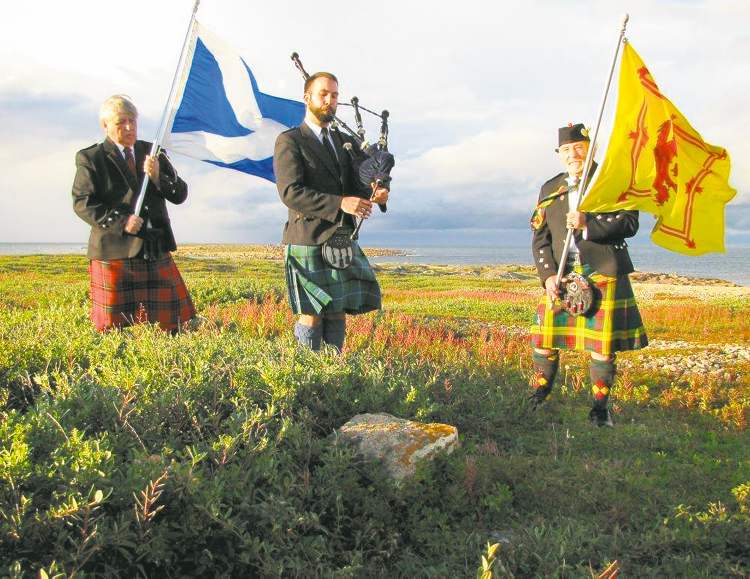
“This is where the Kildonan (street) names come from; that was those guys,” said Churchill resident and former mayor Mark Ingebrigtson the day he and fellow New Zealand-born Scot Rob Bruce-Barron led a piper to the empty marsh to mark the bitter anniversary.
“You look at that marsh and you’d say ‘Oh, my God, you won’t put anyone there!’ And then that’s where they dumped them, without a by-your-leave. And many of them were sick,” Ingebrigtson said.
“There was a Hudson Bay post there, with about four or five people, but they didn’t have food for 100 people, some with typhus. They (the traders at the post) had to go around to the native people and tell them to keep their distance from the new settlers,” Ingebrigtson said.
“A number of people died but there’s only one gravesite we know of and that’s John Sutherland. He was 50. They landed Aug. 19 and he died Sept. 2,” Ingebrigtson said.
A stone hewn into a rough rectangle marks that gravesite, discovered by Parks Canada officials in the 20th century. It lies north of Prince of Wales Fort, now an historical site, along with York Factory.
Eventually the settlers moved several kilometres inland on a creek, now known as Harriet Creek but once called Colony Creek in their memory — where they spent an endless, dark winter.
They fashioned rough cabins and lived off the land. History records they somehow beached a couple of whales and brought down caribou. In the spring, approximately 43 survivors trekked 140 kilometres early in the subarctic spring to York Factory.
“The journey was made on snowshoes, with some provisions, mostly ptarmigan supplied along the way by friendly First Nations people. All the trekkers survived to reach York Factory, including a pregnant lady,” Bruce-Barron said.

This week, Bruce-Barron, Ingebrigtson, bagpiper Joshua Krozhan and a small delegation from Parks Canada and Manitoba Hydro re-enacted much of the trek the settlers made Aug. 19, 1813. The utility supplied a helicopter to fly a bagpiper, Bruce-Barron, and Ingebrigtson, all wearing traditional kilts, to Harriet Creek.
The re-enactment included generous libations of Highland Park, the most northerly made scotch — sprinkled on the ground and shared by the dram.
The benighted passengers on that ship two centuries ago had been tenants of Strath Kildonan, the equally windswept moorland across the Atlantic in northeastern Scotland.
A romanticized statute to the memory of the Selkirk settlers stands today at Waterfront Drive and Bannatyne Avenue in Winnipeg. It shows a fierce bare-chested Highlander in a kilt striding forward, a small boy at his elbow and a woman wrapped in a shawl, babe tucked to her breast, her anguished gaze cast backward.
alexandra.paul@freepress.mb.ca