

In conversation with Silken Laumann
Advertisement
Read this article for free:
or
Already have an account? Log in here »
To continue reading, please subscribe:

Digital Subscription
One year of digital access for only $205*
- Enjoy unlimited reading on winnipegfreepress.com
- Read the E-Edition, our digital replica newspaper
- Access News Break, our award-winning app
- Play interactive puzzles
*First annual payment billed as $205.00 + GST for one year. This annual subscription will automatically renew at $233.00 + GST every 52 weeks (10% off the regular annual price of $259.35). Offer available to new and qualified returning subscribers only. Cancel any time.
To continue reading, please subscribe:
Add Free Press access to your Brandon Sun subscription for only an additional
$1 for the first 4 weeks*
- Enjoy unlimited reading on winnipegfreepress.com
- Read the E-Edition, our digital replica newspaper
- Access News Break, our award-winning app
- Play interactive puzzles
*Your next Brandon Sun subscription payment will increase by $1.00 and you will be charged $17.95 plus GST for four weeks. After four weeks, your payment will increase to $24.95 plus GST every four weeks.
Read unlimited articles for free today:
or
Already have an account? Log in here »
Hey there, time traveller!
This article was published 01/03/2014 (4594 days ago), so information in it may no longer be current.
She is certainly one of Canada’s greatest Olympians and undoubtedly its gutsiest, but Silken Laumann wants everybody to know she’s human and has many of the same problems the rest of us do.
Her legend was created at the 1992 Summer Olympics in Barcelona, Spain. Ten weeks before she was scheduled to compete, she collided with a pair of German rowers during a training run — she was rowing backwards, of course, and didn’t see them coming — and suffered a gruesome injury to her right leg.
She said at the time she knew it was serious “when my muscle was hanging at my ankle and I could see the bone.”
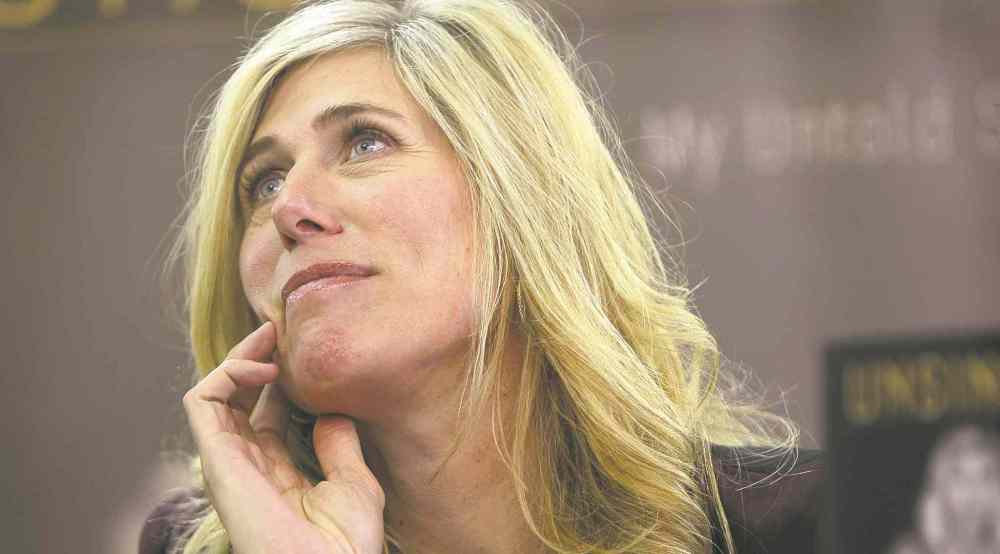
After multiple operations and against all odds, she was soon back in the water, and when she crossed the finish line, she had won a bronze medal in single skulls. (She also won silver in the same event in 1996 in Atlanta and another bronze in double skulls in Los Angeles in 1984 with her sister, Daniele.
Laumann, 49, recently stopped by the Winnipeg Free Press News Café to talk to reporter Geoff Kirbyson about her new book, Unsinkable: My untold story.
FP: Why did you write this book?
LAUMANN: I’ve been in the public eye in Canada for over 20 years, and I’ve spent a lot of time inspiring, speaking to groups, life coaching and writing about my life. Everything I do in my life I end up writing about, including my divorce, which I wrote about in Chatelaine and when I was having parenting challenges, I wrote for Today’s Parent.
Over the last few years, as I’ve started to unwind my past and understand how my childhood particularly affected me as Olympic athlete and how it affected me as a person, I increasingly felt inauthentic not sharing it because I have been so open. I’ve taken my challenges and shared them publicly in order to inspire and encourage people.
FP: And you hope to do that, in part, by discussing topics such as mental illness.
LAUMANN: The book is about strength and vulnerability. I grew up in a home with a mom with an undiagnosed mental illness. She had incredible mood swings, where we never knew what we were coming home to that day. Some days we were coming home to a mom who was happy and embracing us at the door, and other days we were coming home to a mom who was screaming and throwing plates and talking about ending her life.
It was an incredibly difficult environment to grow up in.
For me, it developed this inner resiliency, this desire to be self-determining, because so much of what happened in my home growing up didn’t make sense, so I was looking elsewhere to create my own life.
We wouldn’t think twice of going to the doctor if our arm was broken yet there is still so much stigma and taboo around mental health.
We have children who suffer from anorexia or friends who are bipolar and we’re all pretending. Let’s stop pretending and have heart-to-heart conversations with one another so we can support each other on this wonderful journey called life.
FP: That’s not your typical success story. Some people must find it hard to believe you had depression and anxiety issues yourself.
LAUMANN: I have a really great life. I love my life and I’m very grateful for all of my experiences. I’ve been to four Olympic Games, I have an amazing husband and two healthy kids and two healthy step-kids.
But I’m human. We build up two-dimensional images of what it means to be (a famous athlete). I was living in a very public world. I couldn’t go to the grocery store without people looking at what’s in my cart.
FP: What is in your cart?
LAUMANN: I do love potato chips and I have a strong addiction to cappuccino. I have to have one every morning. I eat very healthy, but I’ve had people stop me in the grocery store and say, ‘Wow, you eat potato chips!’ I’m like, ‘They’re for my kids!’
FP: Your comeback in 1992 has become legendary. Your life was collapsing in front of you and you wanted to come back and race.
LAUMANN: Ten weeks before the Olympics, I was the world champion. Then I was struck by a men’s pair in Germany. The muscle in my right leg was shredded, my ankle was broken and I had massive skin damage and the doctor said ‘You’re not going to row.’
I was so focused. My whole life at that point revolved around rowing. The idea that I wouldn’t go to the Olympic Games seemed out of line, because that’s what I was tracking every day of my life. I almost couldn’t digest the idea. I also felt this huge need to have hope. I have to grab on to something. I think that’s true of us as people. I started to focus on those Games. Because I was physically active my entire life, the idea of sitting in my hospital bed and doing nothing, that was horrifying to me.
Even in the first few days after my accident when I had multiple operations, I would tie a (resistance band) to the end of my bed and pull on it to work my upper body. I also used a lot of visualization, visualizing the blood going to the damaged tissue, visualizing about my bone healing.

FP: Did you have any contact with the rowers who hit you?
LAUMANN: It wasn’t their fault; it was the fault of the organizers. They had created an environment where it was almost a miracle that somebody didn’t get killed.
geoff.kirbyson@freepress.mb.ca