

Invasion of the body stalkers

Advertisement
Read this article for free:
or
Already have an account? Log in here »
To continue reading, please subscribe:
Monthly Digital Subscription
$1 per week for 24 weeks*
- Enjoy unlimited reading on winnipegfreepress.com
- Read the E-Edition, our digital replica newspaper
- Access News Break, our award-winning app
- Play interactive puzzles
*Billed as $4.00 plus GST every four weeks. After 24 weeks, price increases to the regular rate of $19.95 plus GST every four weeks. Offer available to new and qualified returning subscribers only. Cancel any time.
Monthly Digital Subscription
$4.99/week*
- Enjoy unlimited reading on winnipegfreepress.com
- Read the E-Edition, our digital replica newspaper
- Access News Break, our award-winning app
- Play interactive puzzles
*Billed as $19.95 plus GST every four weeks. Cancel any time.
To continue reading, please subscribe:
Add Free Press access to your Brandon Sun subscription for only an additional
$1 for the first 4 weeks*
- Enjoy unlimited reading on winnipegfreepress.com
- Read the E-Edition, our digital replica newspaper
- Access News Break, our award-winning app
- Play interactive puzzles
*Your next Brandon Sun subscription payment will increase by $1.00 and you will be charged $17.95 plus GST for four weeks. After four weeks, your payment will increase to $24.95 plus GST every four weeks.
Read unlimited articles for free today:
or
Already have an account? Log in here »
Hey there, time traveller!
This article was published 01/03/2014 (4456 days ago), so information in it may no longer be current.
The winter sun tumbles in from Osborne Street and lands right where I’m staring in blank-faced silence at a package the Canada Post clerk just handed me.
“So, um,” the sunny postal employee says, shifting awkwardly. “When did you have your baby?”
Never. I never had my baby, because there is no baby and there was never going to be. I am 32, never pregnant, not planning on reproducing any time soon. Not that it’s anyone’s business what’s shaking in my womb; certainly not the folks at Similac, who just direct-mailed me a big ol’ box of baby formula. “Hi Melissa,” the form letter inside the package reads. “Your new addition means preparing for every possibility.” Apparently.
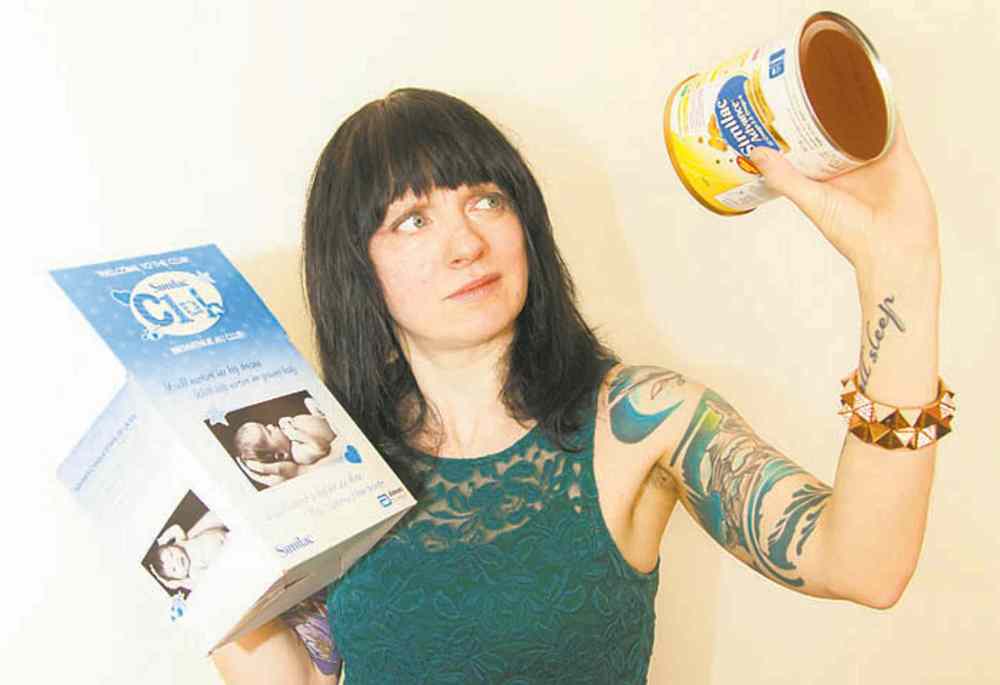
“Naturally, you’ll have a lot of questions during this journey.” Yeah, I have a few.
Truthfully, I already know the shape of the answers, because I got a similar delivery just over a year before. That time, it was a box of Enfamil formula, hand-delivered to my door. That time, I called the parent company to sort out how I ended up on a mailing list for baby formula. On the phone, the Mead Johnson Nutrition representative was helpful: They bought my name on a “new parent” list, sold by a company called West List.
While I am not a new parent, not someone who buys baby stuff at all, how I ended up on this list is revealing.
In February 2012, the New York Times reported on marketing’s “arms race” of predictive analytics, a battle to crunch data on shifting consumer habits. For brands, the prize is hooking potential new customers before the competition, and one of the demographic holy grails is newly pregnant women. “If companies can identify pregnant shoppers, they can earn millions,” Times reporter Charles Duhigg wrote. “The only problem is that identifying pregnant customers is harder than it sounds.”
The scientists found a way. The Times reported how Target started by running numbers on pregnant women on the store’s baby registry. They noticed that as those women progressed in their pregnancy, their purchasing habits shifted: more unscented lotion around their second trimester, more cotton balls, more doses of certain vitamins. From there, researchers began assigning all female shoppers a “pregnancy prediction” score, based on their purchase history in Target stores.
So when a woman of a certain age starts changing her shopping habits — no matter how innocuous — there’s a chance she could tumble onto the lists of “new parents.”
For companies, this is what profit looks like. For women, it seems like a quiet sort of invasion.
Of course, at any given time there is a chance a woman buying unscented lotion could be hoping for, preparing for or enjoying the arrival of a new baby. But there is also a meaningful chance she is struggling to conceive, or unable to become pregnant, or contemplating an abortion. There is a reasonable chance she is not interested in having children. Worse, there is a reasonable chance she is grieving the loss of a wanted pregnancy. Or a wanted infant.
And how painful would it be for them to accept a surprise delivery of baby formula and a guide to Your New Baby.
“That’s totally where I thought you were going with this,” the Canada Post clerk exclaims, relieved it wasn’t me. “I’m so on your side on this.”
The point is this: Baby formula isn’t free toothpaste. Having babies (or not, as circumstances may be) is never a neutral subject: It’s complicated, sometimes painful, sometimes political but always deeply personal. And deeply personal topics don’t make well for a mailbox surprise. But this is where we’re at now — companies do business by knowing (or guessing) everything we do with our bodies, our families and our lives. And business is booming.

While the commodification of personal information has reached a sort of fever pitch, we are never shown how many pieces of our lives companies are selling. In January, a Chicago man received a letter from OfficeMax, addressed to “Mike Seay, Daughter Killed in Car Crash.” It was less than a year since his teen daughter died after her boyfriend’s SUV veered off the road, and the letter ripped the grieving parents’ hearts apart. OfficeMax blamed a “third-party mailing-list provider.”
Whoever that was, they never answered why they would be collecting and selling such a painful piece of information.
This is a rare enough event, though it whispers a sign of things to come, as data- mining techniques catch up to the marketing pressure to know everything about everyone. To marketers, our bodies and our lives are just numbers, a prediction score of buying behaviours.
And while the rush of data itself may be too far advanced to stop, maybe it’s not yet too late for us to draw a line around the most sensitive parts of our lives, and say “enough.”
melissa.martin@freepress.mb.ca
Melissa Martin
Reporter-at-large
Melissa Martin reports and opines for the Winnipeg Free Press.
Every piece of reporting Melissa produces is reviewed by an editing team before it is posted online or published in print — part of the Free Press‘s tradition, since 1872, of producing reliable independent journalism. Read more about Free Press’s history and mandate, and learn how our newsroom operates.
Our newsroom depends on a growing audience of readers to power our journalism. If you are not a paid reader, please consider becoming a subscriber.
Our newsroom depends on its audience of readers to power our journalism. Thank you for your support.
Melissa Martin
Reporter-at-large
Melissa Martin reports and opines for the Winnipeg Free Press.
Every piece of reporting Melissa produces is reviewed by an editing team before it is posted online or published in print — part of the Free Press‘s tradition, since 1872, of producing reliable independent journalism. Read more about Free Press’s history and mandate, and learn how our newsroom operates.
Our newsroom depends on a growing audience of readers to power our journalism. If you are not a paid reader, please consider becoming a subscriber.
Our newsroom depends on its audience of readers to power our journalism. Thank you for your support.
Advertisement Advertise With Us
Advertisement Advertise With Us