

Consistency of enforcement key to curbing hockey violence

Advertisement
Read this article for free:
or
Already have an account? Log in here »
To continue reading, please subscribe:

Digital Subscription
One year of digital access for only $205*
- Enjoy unlimited reading on winnipegfreepress.com
- Read the E-Edition, our digital replica newspaper
- Access News Break, our award-winning app
- Play interactive puzzles
*First annual payment billed as $205.00 + GST for one year. This annual subscription will automatically renew at $233.00 + GST every 52 weeks (10% off the regular annual price of $259.35). Offer available to new and qualified returning subscribers only. Cancel any time.
To continue reading, please subscribe:
Add Free Press access to your Brandon Sun subscription for only an additional
$1 for the first 4 weeks*
- Enjoy unlimited reading on winnipegfreepress.com
- Read the E-Edition, our digital replica newspaper
- Access News Break, our award-winning app
- Play interactive puzzles
*Your next Brandon Sun subscription payment will increase by $1.00 and you will be charged $17.95 plus GST for four weeks. After four weeks, your payment will increase to $24.95 plus GST every four weeks.
Read unlimited articles for free today:
or
Already have an account? Log in here »
Hey there, time traveller!
This article was published 23/04/2014 (4533 days ago), so information in it may no longer be current.
Two games, two similar incidents, two very different outcomes.
In our first incident, Hockey Manitoba assessed suspensions running between 10 weeks and one full season to three players from a Lake Manitoba team involved in a March 30 melee in Stonewall in which on-ice officials were subjected to physical abuse.
In the second incident, a much different approach. The Free Press has learned a coach involved in a Feb. 17 brawl at Southdale Community Centre that also included physical abuse of a referee will be criminally charged with assault. Two 12-year-old players involved in the same incident will be charged with assault with a weapon.
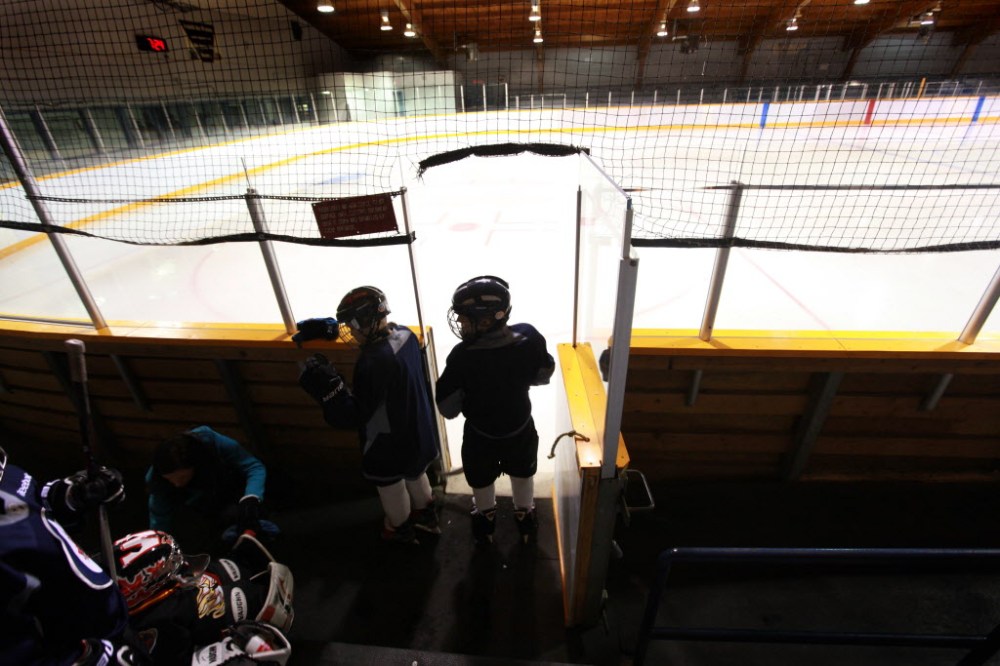
The contrast between the discipline handed down in these two incidents reveals some of the significant challenges facing organized hockey when it comes time to punish those who break the rules. Particularly those who break the rules in spectacular fashion.
The only difference between these two incidents, really, is that one (Stonewall) was a sanctioned Hockey Manitoba game and the other (Southdale) was an unsanctioned tournament. This explains, in part, why no suspensions were handed down by a hockey governing body in the Southdale incident. It does not explain why police and the Crown stepped in to lay criminal charges.
The awful reality is each hockey season, many similar incidents take place in rinks all over the province. Hockey Manitoba executive director Peter Woods said there are somewhere between 10 and 15 incidents each season involving the physical abuse of referees.
Woods said that number may seem high because even one incident of physical abuse of an official is too much. However, Woods said it is important to remember there are as many as 30,000 sanctioned hockey games played in the province each season.
Traditionally, hockey has handed down suspensions for physically abusing officials that range from part of a season, an entire season or, in some extreme cases, multiple seasons.
Hockey at all levels has, for the most part, drawn a line in the sand that dictates on-ice infractions should be penalized via the rule book and not the Criminal Code.
In minor hockey, criminal charges for players, especially minors, are very rare. A 17-year-old hockey player was charged with assault in June 2013 for his role in an on-ice brawl that severely injured another player. His trial is scheduled to go ahead in May.
Still, these isolated incidents represent only a very small fraction of the total on-ice mayhem we assume, with good cause, transpires each season. And as more of these incidents are publicized via YouTube-quality video shot by fans, there is going to be more pressure to turn more of these events over to law enforcement.
Perhaps that’s a positive development. Hockey’s traditional disciplinary protocols are uneven. Hockey has created boiler-plate punishment for certain offences, which take a lot of the mystery and guesswork out of the equation. However, there is still a great degree of discretion used in establishing the length of suspensions for other, more serious infractions.
When deliberation is necessary to determine the length of a suspension, it is done behind closed doors with no effort made to publicize the names of the people involved, the nature of the infractions or the rationale for punishment.
This is an odd approach, because publicizing the punishment for certain on-ice infractions could be a deterrent to others who find themselves tempted to commit a similar act.
But criminal charges? Hockey officialdom has to decide quickly whether certain serious on-ice infractions must be consistently assessed as potential criminal acts. That would mean turning over information and evidence related to any incident to law enforcement expeditiously. And then letting the justice system take its course.

Right now, it seems that only a handful of incidents are cherry-picked for measurement against the Criminal Code. Those incidents are typically the ones that receive the most media or Internet attention.
But that’s not real justice, and it doesn’t send a consistent message to unruly fans, immoral coaches or players with poor impulse control. It essentially says if you can convince the participants and witnesses to an incident that what happens on the ice stays on the ice, then perpetrators may escape punishment altogether.
If — and this is a very big if — we are going to call an on-ice assault a criminal assault, then we have to apply that principle to all similar incidents.
For a sport that is inherently resistant to change, that is a pretty big step to take.
dan.lett@freepress.mb.ca
Dan Lett is a columnist for the Free Press, providing opinion and commentary on politics in Winnipeg and beyond. Born and raised in Toronto, Dan joined the Free Press in 1986. Read more about Dan.
Dan’s columns are built on facts and reactions, but offer his personal views through arguments and analysis. The Free Press’ editing team reviews Dan’s columns before they are posted online or published in print — part of the our tradition, since 1872, of producing reliable independent journalism. Read more about Free Press’s history and mandate, and learn how our newsroom operates.
Our newsroom depends on a growing audience of readers to power our journalism. If you are not a paid reader, please consider becoming a subscriber.
Our newsroom depends on its audience of readers to power our journalism. Thank you for your support.
Dan Lett is a columnist for the Free Press, providing opinion and commentary on politics in Winnipeg and beyond. Born and raised in Toronto, Dan joined the Free Press in 1986. Read more about Dan.
Dan’s columns are built on facts and reactions, but offer his personal views through arguments and analysis. The Free Press’ editing team reviews Dan’s columns before they are posted online or published in print — part of the our tradition, since 1872, of producing reliable independent journalism. Read more about Free Press’s history and mandate, and learn how our newsroom operates.
Our newsroom depends on a growing audience of readers to power our journalism. If you are not a paid reader, please consider becoming a subscriber.
Our newsroom depends on its audience of readers to power our journalism. Thank you for your support.
Related Articles
Charges pending in on-ice melee
Advertisement Advertise With Us
Advertisement Advertise With Us