

Activists hope to boost voting in North End
Turnout was only 16 per cent in area's heart last time out
Advertisement
Read this article for free:
or
Already have an account? Log in here »
To continue reading, please subscribe:
Digital Subscription
One year of digital access for only $1.44 a week*
- Enjoy unlimited reading on winnipegfreepress.com
- Read the E-Edition, our digital replica newspaper
- Access News Break, our award-winning app
- Play interactive puzzles
*Billed as $5.77 plus GST every four weeks. After 52 weeks, price increases to the regular rate of $19.95 plus GST every four weeks. Offer available to new and qualified returning subscribers only. Cancel any time.
To continue reading, please subscribe:
Add Free Press access to your Brandon Sun subscription for only an additional
$1 for the first 4 weeks*
- Enjoy unlimited reading on winnipegfreepress.com
- Read the E-Edition, our digital replica newspaper
- Access News Break, our award-winning app
- Play interactive puzzles
*Your next Brandon Sun subscription payment will increase by $1.00 and you will be charged $17.95 plus GST for four weeks. After four weeks, your payment will increase to $24.95 plus GST every four weeks.
Read unlimited articles for free today:
or
Already have an account? Log in here »
Hey there, time traveller!
This article was published 22/10/2014 (4260 days ago), so information in it may no longer be current.
Voter turnout in the heart of the North End is abysmal — 16 per cent in the last election. But activists hope a neighbourhood renaissance and a get-out-the-vote campaign will boost that figure today.
“Of course, I’d love to see it at 80,” said Jasmine Tara, spokeswoman for North End Votes. “But if we’re being realistic, doubling (16 per cent) would be great.”
After a long campaign, it’s election day in Winnipeg, but only about half of all eligible voters usually mark a ballot. Last election, turnout stood at 47 per cent. Poll-by-poll data provided by the city’s election office shows even starker turnout figures. In some polling subdivisions, just 15 per cent of eligible voters cast a ballot. In others, it was close to 70 per cent.
As expected, older, wealthier neighbourhoods such as Riverview, River Heights, Tuxedo and Wildwood had the highest turnout, with rates well about 50 per cent. New suburbs such as River Park South, Whyte Ridge and River Grove came in at roughly the city-wide average of 47 per cent.
Sage Creek was the outlier, recording the highest turnout anywhere in the city in 2010. There, even though the suburb was new, nearly 69 per cent of voters hit the polls.
“While I was not aware of that statistic, it is not entirely surprising, given how engaged the community is in local events,” said Chris Bohemier, spokesman for the Sage Creek Residents Association.
Bohemier said key civic issues this election for the neighbourhood are snow removal and connecting Warde Avenue with Lagimodiere Boulevard as a second way in and out of the subdivision. But, the area, in the St. Boniface ward, doesn’t have one of the city’s hot council races. A really competitive ward election can often drive people to the polls, notes Marc Lemoine, the city’s senior election official.
In poor neighbourhoods, such as Spence and Centennial, only one in five people made it to the polls in 2010.
Turnout that year was average, but still abysmal compared to federal and provincial elections, made worse by a day-long rain storm.
Lemoine said he’s hopeful turnout will improve this year thanks to a competitive mayoral race and hot campaigns in key wards. Higher rates of advance voting and the city’s batch of television, radio and print ads have also given him reason to hope.
The highest city-wide turnout was 60.7 per cent in 1971, the first Unicity vote following the merger of 13 municipalities into one.

In the North End, community groups are hoping a neighbourhood revival, sparked in part by several newly active residents’ organisations in William Whyte and Dufferin, will spur voters to polling stations. And, issues key to the North End, such as racism and missing and murdered indigenous women, have dominated the campaign like they never have before.
There have been at least three mayoral forums in the North End, including one this month organized by North End Votes.
Today, the group will help residents get to the polls by ensuring they have the right identification, using a new city-made app to check for the correct voting location and offering voters rides and vouching for them at the polling station.
Voting, especially for first-timers, can be daunting, said Tara. “I think people think it’s too much hassle,” she said. “If they don’t have the proper ID they think ‘Oh, I’m not going to be able to vote so it’s not worth the trouble.’ââ”
maryagnes.welch@freepress.mb.ca
Turnout by neighbourhood
City of Winnipeg data shows huge discrepancies when it comes to turnout. In the last election, when overall turnout was decent, those in wealthier neighbourhoods hit the polls in droves. Poorer areas, such as Spence, William Whyte and parts of Elmwood had low voter numbers, making it easier for politicians to ignore their issues. Here are the hot and cold spots:
Where we voted
Sage Creek (subdivision SB48) - 68.6%
Appleton Estates, two large 55-plus apartment buildings on Niakwa Road (subdivisions SV13 and SV50) - 63.6%
Tuxedo (subdivision CT03 and CT04) -- 58.5 %
Where we didn't
The downtown business district, between Portage and Qu'Appelle avenues (subdivisions DM01 and DM02) - 15%
William Whyte (subdivisions MY04-06 and MY08) - 16.4%
Centennial and parts of West Alexander (Subdivisions PD02 and PD04-05) - 17.1%
-- source: City of Winnipeg data
Voter turnout
2010 election – 47.1%
2006 election – 38.2%
2002 election – 48.7%
1998 election – 53.6%
1995 election – 53.5%
Related Articles
Voter turnout highest in a decade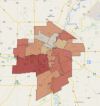
Advertisement Advertise With Us
Advertisement Advertise With Us