

Super-quick snow planes sign of a bygone era
Advertisement
Read this article for free:
or
Already have an account? Log in here »
To continue reading, please subscribe:
Monthly Digital Subscription
$1 per week for 24 weeks*
- Enjoy unlimited reading on winnipegfreepress.com
- Read the E-Edition, our digital replica newspaper
- Access News Break, our award-winning app
- Play interactive puzzles
*Billed as $4.00 plus GST every four weeks. After 24 weeks, price increases to the regular rate of $19.95 plus GST every four weeks. Offer available to new and qualified returning subscribers only. Cancel any time.
Monthly Digital Subscription
$4.99/week*
- Enjoy unlimited reading on winnipegfreepress.com
- Read the E-Edition, our digital replica newspaper
- Access News Break, our award-winning app
- Play interactive puzzles
*Billed as $19.95 plus GST every four weeks. Cancel any time.
To continue reading, please subscribe:
Add Free Press access to your Brandon Sun subscription for only an additional
$1 for the first 4 weeks*
*Your next subscription payment will increase by $1.00 and you will be charged $16.99 plus GST for four weeks. After four weeks, your payment will increase to $23.99 plus GST every four weeks.
Read unlimited articles for free today:
or
Already have an account? Log in here »
Hey there, time traveller!
This article was published 14/03/2015 (4041 days ago), so information in it may no longer be current.
NEAR BRANDON — Stand behind a snow plane, which has a rear propeller, and it can blow your hat off for 30 metres.
But once inside the cockpit, with the engine and propeller roaring behind you, it’s one wild ride.
A snow plane travels low to the ground, like a sports car, skimming across a snow-covered farm field as if over a choppy lake. You almost think it will lift off.
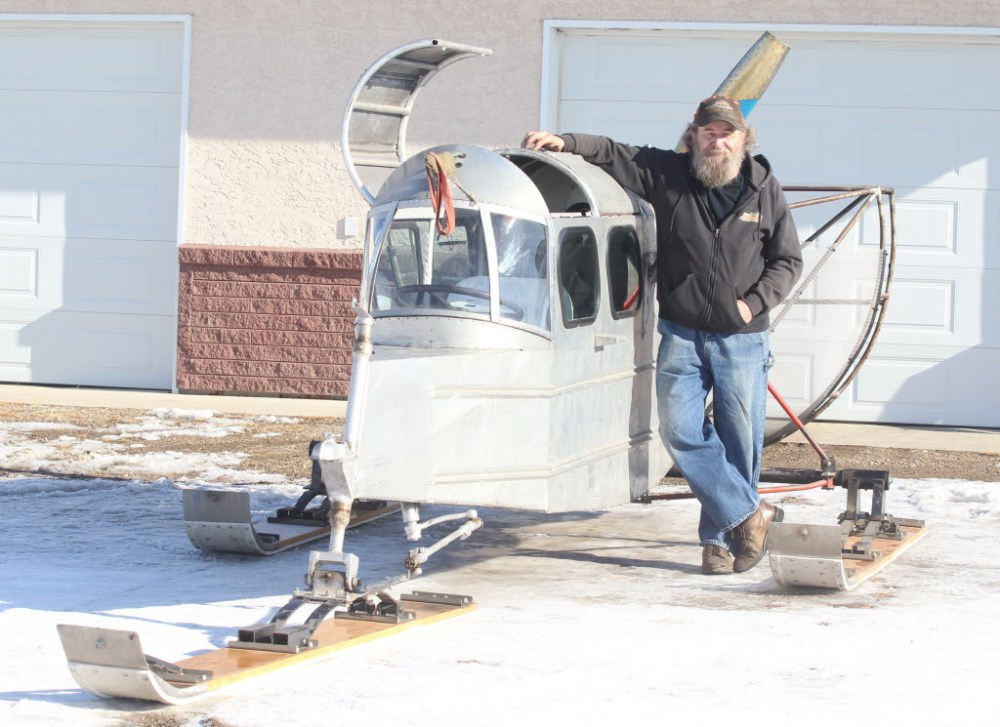
Piloting one, said Paul Dillon, the owner of a snow plane, if piloting is the right word, is “insane.” He’s got his snow plane up to about 150 kilometres per hour. It’s got no brakes, so you need half a football field to stop.
That’s one downside to this vanished technology. “You have to plan your stops well in advance,” said Clarence Davis, Dillon’s neighbour, who got Dillon started.
Snow planes replaced the cutter sleigh on the Prairies in the 1930s and 40s. The plane’s skis were measured to match the track of horse-drawn sleighs, so the two could share the same trails.
What a leap that must have been, going from an open, horse-drawn sleigh, to an enclosed cockpit with a giant propeller on the rear end.
Snow planes weren’t widespread, however. The Great Depression was on. Doctors had them for making cross-country house calls, including baby deliveries. RCMP and utility companies had them, as there weren’t many cars or trucks in those days, fewer roads, and even fewer snow-plowed roads. Farmers who could afford it had snow planes or they built their own.
“There were probably as many or more snow planes built on farms and backyard shops,” said Davis, 75, who runs a grain farm east of Brandon. Davis owns two snow planes, including one he built himself.
Two of the major snow plane manufacturers in North America were in Saskatchewan, at Moosomin, situated along the Trans-Canada Highway; and Spy Hill, on a straight line west of Binscarth. The Fudge snow plane, started by Robert Fudge, was made in Moosomin; Lorch snow planes, named after Karl Lorch, were made in Spy Hill, employing 40 people.
The first snow planes had just two rows of skis, and were tippy, especially with the engine situated high in the back, Davis said. A third ski in front, such as on a snowmobile, later made them more stable.
Davis owns a Trail-A-Sled, made in Crosby, Minn., one of the last snow planes built. It’s a little fancier than most, with the propeller guard ventilated with slits like a shark’s gill, the equivalent of pasting flame decals on the sides of a muscle car. The Trail-A-Sled, with an 85-horsepower engine, is also made from fibreglass, instead of wood, canvas and airplane tubing used in earlier models.

Another unique feature of his Trail-A-Sled is the trailer hitch in front. Davis can easily switch the skis with wheels, and tow it behind his truck.
Dillon’s snow plane is a homemade job he bought several years ago near Langruth. Its sides are made of tin sheeting that look like it was torn off a shed.
It has no doors, just a top hatch for getting in and out. It’s a narrow two-seater: one seat in front, and one in back. The hatch comes off the back where the gunner would sit and pick off coyotes and foxes, Dillon said. The back had brass shell casings when he bought it. “It was the prairie version of an assault vehicle,” he said.
What happened to snow planes? Bombardiers, with their rubberized tracks, came out in the early 1950s, and were superior in many ways. They were more comfortable, could hold more people, weren’t as noisy, and could stop. The snowmobile came along around 1961. By then, roads were cleared in winter, so the primary function of snow planes, to fetch supplies and for use in emergencies, had disappeared. Snowmobiles were more for the recreation market, Davis said.
bill.redekop@freepress.mb.ca